Sending e-mail spam to consumers has been illegal in the Netherlands since 2004. Back then I wrote elsewhere that this would be enough to deter Dutch spammers because separating out business addresses from home addresses would be too costly. It seems I was wrong though. Since the general spam prohibition was passed into law, I have been deluged with the stuff on my business account. (It takes half a year for a law to come into effect after it has passed both houses of parliament, in case you were wondering.)
The maximum fine for sending spam in the Netherlands is 450,000 euro.
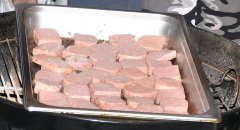
(Photo of spam on a barbecue by Kyle Nishioka, some rights reserved. Cropped by me. Link tip: every retard who has been sending me a reminder the past week that I need to explicitly sign up for their trash if I were to go batshit insane and suddenly decide to want to keep receiving their mails after October 1.)
Rotterdam artist Florentijn Hofman basically explains that the rubber duck is friendly and makes people happy. We spotted his work in Amsterdam once back in January 2008 and this video shows us what the port of Osaka looks like with a whole bunch of rubber ducks.
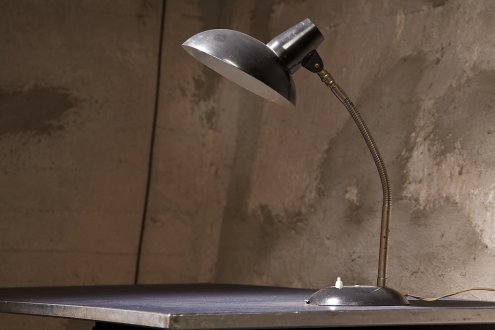
This photo of a Gispen lamp, taken in the cellar of the Hilversum city hall, won the Wiki Loves Art contest in which museums opened their doors to amateur photographers
The jury wrote: “A photo with a great atmosphere, and also a photo that piques one’s curiosity, and furthermore a photo that is very useful for illustrating Wikipedia articles. The perfect match of a good depiction of the object and atmosphere.”
Consumentenbond compared the prices of making a single cup of coffee in regular households and came up with the following figures, according to Z24 (Dutch):
Instant: 3 euro cent.
Regular (using a coffee filter): 4 euro cent.
Aldi pods for Senseo: 5 euro cent.
Albert Heijn pods for Senseo: 7 euro cent.
Official Douwe Egberts pods for Senseo: 9 euro cent.
Nespresso: 33 euro cent.
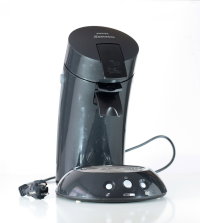
Of course, the real coffee snobs own (or want to own) their personal espresso machine. Senseo pods are called pads in the Netherlands, but when Philips and Douwe Egberts decided to export their product they wisely chose to avoid any associations with women’s hygienic products. The Albert Heijn figure was added by me.
I switched to Senseo myself, because using the regular method you never end up with just a single cup, and instant coffee is just vile.
BONJO, a Dutch partnership organisation that defends prisoners’ rights runs a dating site for male and female prisoners. They started about half a year ago with the women by placing contact adverts and apparently it’s a hit: 1,300 adverts for just 450 female prisoners. They say the foreign female inmates are popular with Dutch men, which seems to paint quite a different picture that on the outside.
A dating service for prisoners is not odd, but then there’s a Dutch-language one for vegetarians.
Rotterdam based company Metrological hopes to introduce a set-top box in November which will enable users to browse the Internet on their television sets.
Yes, that sounds very 1980s, but apparently the device also works as a regular TV tuner. At a price of around 400 euro, the Mediaconnect TV is somewhat expensive for a peppy tuner, the inventors admit, but they hope to sell the device to cable companies who can package it with subscriptions.
Inventors Jeroen Ghijsen and Albert Dahan have a background in designing telemetry systems for airports, and their new device is indeed based on software they wrote for controlling video cameras and lights on landing strips.
To protect the privacy of stewardesses (and stewards, I imagine), pilots and ground personnel, KLM has decided that they won’t be wearing any nametags anymore as of April 2010. Apparently, there’s no rush to protect them — odd. Their ‘title’ will still be displayed on a pin they’ll have to wear.
KLM personnel will also be getting new uniforms, as the ones stewardesses (and again stewards, I imagine) now wear date from 1990.
Yes, this is a silly picture of two co-pilots in an old DC-9 cockpit.
The Key Card Hotel (tons of pics here) was recently opened in New York City, a hotel entirely made of key cards, designed and built by world record holder of card house building, Bryan Berg, aka The Cardstacker.
The hotel is 37 m2 in size and has a bedroom, bathroom and lobby, entirely made of Holiday Inn key cards. Berg says that it is his biggest challenge ever on a human scale.
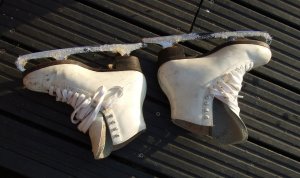
Speed skaters have suffered no ill effects from the economic crisis, reports Z24 (Dutch).
The on-line financial magazine points out that sponsor contracts for long track speed skating teams tend to be long term. Insurers TVM and DSB for instance have sponsorship contracts in place until 2014. “Skating has loyal partners,” Barbara Peeters of Referee Sportsmarketing is quoted as saying.
But the main reason appears to be the loyalty of the fans. “Skating is not a sport, but a madness,” the TVM team’s manager Patrick Wouters said.
And what may also help is that skating matches generate an enormous amount of exposure. Whereas the most popular sport, football, is behind a pay wall with only an hour of summaries shown on public television, long track speed skating is shown 120+ hours a year. With only a few companies sponsoring the sport, logos tend to be on screen for a long time.