

 The Dutch branch of the Church of the Flying Spaghetti Monster has scored a small victory. On Tuesday the Utrecht Chamber of Commerce has allowed the church to be entered in the company register, NOS op 3 writes.
The Chamber of Commerce had initially refused to register the church, but replied after an appeal that “there is not a sufficiently solid (legal) basis for a continuation of [our] refusal.”
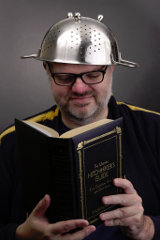
Legal recognition of a church can lead to many tax breaks, according to an article in Trouw in 2004. Another battle, the right for pastafarians to wear their religious hat (a colander) in passport photos, has yet to be won.
The Church of the Flying Spaghetti Monster was founded in 2005 by American Bobby Henderson after the state of Kansas had decided that the Christian dogma of creationism should be given equal weight in the classroom to the scientific theory of evolution. Henderson felt it was important that the children of Kansas should be taught the real origins of life: “I and many others around the world are of the strong belief that the universe was created by a Flying Spaghetti Monster. It was He who created all that we see and all that we feel.”
In 1998 about 32% of the Dutch identified as Catholic, with Ietsism coming in as the second biggest religion at 18%. I estimate the percentage of self-identified Pastafarians to be less than a tenth of a percent.
(Photo of a Pastafarian worshipper in full regalia by Dennis van Zuijlekom, some rights reserved)
 NRC reports that the
  In the past ten years the percentage of Dutch Christians who shop on their prescribed day of rest has risen,
 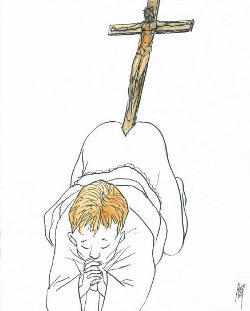 Last Thursday a cartoon depicting an altar boy raped with a crucifix was stolen from the Limburgs Museum in Venlo, Limburg.
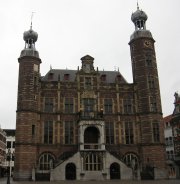 In elementary school I was taught about the founding legend of my city of birth, Venlo. The story went that the leader of a local tribe, the Bructeri, fled a lost battle with the rival Chamavi tribe towards the fertile ground on the Meuse river in 96 AD.
  There are only a few steps to holiness according to Roman Catholic creed, and beatification is the penultimate one. On June 29, Sister Hendrina Stenmanns of the Servants of the Holy Spirit mission congregation in Steyl will be the second person to be beatified on Dutch soil (though not the second Dutch person to befall that honour). The Pope will be represented during the ceremony at the open air theatre of Tegelen, Limburg by Cardinal José Saraiva Martins.