
Embedding is a form of publication, and therefore infringement if it happens without permission, Dutch judges Brandenburg, Huijbers-Koopman and Struik concluded two weeks ago in an infringement case. Oddly enough, their judgement seems to hinge on the court’s conclusion (Paragraph 4.99, PDF) that “in case law and legal literature it is generally held that an embedded link constitutes a publication. After all, the material can be viewed or heard within the context of the website of those who placed the link, and placement causes the material to reach a new audience.”
The court seems to have borrowed this quote literally and without attribution from a blog posting by SOLV lawyer Douwe Linders who, according to Webwereld, said that “it looks a lot like copy and paste.” Since it is literally copy and paste, not just a lot like it, it sounds like Linders was unaware that the court had copied him, and that he had not given the court any permission to do so.
Although Dutch copyright law does allow you to quote bits of a work for a number of reasons, it does not allow you to do so without attribution. Further, by pretending the court had written this bit itself, the judges also plagiarized Linders’ words, which is a much more serious offence in my opinion (although, unlike copyright infringement, not actually illegal).
I have never heard before of a copyright infringement case in which judges infringe copyrighted myths and present them as fact in order to bury alleged infringers. This stinks in my opinion, but then I am not a lawyer. Perhaps in their world this is how roses smell.
According to Webwereld, the court’s argument “has caused consternation in copyright land.” Although I agree with Linders’ opinion that embedding generally constitutes a form of publication, the debate about this is far from over, as the comments collected by Webwereld attest.
(The literal Dutch text by Douwe Linders: “In de rechtspraak en juridische literatuur wordt betrekkelijk eensgezind aangenomen dat een embedded link wel een openbaarmaking inhoudt. Immers, het materiaal is dan te bekijken of beluisteren binnen de context van de website van degene die de link heeft geplaatst en door de plaatsing wordt over het algemeen een nieuw publiek bereikt.”)
Tags: copyright, courts, judges, plagiarism
From the Strategic Plan 2010-2013 of the Dutch national library:
Strategic priority 1: As a national library, the KB wishes to offer everyone everywhere digital access to everything published in and about the Netherlands. …
Main aims …
* We digitize all Dutch books, newspapers and periodicals from 1470. …
* We make agreements about copyright in order to guarantee free access to our collections. …
The KB in 2013: …
* We offer a service for digitization on demand (digitisation of texts from the paper collection on request) in order to meet the wishes of individual clients. …
* We keep a digitisation register that prevents possible overlap of digitization activities by other institutions. …
The Koninklijke Bibliotheek (Royal Library) will not only digitize printed works, but will also archive digital works such as web pages. According to Trouw, the first 10% of 600 million books pages to be digitized should be available in 2013.
Via Open Access News.
Tags: books, copyright, libraries, public domain
Miffy representative Mercis lost an old-fashioned game of bully-the-penniless-blogger yesterday when a web hosting provider who refused to lie down won most points of a copyright infringement lawsuit.
The hoster, Punt.nl of Gouda, argued that cartoons some of its users hosted in which Miffy is depicted doing cocaine or DJing at a party are parodies, and therefore protected by an exemption to copyright law. The court went along with that argument, and felt that since Miffy was depicted in the cartoons as engaging in activities Dick Bruna would never put her through, it should be abundantly clear to the reader that these are parodies. Using the same shaky logic, the court banned two cartoons that were too close to the original.
As Punt.nl’s Henri de Jong pointed out to De Volkskrant, “What the judge is really saying is the harder the better, because that way you put distance between the parody and the original.” Cory Doctorow argued something similar in his column for the Guardian earlier this year.
The text of the illustration goes:
The Party
Matt is at the party.
Dan is there too.
Matt is playing trance.
“What noise,” Dan yells,
And pushes Matt.
Dan throws a fat hardcore
Tune on the SL-1200.
Everybody is happy.
Matt is a dirty trance fag.
Several more Miffy parodies can be found in the verdict. According to De Volkskrant, Marja Kerkhof of Mercis denies the company is bullying bloggers.
(Source illustration: Iusmentis.com, artist unknown)
Tags: copyright, Miffy, Nijntje, parody, web hosting
BUMA/Stemra has decided not to pursue its blogger’s tax of 160 euro per 6 embedded songs for 2010. At the same time, the collecting society for composers and performing artists has closed a deal with Youtube, allowing the Google daughter to serve videos containing music to a Dutch audience.
After a storm of protest, BUMA/Stemra cancelled its tariffs for non-commercial users earlier, leaving blogs like 24 Oranges in the cold, because we run Google ads. Now Webwereld reports that commercial users will also be exempt for one year, while BUMA/Stemra tries to iron out any legal glitches. I guess that is a step forward from past practices, where the society would start lawsuits against pretty much anyone and use the resulting jurisprudence as either law, or as a springboard for further lawsuits.
Music Week reports that the new licensing agreement covers “professional or user-generated video hosted on and streamed via YouTube in the Netherlands.”
Odd, then, that I still come across notices now and again that music has been removed from a clip after complaints by somebody pretending to be a rights holder (typically one of the Big Four). Let’s see how this will pan out in 2010. My guess though: Google will be paying lots of money for nothing in return.
Meanwhile the union for musicians, Nederlandse Toonkunstenaarsbond, has urgently requested that BUMA/Stemra apologize over the heavy-handed manner in which it introduced its tax for embedded videos. Chairman Erwin Angad-Gaur fears the society’s tactics have damaged the reputations of musicians. He told VPRO’s 3 Voor 12: “Musicians are not against copyright fees, to the contrary. But we do want more flexibility.” For instance the flexibility to decide they want money for certain songs only.
(Still of a video by Orangemaster.)
Tags: BUMA, copyright, Stemra, videos, YouTube
NVPI, an organisation representing the ‘Dutch’ entertainment industry*, recently called for harsher measures against legal copying in the Netherlands, pointing out that there is a ’sufficient’ supply of stores offering really legal downloads**. However, as Internet lawyer Arnoud Engelfriet points out, they are stretching the truth a bit.
There are indeed 19 online stores selling legal video downloads to the Dutch, but as Engelfriet’s research shows, hardly any of them sell the movies people want to buy. The article is in Dutch, but the accompanying table speaks volumes. Engelfriet compared the 100 videos currently most popular at Bol.com to what NVPI’s champions were offering.
*) Amongst which such familiar ‘Dutch’ giants as Disney, EMI, and Nintendo.
**) I realize this must be confusing. Basically, NVPI wants to outlaw what is known as file sharing, which is currently legal in the Netherlands for some types of creative works.
(Illustration: Arnoud Engelfriet.)
Tags: copyright, file sharing
English translations of Vincent van Gogh’s letters to his brother Theo have been released in a 6 volume boxed set by the Van Gogh Museum in a 15-year-long cooperation with the Huygens Instituut. The original letters in French and Dutch have also been reproduced.
The entire set contains all the pictures referenced in the letters, that is, all 4,300 of them, The Guardian reports.
If you don’t feel like shelling out the 325 UKP that the set is undoubtedly worth, you can also read the letters and their translations at vangoghletters.org. The Huygens Instituut is part of the Dutch academy for sciences.
Story via Eamelje.net (Dutch), who in a totally unrelated story also points out that another Dutch giant of the 19th century, writer Multatuli, published his masterpiece Max Havelaar 150 years ago last Tuesday. The Havelaar has been in translation for a long time, and a public domain English version can be found at Google Books.
If you do not like PDF or EPUB, you might be able to extract the HTML version from the EPUB file (which is just a ZIP archive under a different name).
(more…)
Tags: copyright, Eduard Douwes Dekker, Max Havelaar, Multatuli, public domain, Vincent van Gogh
Collecting society Buma/Stemra is after Dutch bloggers now. Starting in 2010 you must cough up 130 euro for every six music videos you embed in your web page, according to Madbello (Dutch).
Buma/Stemra is a copyright collecting society for composers. It makes use of a feature of Dutch copyright law that says that negotiating licenses and royalties is too cumbersome for some forms of creative works, and that therefore collecting societies can be set up that charge bulk rates and pass on the money to the creators.
IT law specialists Arnoud Engelfriet and Kamiel Koelman are quick to dismiss B/S’ claims at Tweakers.net (Dutch). Both point out that embedding content on your web page is not necessarily a new publication of that content, and therefore B/S cannot charge money for it.
Dutch copyright law makes a distinction between the act of copying and the act of publishing. A famous lawsuit that highlights the difference between the two, and that went all the way to the Dutch High Council is Poortvliet vs. Hovener (Dutch, PDF). Hovener was a publisher who had an agreement to sell 13 reproductions of Poortvliet’s paintings as part of a calendar. Although Hovener did print the calendar, they then cut out the reproductions and sold them separately, pasted on cardboard and presumably at a much higher price. No copying took place, yet it was considered a new form of publication, and therefore infringement.
Engelfriet’s and Koelman’s reasoning are in my opinion unconvincing, but even more so I think B/S rates are through the roof. A rate of 13 cents per embedded video seems much more reasonable considering that videos embedded in blogs (with the rare exception perhaps for blogs where people come to listen to the music) only work to expose an audience to the embedded works.
UPDATE: Sign the petition: bumablog
Tags: blogging, BUMA, copyright, Internet, law, Stemra
Yesterday was the start of the official, lecture-filled part of Hacking at Random, an episode of a Dutch hackers convention that takes place every four years under a different name and at a different location. This year’s HAR is situated at Nunspeet, in the Dutch bible belt, and as always has a strong emphasis on debating the confluence of politics and technology.
Speakers this year include the guy who’s getting a camera planted in an empty eye socket, the people who make prostheses for 50 bucks instead of 250,000 (presumably we’re not talking about eyes anymore), IP/IT lawyer Arnout Engelfriet, and the infamous BREIN organisation, the Dutch ‘RIAA’.
If I have the time, I will report on the activities from the scene of the action in future postings.
Tags: copyright, hacking, HAR 2009, medicine, prostheses
We recently wrote about Dutch copyright collection agency Buma/Stemra, (pet name: B/S) charging big bucks for using embedded radio players. Since bad news often travels in packs, people who embed stations and streams on their sites will have to pay 312 euro a year to do so. Oh, and payment is retroactive to January 2009.
Since I own a webradio, I am now considered a ’source site’ by B/S, while anyone restreaming me in the Netherlands is a ‘target site’. I don’t know anyone who restreams me and if they do, they probably don’t live in the Netherlands. As usual with new rules and rates from B/S, the Dutch ‘twittosphere’ is buzzing with more questions than answers, while the Managing Director of B/S twitters about his new office furniture (well, pretty much) and answers no tweets. Grow a pair and defend your policies already.
Imagine having to pay to embed YouTube on a blog! Imagine paying for anything embedded like conferences or a film of your dog doing tricks because you posted it on Facebook first or something. And why do people have to pay almost as much as I do for just adding a link?
And I will quote myself: “The Dutch are used to paying for everything and even want to do so like I do, but not when they have no idea who or what they are paying for. It remains vague, incomprehensible and frustrating.”
Sigh.
(Link: marketingfacts.nl, image: Oh La La)
Tags: BUMA, copyright, embedded, webradio
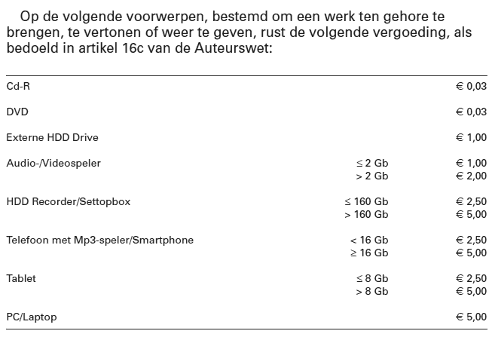
Anti-’piracy’ bureau BREIN, the Dutch equivalent of the infamous RIAA, scored its first kill last Saturday. Literally, I am afraid. During a raid on a market in Beverwijk, a 47-year-old man from Waalwijk accosted by the raiders died of a heart attack, reports Blik op Nieuws (Dutch). The police were presumably testing that the requisite taxes on empty CDs and DVDs had been paid, and were accompanied by a posse consisting of people from the FIOD (tax police) and the Thuiskopie and BREIN foundations.
Interestingly, the story of the police and of witnesses differ substantially, writes Noordhollands Dagblad (Dutch). According to the former, the man had a heart attack after running away from the merry band of official and self-appointed copyright hunters, after which the police tried to administer first aid. Witnesses however claim that the man did not run away, and that everybody just stood there, without helping the victim.
You have to wonder why private organizations like BREIN are even allowed to accompany the police on raids like this.
(Photo by Flickr user Sheep Purple, some rights reserved.)
Tags: Beverwijk, CDs, copyright, DVDs, justice, law, markets, militias, piracy, vigilante, Waalwijk