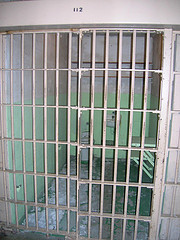
Law professor Yvo Buruma has sounded the alarm about the number of innocent people being detained pre-trial in the Netherlands.
According to Buruma the numbers of acquittals in the country has risen from 4.5% to 7% in the past five years. More people are currently awaiting trial than people who have already been convicted.
In a blog entry last week Buruma claims this is a worrisome development because robbing somebody of their freedom is an exceptional power that the state should only exercise under exceptional circumstances, and because a person should be considered innocent until proven otherwise. Although he does not outright say it, it would almost seem that the justice department is keeping people imprisoned for the wrong reasons.
The criminal law professor at the Radboud University Nijmegen determines four categories of aquittal:
- It is unclear what happened,
- It is unclear what part the suspect played,
- There was no intent, and
- The judge fails to see the crime in the accused’s actions.
An example of the latter is the 14-year-old who jokingly told Prime Minister Balkenende on the social networking site Hyves that he was going to die and was acquitted earlier this month.
It is nteresting to note that the falsely imprisoned typically only receive 80 euro a day in damages, regardless of actual income lost.
Link: Sargasso.
Tags: crime, damages, imprisonment, law
A 18-year-old man from The Hague staged a robbery two weeks ago in order to impress his ex-girlfriend with his heroic intervention and win her back that way.
A friend in a white ski mask pulled a knife on the 17-year-old girl on the Grote Markt and demanded her purse, only to see his ‘robbery’ thwarted by the ex-boyfriend who ‘happened’ to be on the scene. After studying security camera footage (the girl reported the attempted robbery to the police), the police concluded the ‘robber’ and the ex-boyfriend were in cahoots.
Both conspirators were arrested.
According to De Volkskrant, the ploy did not have the desired effect.
Tags: balaclavas, crime, criminals, Den Haag
A particular dumb thief from The Hague was caught twice on the same day last Tuesday for stealing police bait bikes.
When the 35-year-old was released after the first arrest, he walked along the spot in the Wagenaarstraat in The Hague where his first crime had taken place, and, presumably to his great joy, discovered another bicycle just ready for the taking. This bike again turned out to be a bait bicycle.
Telegraaf doesn’t say if they also released the man after his second arrest.
Tags: bait, crime, criminals, police, The Hague
A man from Nieuwegein near Utrecht had to be taken to the hospital last Monday after being hit in the head by a bicycle thrown from an apartment building, Telegraaf reports.
A fight on the seventh floor which the 18-year-old victim had nothing to do with resulted in a bicycle being thrown off the balcony. The victim was about to enter a car for a driving lesson when the bike partially hit him and the car.
The victim has filed charges for attempted manslaughter. The suspect turned himself in on Wednesday and was arrested, according to the Utrecht police.
(Photo by Mike Porcenaluk, some rights reserved)
Tags: crime, Nieuwegein
Tomorrow the prohibition on business spam mails (Dutch) will come into effect.
Sending e-mail spam to consumers has been illegal in the Netherlands since 2004. Back then I wrote elsewhere that this would be enough to deter Dutch spammers because separating out business addresses from home addresses would be too costly. It seems I was wrong though. Since the general spam prohibition was passed into law, I have been deluged with the stuff on my business account. (It takes half a year for a law to come into effect after it has passed both houses of parliament, in case you were wondering.)
The maximum fine for sending spam in the Netherlands is 450,000 euro.
(Photo of spam on a barbecue by Kyle Nishioka, some rights reserved. Cropped by me. Link tip: every retard who has been sending me a reminder the past week that I need to explicitly sign up for their trash if I were to go batshit insane and suddenly decide to want to keep receiving their mails after October 1.)
Tags: crime, e-mail, spam
Last Wednesday a car thief in The Hague was in the possession of 10,000 euro without even knowing it, reports Algemeen Dagblad (Dutch). The man, a known offender, was addressed on the Broekslootkade by two passing cops who just wanted to have a chat. In response he bolted, leaving behind a purse which he had, as it later turned out, stolen from a car a day earlier together with a navigation system. The purse contained 10,000 euro in cash, unknown to the 36-year old thief.
(Photo of the arrest of a Rotterdam bicycle thief by Flickr user Hellobo, some rights reserved. The police officers are the ones wearing dark trousers.)
Tags: car navigation systems, crime, money, police, The Hague, theft
Last December, Paul Wiegmans from Alkmaar discovered an ATM skimming device (Dutch) attached to an NS ticket vending machine (Nederlandse Spoorwegen, i.e. Dutch railways). Being a hacker, he pulled the device loose and photographed it extensively before turning it in to the police. Marvel at the diminutive size of these things!
The Nederlandse Bank estimates that skimming at train stations and banks results in ten million euro in damages per year, reports Algemeen Dagblad (Dutch). The NS told the same daily that approximately two skimming accidents occur per day at its train stations. That’s a rather small amount compared to the number of ATM transactions taking place per day there—200,000.
Update: Meanwhile, Salima Douhou and Jan Magnus of the University of Tilburg claim that skimming would become almost impossible if banks incorporated code that would verify the way people type their PIN codes, reports De Telegraaf (Dutch). Apparently, nobody does that quite the same way, making your punch as distinct as your signature. The article unfortunately doesn’t mention what the percentage of false positives is with this method, and calls the method “almost unhackable”, which in this reality means the same as positively hackable.
(Photo: Paul Wiegmans.)
Tags: banking, crime, Dutch railways, hackers, hacking, money, skimming
Last Sunday a group of thugs who were sharing a building complex in the Kinkerstraat in Amsterdam with a group of squatters drove out the latter with the use of force, wounding three of the squatters. At the end of the fight, the police installed the squatters back in the building, and arrested 14 members of both groups. One of the squatters was taken to a hospital with a double fractured jaw.
The squatters told Parool (Dutch) that the thugs spoke Russian with each other and partly consisted of builders that were staying nearby. Quote thinks (Dutch) that the owner of the Vinkzicht buildings, Cornelis Komen, may have paid the thugs to drive off the squatters. Komen denies the allegations.
The buildings have had no designated use since 1972 until Komen bought the six buildings in 1999 for 1.6 million euro each, with the plan to wreck them and build a hotel in their stead. That plan came under heavy fire from the neighbourhood, which managed to convince city hall to declare the gables monuments.
The top floors of the buildings are rented out in so-called anti-squat constructions where a tenant gets a short-term lease typically at a low price. Sometimes, you can score magnificently large housing this way for a price way below the going rate of the average shoebox an Amsterdam resident calls their castle, though I hear that with the housing shortage in the city even the anti-squat rates have gone up.
Squatting is mainly legal in the Netherlands (albeit often frowned upon) because of a constitutional right to domestic peace. The police may not invade your home, even if your means to acquire the home may have been less than legal. The house owner must then go to court and prove they have a pressing need with their property to get the squatters evicted. Neighbours tend to prefer squatters over slowly decaying houses.
It’s been a while since I’ve heard of thugs being used to evict people. The university grapevine in Nijmegen had stories of students being evicted this way, but I cannot remember a single proven one.
This is one of those stories that spawns two new questions for every answer you find, so I’d rather field any actual questions our readers have.
Totally off-topic: many congratulations to Orangemaster for getting her Dutch driver’s license! Wootalicious!
Link: Radio Netherlands, the only medium I could find so far that thinks the fight was between two groups of squatters.
Photo of the Kinkerstraat by Wikimedia user Ilonamay, some rights reserved.
Tags: crime, housing, journalism, landlords, squatting, thugs
“You stupid woman, digital signatures don’t count,” we said less than a year ago, but a new law has changed that rule. If you want to tell parliament to put certain topics on the agenda, digital signatures are good enough to support your Citizen’s Initiative. Last year for instance, a group of women wanted parliament to debate on binge drinking youth. That bid failed, because the autographs had been digitally collected. The law has now been changed, and as of 1 January 2009 digital signatures do count.
So, with this great democratic leap forward, what do citizens elect to do with their new found power and responsibility? Why, declare their support for the War on Fun of course! The first digital Citizen’s Initiative is here, and it’s about fireworks. The citizens, led by Green Party city council member and sour puss David Rietveld, want it outlawed. To be precise, they demand that only professionals are allowed to light fireworks on New Year’s Eve, an activity often shared between dads and their sons.
As is typical for this time, something that is clearly wrong and illegal is taken and glued to something that is fun, yet irritating to some. In this case, the New Year’s celebrations are a signal to a very few troublemakers to start burning cars and houses. And so the David Rietvelds of this world figure that it is clearly the fireworks that are at fault, not the troublemakers—who in my opionion won’t be hindered by fireworks-banning legislation in the first place, and if they did would just find other ways to be dorks.
Photo by Mark Crossfield, some rights reserved.
Tags: crime, democracy, fireworks, Greens, nimbies, politics, War on Fun
Two burglars from Dordrecht have to pay a child 93 euro in damages, a local court decided. After the burglars broke into the child’s home, the child was afraid to sleep in its own bed for fear of the criminals returning, Algemeen Dagblad reports. After the two men were arrested, the parents asked for the symbolic amount in damages.
(Link: Z24 (Dutch))
Tags: children, courts, crime, Dordrecht