April 8, 2013

A day in the life of a parcel (video)

Filed under: Design by Branko Collin @ 11:45 am

Ruben van der Vleuten, a Dutch student at the Copenhagen Institute of Interaction Design, wanted to see what happened to a parcel once it disappeared into the bowels of the Danish postal system.

He then made a parcel with a hidden camera in it and sent it through the mail repeatedly until he got a video that had the camera facing the right way all the time.

Van der Vleuten explains on his website: “The timer circuit was set to make a three-second video every minute and make longer videos while the box was moving, so as to not miss the ‘interesting’ parts.” There’s circuit board porn and technical explanations there and at the Vimeo page.

All that circuitry made the package look suspect. In an interview with Fast Company the designer admits that this had crossed his mind:

The second was based on the pics that showed the open box; that thing really, really looks like a homemade bomb (if homemade bombs look like they do in the movies). “To be honest this was my biggest concern as well,” Van der Vleuten admits. He included a note explaining that this was part of a student project with no criminal intent, but regardless, “Every time, I was bringing it to the post office with sweaty hands.”

(Link: Bright. Photo: crop of a still of the video)
Tags: , , , , , ,

April 7, 2013

Anti-monarchal society almost doubles in size

Filed under: General by Branko Collin @ 4:23 pm

One of the two Dutch republican societies has seen an increase in membership from 1200 to 2000 since January, AD writes.
The Nieuw Republikeins Genootschap (New Republican Society) wants to replace the Dutch hereditary monarchy by a republic with an elected head of state. It was founded in 1998 in response to the existing Republikeins Genootschap which only admits new members through co-option and which believes that merely existing is enough to bring about the republic.

The society expects that the large increase in members is due to the ‘hype’ surrounding the abdication of Queen Beatrix and the ascension to the throne of her son Willem Alexander on 30 April.

According to TNS Nipo the monarchy continues to enjoy strong support among the Dutch. In 2011 a whopping 87% of the population supported the monarchy, 4 percentage points down from 1961, but 6 percentage points up from 2003.

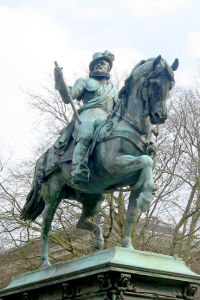
The Netherlands was a republic from 1581 until 1806 at which point Napoleon Bonaparte made his brother king of the country. After Napoleon was defeted at Waterloo in 1815, Willem Frederik of Orange-Nassau became King Willem I of the Netherlands. Since then the country has been a monarchy.

(Photo: statue of William the Silent, he who both led the Dutch revolution that started the republic and who started the house of Orange-Nassau.)

Tags: , , , , ,

April 5, 2013

Napoleon letter praises the Pyramid of Austerlitz

Filed under: History by Orangemaster @ 10:15 am

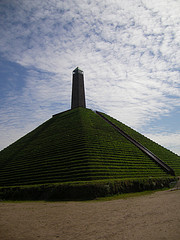
A letter written by Napoleon Bonaparte 200 years ago has been found in an antique shop in the small town of Ermelo, Gelderland. It was written to General Auguste De Marmont, Napoleon’s adjutant, praising him for the building of the Pyramid of Austerlitz in Woudenberg, a tribute to Napoleon.

Apparently, it is the only letter in which Napoleon mentions the Dutch monument. The letter will be put up for auction eventually. Last December, another letter written by Napoleon in 1812 fetched 150.000 euro.

(Link: www.omroepgelderland.nl, Photo of Pyramid of Austerlitz by evil nickname, some rights reserved)

Tags: , , ,

April 4, 2013

Nineteenth century Netherlands plans to reclaim everything

Filed under: Architecture,Technology by Branko Collin @ 10:10 am

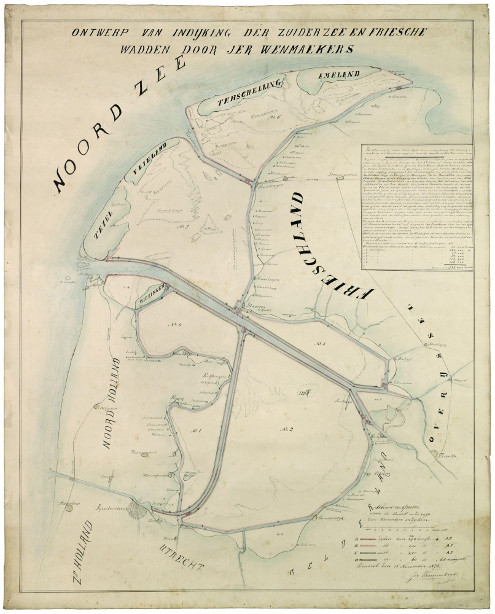
This map by Belgian citizen and inventor Jerôme Wenmaekers from 1876 shows his plans to reclaim the entire Zuiderzee, including the Wadden Sea.

According to De Verdieping van Nederland, Wenmaekers plans required the use of his own dike building machines, but the inventor would not release the plans for those until he got the reclamation concession. On the other hand, the minister of public works would not approve the plan as long as he could not see how the machines worked. Both parties remained in that deadlock and in the end it was Cornelis Lely whose plans were used.

Lely’s plan was much less ambitious, but still very ambitious—his Flevoland polder is the largest artificial island in the world by a wide margin.

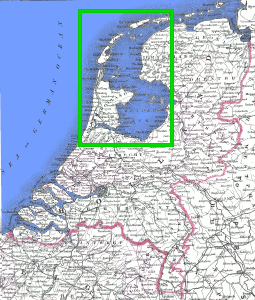
The green inset in this second map from 1866 shows the area Wenmaekers wanted to reclaim. According to NRC, for 70 years (between 1850 and 1920) the Dutch discussed what to do with the country’s ‘wet heart’, which led to at least 581 publications. One plan even called for the reclamation of the North Sea.

(Source: Nationaal Archief, via Martin Wisse)

Tags: , , , , , ,

April 3, 2013

Promo video for Rijksmuseum shows 17th century chase

Filed under: Art by Branko Collin @ 2:57 pm

The Rijksmuseum (or Rijks Museum) in Amsterdam, home to many a Dutch master, has been partially closed to the public for renovations ever since 2003 and will be reopened on 13 April by Queen Beatrix in the last month of her reign.

Sponsor ING made this video in a shopping centre in Breda of a 17th century shop lifter being chased by the city watch. The tableau vivant at the end depicts Rembrandt van Rijn’s ‘Night Watch’, the most prominent work in the Rijksmuseum’s collection. (Rijksmusem means ‘state museum’—there are several Rijksmuseums in the Netherlands, but if there is no city name attached people assume it is the one in Amsterdam).

Yes, it’s that same ING, the Dutch bank too big to fail. Its managers are now complaining that their salaries are too low. But at least they get to play patron of the arts with my tax money. These are the same arts the government no longer had money for after they loaned 10 billion euro to ING. Welcome to neo-liberal Upsidedownia.

(Video: ING/YouTube. Image: crop from the video)

Tags: , ,

April 2, 2013

Park-and-ride actually increases car use, an unintended effect

Filed under: Automobiles by Orangemaster @ 6:02 pm

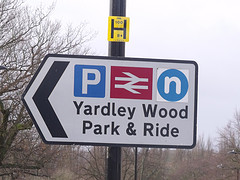
Park-and-ride, which was meant for people to drive and freely or easily park near train and subway stations to then continue their commute apparently increases car use instead of decreasing it. Dutch researcher Giuliano Mingardo surveyed some 700 commuters at nine railway park-and-ride sports around Rotterdam and The Hague a few years ago at small and large parking lots. Adverse effects included people parking and then walking somewhere, technically using up a commuter’s spot, people driving or cycling to a railway station instead of commuting the entire way, and generally using the car more because parking was cheap or free.

According to Mingardo, he believes that park-and-ride facilities “do present a net increase in traffic volume rather than a reduction”.

In the Netherlands, parking in and around train stations that are not park-and-rides are either physically impossible (a car cannot actually stop anywhere), only for permit holders or terribly expensive. It is still socially acceptable to be late for work when public transport goes haywire like in the winter, but it is still very important and expected in many professions for people to arrive at work or at a client’s with their own car.

(Link: www.theatlanticcities.com, Photo of Park and ride sign, England by Ell brown, some rights reserved)

Tags: , , ,

April 1, 2013

Computer science unpopular in secondary school

Filed under: IT by Branko Collin @ 12:38 pm

Only 1 in 20 Dutch secondary school students choose to take a computer science course, Webwereld reports.

On average Dutch high schools have one computer science teacher who received their last training ten years ago.

I remember when computer science was introduced at my grammar school in the mid-1980s, the instructors were our regular maths teachers who often did not know what they were doing. The booklet that came with the course was flimsy—I had finished reading it before the semester started and spent the rest of my time programming games. What was worse was that the course was aimed at the few who were interested in programming, even though learning how to use a word processor and a spreadsheet would have been more useful to the majority of the pupils.

Tags: , ,