October 17, 2008

The future still looks like the sixties

Filed under: Architecture by Orangemaster @ 9:50 am
Villa by Powerhouse

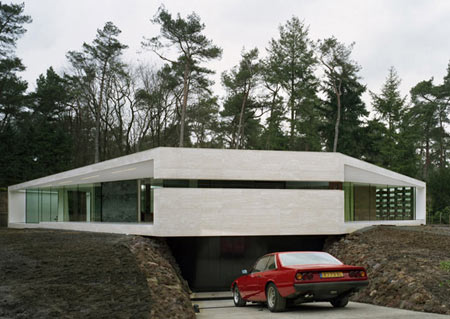
“Set in the Dutch woodlands, the program of Villa 1 by Powerhouse Company is optimally oriented towards the views on the terrain and the sun. Half of the program is pushed below ground to meet local zoning regulations, creating a clear dichotomy in the spatial experience of the house: a glass box ground floor where the mass is concentrated in furniture elements and a ‘medieval’ basement, where the spaces are carved out of the mass.

The interior of Villa 1 has been nominated for the category ‘best private interior’ of the Dutch Design Award. The villa is said to “ruthlessly position itself within the tradition of modern (interior) architecture”. The award will be granted on 18 October 2008, during the Dutch Design Week, in Eindhoven.”

Do follow the link below for more dreamy pictures.

(Link: dezeen.com)

Tags: ,

October 5, 2008

Letter reveals Anne Frank house as ‘unworthy’

Filed under: Architecture,General,History by Orangemaster @ 1:16 pm

annefrankstatue1.jpg

According to De Telegraaf, The Dutch government had no objections to the house where Anne Frank wrote her wartime diary being torn down in the 1950s. The place where the young Jewish girl described life hiding from persecution by the Nazis was not considered worthy of preservation, De Telegraaf said, quoting from a letter written by Joseph Luns, the foreign minister at the time.

Luns said the house where Anne and her family hid from 1942 until her betrayal in 1944 was “not a historical monument of the Netherlands” and unremarkable from an architectural point of view. The letter, dated May 3, was sent to the Dutch ambassador to the United States, informing him of the official position of the Ministry of Education, Art and Science towards the Anne Frank House. The newspaper said the letter was discovered recently when the part of the ministry’s archives was being moved to a new home.

According to the Anne Frank Foundation, it was apparently written in response to questions by Americans why the house was not declared an historic building. Located on Amsterdam’s Prinsengracht, the house began attracting its first visitors shortly after the book Anne Frank – The Dairy of a Young Girl was published in 1947. In the mid-1950s, a real estate firm proposed knocking it down to make way for a modern building, but dropped the idea after a series of protests.

(Link: earthtimes.org)

Tags: , ,

September 19, 2008

Recently discovered Jewish interior will not be wrecked for now

Filed under: Architecture,History by Branko Collin @ 5:30 pm

A uniquely preserved WWII Jewish living room in Amsterdam will stay intact a little bit longer. The room which we wrote about last week, was discovered last year by a student at that time Alexander Westra (currently of the University of Amsterdam). AT5 reports that Lebo, the company that now owns the house, has stopped the wrecking works of the property.

The house used to belong to banker Korijn who died in 1942, after which his entire family was deported to the concentration camps where they died at the hands of the Nazis. One source called the room “more authentic than the Anne Frank House.” After the war, the house at the J.J. Viottastraat in Amsterdam came into the hands of Catholic theology students who barely touched the room, although Westra apparently did uncover some traces of parties.

In the next month and a half the owner will look at possibilities to preserve the room which is built in the Amsterdamse School style. One possibility is to turn the luxurious room into a museum.

According to a spokesperson for Het Schip, the museum for the Amsterdamse School, focus for this architectural movement usually lies on exteriors. To answer a question asked earlier by one our readers, Jay Vos, the spokesperson did not know of any books that focussed solely on Amsterdamse School interiors, although the museum is currently working on a book that will also document these interiors.

The students who lived there recorded a corny video invitation to their new year’s bash in the living room last year, which 24 Oranges discovered at that wonder-wasteland of archeology, YouTube.

Photo: Alexander Westra, republished with permission. Westra sent us several photos, a selection of which we showed in our earlier article.

Tags: , , , ,

September 16, 2008

Gigabit internet connection to the houseboat

Filed under: Architecture,Online by Branko Collin @ 7:57 am

A quick technology lesson for the easily intimidated: an Internet connection speed of 1 gigabit per second translates to a single high definition movie off the internet onto your PC in a minute. In theory.
A recent study shows that the Netherlands is the country with third best broadband Internet connection, after Japan and Sweden.

Jealous cries were heard from across the globe, bemoaning the lack of local governments’ willingness to innovate, but the position of the Netherlands has probably less to do with the innovative nature of its citizens and more with the way the country urbanised during the industrial revolution. Many railroads not just connecting cities but cutting through right to the city centres makes it easy to lay cables, especially if this network of rails is already owned by the government.

Meanwhile, a company called Draka has developed fibernet connectors for houseboat owners, so that they too may be connected to the Citynet initiative which aims to hook up almost all of Amsterdam to a 1 gigabyte per second fiber optics network before 2010. Shown here is Olivier Ax in front of his houseboat. So what do these owners of the first fiber optic connections do with all that speed? Whispers around the Internet say they first throttle it to 20 megabit per second, because the faster subscriptions are too expensive.

Photo: Draka. Also via Toby Sterling.

Tags: , , , , , ,

September 11, 2008

Preserved interior of Jewish family home found

Filed under: Architecture,History,Religion by Orangemaster @ 9:44 am
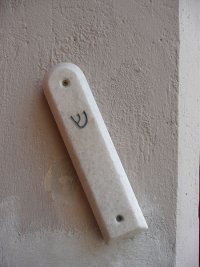
Mezozah

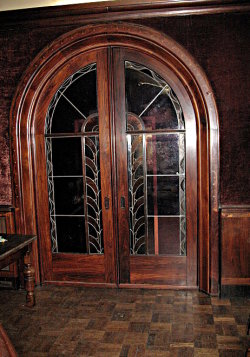
Researchers have found a house in Amsterdam-Zuid on the J.J. Viottastraat that has an almost intact 1940s interior which used to belong to a Jewish family. The living room, the most important and usually biggest room of Dutch houses, is apparently more authentic than the Anne Frank House. Alexander Westra, university teacher of heritage studies at the Universiteit van Amsterdam, confirmed this yesterday.

Westra stumbled upon this unique find last year when he was working on a project on historic interiors in the capital. The family of Jewish banker Lodewijk Korijn left the home in 1942 when they were carted off to concentration camps. And since then, the interior has barely been touched.

Westra believes that the home should be protected heritage. After the war, the house was used by theology students. The living room was their common room. In the vestibule there is still an original dresser integrated to the wainscoting on the wall. Even the lighting from that era still works, which is rare, says Westra. The backroom also features a few original details even though a fire raged through it once. The interior was made in Amsterdam school style.

(Link: parool.nl)

Update 11:30, by Branko: Alexander Westra, the scientist who made the discovery, sent us some photos he took from the interior. You will find them below the fold. Thanks, Alexander! According to him, the statues of saints and the crucifix were put there by later residents.

(more…)

Tags: , ,

August 30, 2008

A peek at the Amsterdam Begijnhof

Filed under: Architecture,History by Branko Collin @ 9:09 am

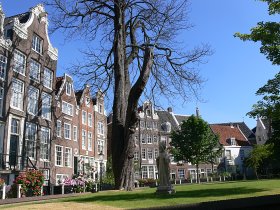
Apartment Therapy visited the 70 square metre home of American radio maker Ruth at the beguinage in Amsterdam. The complex, simply called Begijnhof (Dutch for beguinage), lies smack in the middle of the city and is open to the public. Located just off one of the busiest streets in the country, the Kalverstraat, it’s a sea of calm on the inside.

A begijnhof, or beguinage, is a secluded garden around which devout women lived a life dedicated to their faith, outside the formal structure of the church. Unlike nuns, beguines took no vows and kept any property they might have. There are dozens of former beguinages in the Low Countries. Although the houses were typically small, beguinages are still sought-after property because of their court-yard lay-out.

De Begijnhof is no longer home to beguines, but still only women live there. Should you wish to do the touristy thing, and should you be able to find De Begijnhof, access is free, and the beguinage has a couple of trumps up its sleeve other than just being there and being unique. It sports one of the two remaining wooden houses in the center of Amsterdam (1470). The panels of the pulpit of the English Church were made by Piet Mondriaan, and there’s a second, Catholic church hidden somewhere behind the gables.

Photo by Andreas Praefcke, some rights reserved.

Tags: , , , , ,

August 20, 2008

Villa Peet in Lelystad: sensation white architecture

Filed under: Architecture by Orangemaster @ 9:31 am
White house

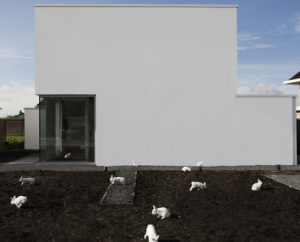
Recently completed, Villa Peet is described as an experience in contrasts. These contrasts create a sensation of entering into new worlds through a series of “rabbit holes”. The lack of doors inside gives the ground floor a sensation of continuity in order to keep the spaces clearly defined.

If you look around carefully, Lelystad, capital of the province of Flevoland, is one big garden of architectural experiments. As a big polder established as recently as 1967 (the last Dutch province), it has room galore to let architects, like these cute bunnies, roam free.

(Link and photo: plataformaarquitectura.cl)

Tags: , ,

August 19, 2008

Every new house an outdoor space and a bike shed

Filed under: Architecture,Bicycles by Branko Collin @ 8:11 am

Ella Vogelaar, Minister for Housing, Neighbourhoods and Integration, wants to force builders to produce an outdoor space (balcony or garden) and bike shed for every apartment built. An earlier obligation to do so was dropped in 2003. Vogelaar claims the market insufficiently provides the need for outdoor living space and bicycle storage, and so she is making the provision of this part of the building code, the complex set of rules governing the construction of buildings.
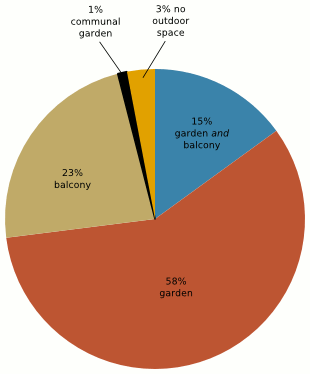
The ministery’s press release refers to an extensive study into how the Dutch live, the Woningbehoefte Onderzoek (Study into Living Needs), suggesting that this research was somehow the basis of the minister’s decision. Although I could not find anything about a shortage of bike sheds or balconies, I did find this interesting little pie chart (with small typos original typos introduced by me, now removed) on page 11 of the results of the Woononderzoek Nederland 2006, entitled “Types of outdoor spaces that houses have”:

Balcony plus garden 15%
Garden 58%
Balcony 23%
Communal garden 1%
No outdoor space 3%

Tags: , , , ,

August 3, 2008

Flower-filled walk in Apeldoorn

Filed under: Architecture,Nature by Branko Collin @ 1:52 pm

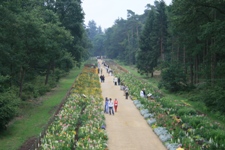
Until August 30 visitors of the Triënnale in Apeldoorn will be able to walk the Royal Mile, a path lined with flowers on both sides. One half of the path contains annual flowers and bulbs, the other half—designed by Jacqueline van der Kloet—is planted with perennials. The organization claims that in total there will be 48,000 flowers and bulbs. The walk is located in Park Berg en Bos, entrance limited to holders of a Triënnale pass.
The Triënnale is a 100-day exhibit of “garden, culture and landscape” in and around Apeldoorn, amongst others in the CODA and Kröller-Müller museums, the Het Loo palace and National Park Hoge Veluwe, each location worthy of a visit by itself.

Via Blik op Nieuws (Dutch). Photo: Triennale.nl.

Tags: , ,

July 27, 2008

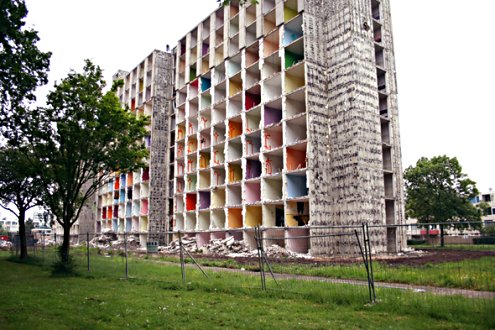
Living room colours ‘freed’ by partial demolition of apartment building

Filed under: Architecture,Art by Branko Collin @ 8:49 am

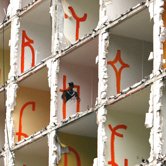
Artist Rutger de Vries, displays these images in his portfolio and offers no other explanation than the project’s name: “Art school made me do this.” (I’ve mailed him some questions, but he hasn’t answered them yet.)

Update 5-8-2008: Rutger tells some more about the project in the comments.

Via Trendbeheer.

Tags: ,