August 20, 2012

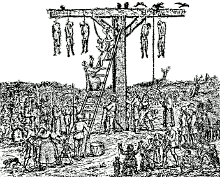
Goat Riders of 18th century Limburg

Filed under: History,Weird by Branko Collin @ 5:11 pm

The legend of the Bokkenrijders (‘Goat riders’) from Limburg knows many forms. Crossroads Magazine poured one of them in an essay in 2008, contrasting the popular form quoted below with the opinion that the Goat Riders were a precursor to the enlightenment.

In the 18th century, while most of Europe was shaking off centuries of superstition and beginning to prepare for the age of reason, the lands which now form the Dutch and Belgian regions of Limburg were terrorised by hordes of flying devil worshippers.

These mysterious robber bands met in caves or at isolated roadside chapels. Riding through the nightly sky on the backs of big black goats, they plundered farms and churches. The Goat Rider owned the night throughout most of the 18th century, until they were finally brought to justice by brave and god-fearing officers of the law. This is a story that practically everyone in Limburg knows to this very day.

And:

If one thing is clear about the Goat Rider, it is the fact that a great number of people must have met violent, degrading deaths while being completely innocent of any crime. Indeed it is quite likely that the Goat Rider’s bands as such never even existed outside of the human imagination.

Via Metafilter. I cannot believe I’ve never blogged about the goat riders before.
Tags: , ,

August 18, 2012

Preprinted election billboards are on the rise

Filed under: General,History by Branko Collin @ 11:26 am

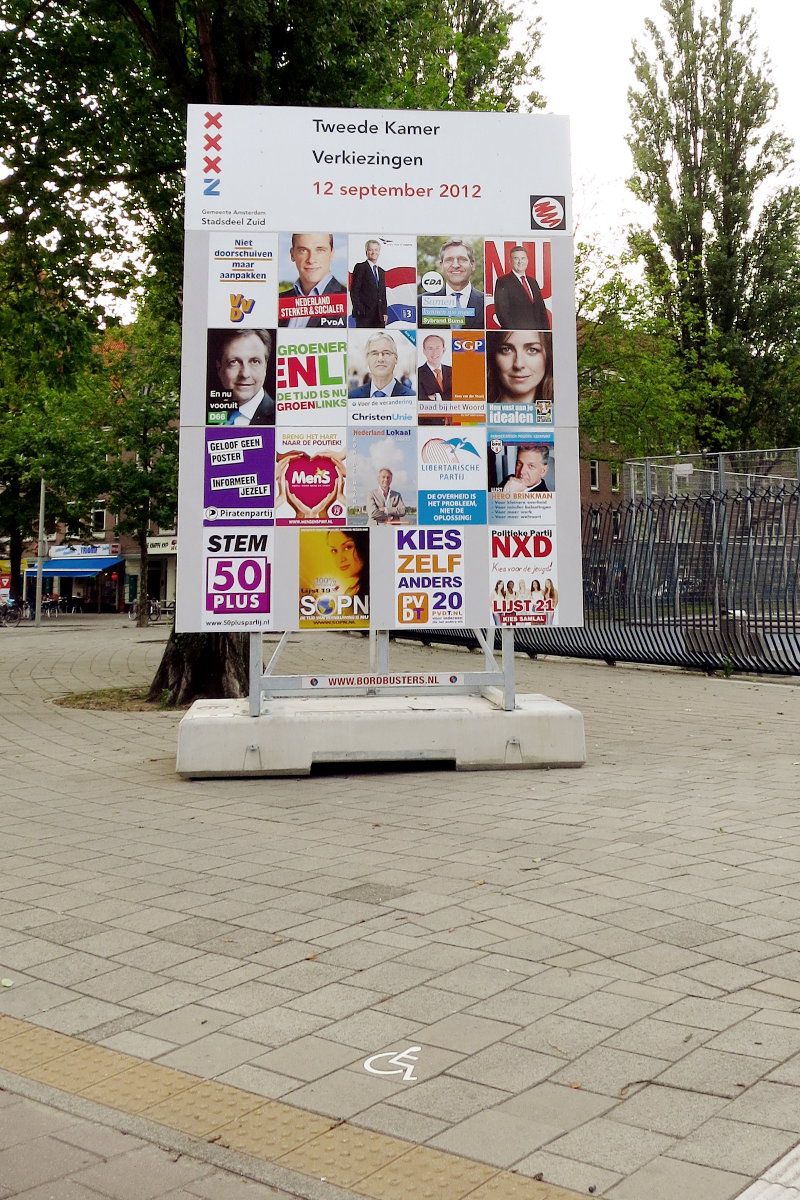
A new phenomenon is emerging in the Dutch electoral landscape, the preprinted election billboard.

Traditionally municipalities provide blank billboards for campaigners to glue their posters to, but amongst others The Hague, Soest, Capelle aan den IJssel, Oosterhout and parts of Amsterdam have chosen to go with preprinted boards this year for the September parliamentary elections.

According to Trouw, spokespersons for the various municipalities quote as reasons “moving with the times”, the desire to have “neater” looking billboards, and the desire to stop parties pasting posters on top of other parties’ posters.

I saw the one shown here near my house (click the photo for a larger version), and I must say, it does feel a bit like curtailing political speech. By printing the posters at the same size and in a neat grid, the individual posters become practically invisible.

I can fully understand the Socialist Party’s protests against this type of billboard. Theirs is the party of no political power whatsoever on the national level, but a very broad base. Campaign posters have traditionally been their medium, where other parties sometimes simply could not be bothered.

See also:

Tags: , , ,

August 14, 2012

Don’t throw out WWII stuff, museums will take it

Filed under: History by Orangemaster @ 1:25 pm

Today, sixteen of the country’s resistance and war museums are calling on people to give them objects from WWII such as books, documents, photos and more that they no longer want to keep. Most importantly, the museums don’t want people to throw anything out, as there is still a lot out there to collect.

Some Dutch videos show people handing in clothing, embroidery, letters, jewellery and more.

And a bit like The Antique Roadshow programme where people have gran’s old pendant appraised, museums probably know a lot more about many of the objects than their current owners do.

Although I have yet to visit many war-related sites in the Netherlands, I very much enjoyed the Groesbeek Canadian War Cemetery, which I visited when I used to live in nearby Nijmegen. It has more than two thousand Canadian soldiers buried there, along with Poles, Moroccans, Pakistanis and others that fought in WWII. Wikipedia states that bodies were moved across international frontiers, so that the Canadians would not be buried in German soil, something rarely done internationally.

(Link: www.gelderlander.nl)

Tags: , ,

July 11, 2012

The Netherlands grows itself a bit further

Filed under: Architecture,History by Branko Collin @ 10:53 am

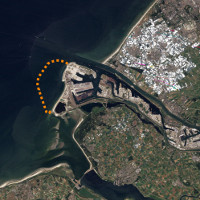
Tweede Maasvlakte indicated with a dotted line. The white blotches to the North-East are caused by sunlight reflecting off the greenhouses of the Westland area.

Today Queen Beatrix will officially close the last bit of an 11 kilometre dam that encloses an area of the North Sea that should become new land this year.

The Tweede Maasvlakte will be a 2,000 hectares large area atttached to the first Maasvlakte (‘tweede’ means ‘second’) outside Rotterdam that will be used as part of the port. The Betuwelijn railroad will be extended into it. It will mainly be used as a container harbour.

The new land will grow the area of the harbour by 20%. The dam surrounding Tweede Maasvlakte will contain 20,000 blocks of stone. RTV Rijnmond calls it an ‘ultra-Dutch project’, as it involves ‘building land to trade upon’.

To my knowledge there are no plans yet to extend this thing all the way to England, though people have been talking about moving our national airport to the sea.

(Image: NASA + 24 Oranges)

Tags: , , , , ,

July 7, 2012

Oldest farm in Western Europe almost torn down

Filed under: Architecture,History by Branko Collin @ 11:36 am

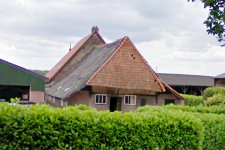
Farmer Piet Scheepers from Best, Noord Brabant, simply did not know that this barn of his was so old. He figured 300 years, tops. And because it was difficult to work in due to the low ceiling, he was ready to tear the building down, six years ago.
Research by local historian Dick Zweers has since put a stop to those plans, Omroep Brabant reports. Zweers found out that the wood in the building was from 1263: “The first thing I noticed that this used to be the sort of house where there was always a fire, people were always in the same room, they always had a need for warm water—you can tell by those sooted beams.” He adds: “There have been changes, but the construction is in essence still the same.”

Scheepers had already acquired a permit for demolition, now the government wants to turn the barn—which currently houses calves—into a state monument, and is willing to invest 100,000 euro in renovation, as is the provincial government.

Omroep Brabant calls this the oldest farm still in use in Western Europe. Back in November, Zweers was still hedging his bets: “Great Britain has also got a lot of old stuff.”

(Photo: Google Street View)

Tags: , , , , ,

June 19, 2012

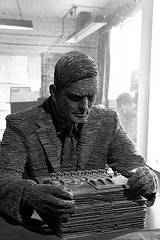
Lego computer built for Alan Turing’s 100th anniversary

Filed under: Design,History,IT by Orangemaster @ 12:50 pm

Jeroen van den Bos and Davy Landman from the Centrum Wiskunde & Informatica (CWI), a world-renowned scientific research institute specialised in mathematics and computer science, built a LEGO Turing Machine for the CWI’s exposition “Turings Erfenis” (‘Turing’s Legacy’) in honor of Alan Turing’s 100th birthday this year. The institute is known for creating the popular programming language Python, which is used by Google, while cwi.nl was one of the first national domain names ever issued in the world. The CWI played a pioneering role in connecting the Netherlands to the World Wide Web.

Enjoy the short documentary below and in true nerd fashion, you can read all about the making of this documentary by Andre Theelen right here.

“Alan Turing was an English mathematician who was highly influential in the development of computer science, providing a formalisation of the concepts of “algorithm” and “computation” with the Turing machine, which played a significant role in the creation of the modern computer,” say Wikipedia.

LEGO Turing Machine from ecalpemos on Vimeo.

(Photo of Alan Mathison Turing by Garrettc, some rights reserved)

Tags: , ,

June 16, 2012

Amsterdam discovers a new oldest house

Filed under: Architecture,History by Orangemaster @ 2:50 pm

For ages, the house hailed as the oldest in Amsterdam was the unique wooden house (‘Houten Huys’) from 1530 at No. 34 of the Begijnhof (map), one of the oldest inner courts in the city of Amsterdam, inhabited solely by unmarried women.

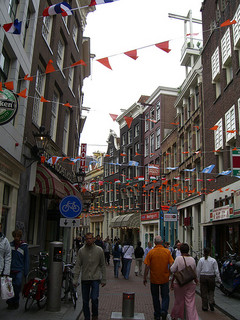
And now Amsterdam has a new oldest house, located at No. 90 of the Warmoesstraat, near the Red Light district and Central Station. Experts have dated the house back to 1485 by having its wooden structure analysed in a special lab in Berlin. The rich discovery also makes it the very first 15th century house to be discovered in the city.

A fire broke out in No. 90 back in 2010, and during the repairs, a building inspector noticed some very old details in the wood of this old house, also confirmed by the experts that tend to historical monuments and architecture. The façade of the building is from 1800, which is why no one bothered or noticed before.

(Link: www.rtvnh.nl, Photo of Warmoesstraat by Olivier Bruchez, some rights reserved)

Tags: , ,

June 2, 2012

Monumental tobacco barns may now be used to house businesses

Filed under: Architecture,History by Branko Collin @ 8:19 am

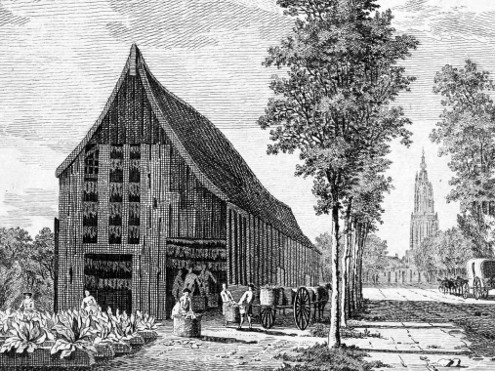
The municipality of Utrechtse Heuvelrug has broadened usage rules for so-called ‘tabaksschuren’, or ‘tobacco barns’, barns that were used in the 18th and 19th century to dry tobacco leaves.

According to De Telegraaf the region used to be the tobacco centre of the Netherlands. The barns were typically 24 metres long and 12 metres wide, and had a tarred roof and shutters in the gable to keep the inside cool and draughty.

Until last Wednesday old tobacco barns could only legally be used as homes, but the municipality will now allow businesses such as offices and tea houses to operate from the classic barns.

A list of tobacco barns (with photos) can be found here (PDF).

(Drawing by Paulus van Liender, 1731-1797, of a tobacco barn just outside Amersfoort.)

Tags: , , ,

May 24, 2012

Dutch couple sells expensive Belgian castle for 1 euro to municipality

Filed under: Architecture,History by Branko Collin @ 10:39 am

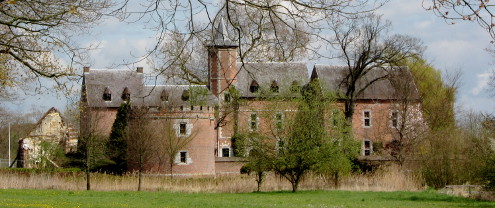
The Commandry of Gruitrode, containing a castle and farm built in approximately 1400 AD, has changed hands.

The Dutch owners decided to sell it for 1 euro to the municipality of Meeuwen-Gruitrode in the Belgian province of Limburg.

Telegraaf quotes one of the owners, Cornelia ter Horst: “We have no children and feel that such a beautiful castle belongs to our fellow villagers. My husband always says that everything in life is borrowed.” The couple is in their eighties and will be made honorary citizens by way of thanks.

A lovely story, but personal experience makes me wonder if there isn’t a catch. My parents were able to buy castle d’Erp in Dutch Limburg in the 1970s, also for a very reasonable price, namely one guilder. The snag then was that the castle needed extensive repairs that would cost about one million guilders. The municipality of Maasbree ended up buying the castle and used it to house the mayor.

(Photo released into the public domain by Wikimedia Commons user Wasily.)

Tags: ,

May 20, 2012

How to defend your thesis at Leiden University

Filed under: General,History by Branko Collin @ 6:59 pm

Australian law blogger Kevin Jon Heller got his PhD in Leiden and describes the process of defending his thesis in a recent posting:

My casual attitude didn’t last long — only until I began to put on my tuxedo, complete with tails, in the room in which candidates change. My interlocutors for the viva, kindly known as ‘the opposition committee’, were changing on the other side of the room. The solemnity of the occasion finally penetrated my thick skull — this was my rite de passage into an academic tradition that had been taking place in Europe for centuries.

Once I had changed, Leiden’s pedel (registrar) explained the viva process to me and my two paranymphs, Mirjam and Bianca. The role of the paranymphs is now purely ceremonial; they sit and stand beside you during the viva. Traditionally, however, they served as the candidate’s protectors, intervening on his behalf if the opposition committee was being unfair or physically abusive (!).

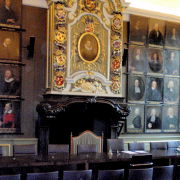
The defense traditionally takes place in the Senaatskamer (Senate Room, 1733) which is adorned with portraits of the professors of the early days of the university and seats 64.

(Photo by Wikimedia Commons user Effeietsanders, some rights reserved)

Tags: ,