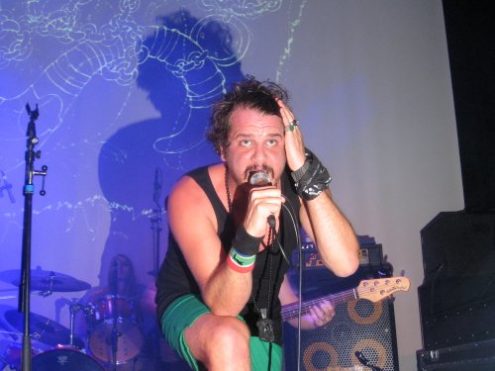

Kyteman’s Hip Hop Orchestra won the Popprijs 2009 (’Pop prize’) in Groningen last Saturday.
The 12-piece-band won one of the most prestigious pop music awards of the Netherlands for its contributions to the genre. The chairman of the jury, Hans Kosterman, called the orchestra “authentic, a source of inspiration, strong-minded and very successful.”
The prize consists of 10,000 euro and a statuette. The annual award was introduced in 1986, when it was given to singer Mathilde Santing. Despite having 10 MCs, the band is perhaps best known for its instrumental, Sorry.
Last night, a group of young artists hung up their own works of art in three major Dutch museum, the Groninger Museum in Groningen, the Bonnefanten Museum in Maastricht and Museum de Fundatie in Zwolle. This act of protest was meant to draw attention to the fact that not just established artists should be in museums, but young, up and coming artists as well.
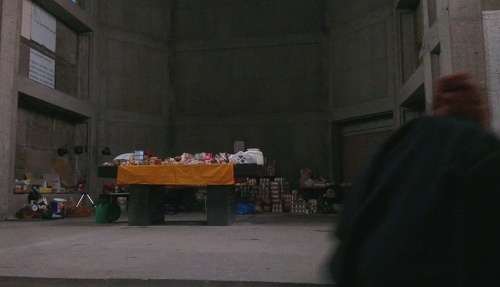
This morning the Bonnefanten Museum (shown here) said that they found a large black-and-white photo in the old art wing, while de Fundatie found a small colour painting among its collection. Both museums were closed at the time and neither of them has any idea how the art got there. Employees of the Groninger Museum saw a big object in their security cameras and when they went to check it out, the big object had disappeared. Spooky.
So besides this stunt making the news and all, it also tells me how useless the security actually is at all three museums.
This map shows the fake island kingdom the Netherlands could be if its geography fully followed its politics. In the real world, top left dogs Nijmegen and Groningen are separated by 200 kilometres, as are right wing islands Kessel and Urk.
The two regions that in reality do exist as geographical areas are the Bible Belt and the Rode Regio, an area that used to have a lot of communists, basically the Groningen country-side.
I can vouch for the position of Nijmegen, having lived there for ten years. Nijmegen’s and Groningen’s progressive and left-wing attitude may at least in part have to do with a large student body, making up ten percent of the population in the case of Nijmegen. Would the Catholic church have thought that when they started their university there in the 1920s as a bulwark against socialist forces?
Radio DJs Coen Swijnenberg (’swine mountain’) and Sander Lantinga (wholly unremarkable name) have elected their ’shame name’ for 2009: Fokje Modder.
Fokje had to fight other strong contestants like Constant Lam (’continuously drunk’), Wil Krikke (’wants to have sex’), and Englishman Ben Brack (’have a hangover’) in an involuntary election of the oddest name of the country.
According to NOS Headlines, Fokje (pronounced fok ye) has never been troubled by her name, but she has never been abroad either.
Considering the amount of Fokjes whose last names end in -(e)ma, I would guess the name stems from Groningen.
Camping ‘t Buitengewoon Groenhoff in Vriescheloo, Groningen, is using sewer pipes to build a ‘bear hotel,’ although intended to house paying human guests instead of bears.
The ‘caves’ will each have a bed and two chairs, and are meant to house the participants of team-building sessions and similar outings. Apparently, the brainstorm that led to this idea was drenched in beer. Staying a day under these spartan conditions will set one back about 100 euro, a price that includes three meals.
The camping is not the first to use sewer pipes as rooms, a hotel in Austria has done something similar before.
Filed under: General, Science by Branko Collin @ 9:36 am
Last month, three coin treasures were found in Groningen during archaeological digs. Don’t get all excited though, as a coin treasure is defined as anything over five coins, or as Blackadder character Baldrick would have it, some coins. The biggest find was a collection of half-stuivers, stuivers and double stuivers (a stuiver is the Dutch equivalent of a shilling or a nickel) in a jar, estimated to be worth three monthly salaries at the time they were minted, reports Blik op Nieuws (Dutch).
So who gets the loot? After a find of celtic silver and gold coins near Maastricht two years ago, archaeologist Wim Dijkman of the city of Maastricht told Z24 (Dutch): “According to the law, half of the estimated value goes to the owner of the land, the other half to the finder. Since this find has become an official one, the finder is the city of Maastricht.” That find was estimated to be worth several hundred thousand euro, and since Maastricht wanted to keep the coins for its own collection, it had to pay the land-owners from its own purse.
(By the way, the coins in the picture were found in my own wallet and are not an official treasure.)
The story goes that Alfred Hitchcock phoned prolific French detective writer Georges Simenon (1903 – 1989) once, only to be told by the great man’s secretary that he could not be interrupted, as he had just started working on a new novel. “That’s all right,” Hitchcock said, “I’ll wait.”
In 1927 Simenon had his boat Ostrogoth built, a cutter modelled after the fishing vessels of the English Channel. In 1929, when he arrived in Delfzijl, Groningen, he noticed a leak, the repairs of which kept him there for four months. “I still have vivid memories of my discovery of this pink town, surrounded by dikes, with its walls that weren’t meant to keep out attackers, but were there to keep the streets from flooding with sea water during bad weather,” he writes in a companion article to the 1966 Dutch edition of Le Château des Sables Rouges.
He wrote that novel then and there (”I was still in the habit of writing two or three chapters a day back then”), and when he had finished it, he wondered what the next step would be. Drinking genever one morning in café Het Paviljoen—two, three glasses?—he saw the outlines of a broad-shouldered man through the alcohol induced veils of his imagination. A pipe followed, a bowler hat, a warm overcoat with velvet collar. In short, a proper police commissioner.
Theater te Water will stage a play about the birth of this most famous of all French detectives, Jules Maigret, in Delfzijl starting May 12. The play, called Noord Moord (’Northern Murder’), will be performed on a boat. Where else?
(Link: Dagblad van het Noorden. Photo of a Pieter d’Hont statue of a Georges Simenon character by Wikipedia user Gerardus, who released it into the public domain.)
- “Officer, officer! You have to arrest my neighbour, Mr De Vries.”
- “What has he done wrong this time, Mrs Jansen?”
- “He’s whistling dirty songs!”
The following news made me think of this old Max Tailleur (Dutch) joke:
A man in Groningen was arrested last week for wearing an insulting tattoo, according to Dagblad van het Noorden (Dutch). Written on the man’s neck were the letters ACAB, and the police assumed this abbreviation stood for All Cops Are Bastards. Some mothers do ‘ave ‘em, eh? The man first stated that he had his neck tattooed after spending some time in jail, and later added that the abbreviation meant “acht cola, acht bier” (eight colas, eight beers).
Insulting a civil servant, including police officers, is a crime in the Netherlands (article 267 of the criminal code).
Photo: montage.
Update: another man got convicted in February for wearing a jacket with the text A.C.A.B. The court had a rather curious opinion (Dutch), in which it held that the number of Google hits that linked to page in which ACAB was used as All Cops Are Bastards was evidence of the popularity of the term.
Filed under: Dutch first by Branko Collin @ 10:29 am
When the smoking ban for bars was introduced last year, it hit Groningen bar De Balk as hard as any other café. Owner Aethne McGhie, originally from Scotland, turned a storage room into a smoking room, but the result was that the bar area itself looked absolutely dead. Her remaining customers came up with an idea: why not turn things around, move the actual bar into the storage room, and the former bar area into the smoking area. And so it was done. The result is that people now have to walk to the former storage room to get their drinks, but, McGhie told Parool (Dutch), even the toughest customers soon learned how to play nice.
The professional busy bodies who have to enforce the ban on fun, the Voedsel en Warenautoriteit (VWA), grudgingly admitted to De Telegraaf (Dutch) that this ploy is actually legal. “But we wouldn’t necessarily call it a legal bar,” a spokesperson said. Turns out that they found a technicality with which they can still cause problems for De Balk. Apparently, the law that says that a room where drinks are served must have a minimal size hasn’t been adapted to take the new circumstances that the smoking ban created into account.
Another entity that won’t call De Balk “the first legal smoking bar” is perhaps not surprisingly Hiermaghetwel.nl (Dutch), the website that keeps track of all the bars in the Netherlands where you can legally smoke. They point out that Café Populair in Amsterdam was the first to come up with the idea of a small bar section and large smoking area, way back in September last year (AT5, Dutch).
Source photo: Google Street View, a Dutch version of which was introduced a couple of days ago.
Filed under: Music, Religion by Orangemaster @ 10:09 am
In the growing catergory of the War on fun and religious people publically showcasing their crisis of faith to the media who enjoy running with it, let’s take a stab at a golden oldie target-wise: heavy metal music.
A local religious association from Middelstum (Stichting de Cederborg), some 15 km from Groningen, is protesting against a pop event called Sunsation that’s been around for years. They claim the music pushes kids to suicide and oh yeah, they make noise. “Rap and pop rock have a negative influence on children and heavy metal is really focused on suicide. And we have church on Sunday. It’s important to get a good night’s rest.”
I’m totally down with that last bit (the rest part), but the first bit is top quality bull, and not a good way to win an argument in 2009. The organisers of the event explain that the Cederborg people are trying to draw attention to something the event has nothing to do with. The organisers are also avidly looking for a better location.