


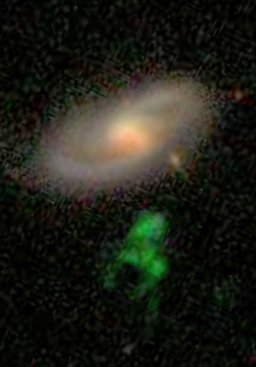
 Amateur astronomer by night and primary school teacher by day Hanny van Arkel discovered this little green man-cloud in the sky, and promptly got it named after herself: Hanny’s Voorwerp (voorwerp = “object”). When I say little, I mean huge.
Van Arkel, who hails from Heerlen in Limburg, made her discovery as part of a distributed computing project called Galaxy Zoo, in which volunteer participants are asked to classify images from the Sloan Digital Sky Survey according to a list of known celestial objects. The Voorwerp wasn’t on that list.
A guess of what the object could be comes from astronomer Bill Keel. Quoting the Galaxy Zoo blog:
A hundred thousand years ago, a quasar blazed behind the stars which would have already looked recognizably like the constellation Leo Minor. Barely 700 million light-years away, it would have been the nearest bright quasar, shining (had anyone had a telescope to look) around 13th magnitude, several times brighter than the light of the surrounding galaxy. This galaxy, much later cataloged as IC 2497, is a massive spiral galaxy which was in the process of tidally shredding a dwarf galaxy rich in gas – gas which absorbed the intense ultraviolet and X-ray output of the quasar and in turn glowed as it cooled. But something happened to the quasar. Whether it turned off, dropped to a barely simmering level of activity as its massive black hole became starved for gas to feed its accretion, or it was quickly shrouded in gas and dust, we don’t see it anymore.
But we see its echo.
Astronomers are apparently lining up to get a shufty at the Voorwerp through the Hubble Telescope, which is currently awaiting repair by a Space Shuttle crew.
Via Sargasso (Dutch). I re-coloured the original photo, because people pointed out that the blob is more likely to be green than blue. CP/IMH: “The chances of anything coming from Mars / Are a million to one, he said / The chances of anythiiiing coming from Mars / Are a million to one … and still, they come.”
 Researchers from the Radboud University in Nijmegen
 Earlier this year researchers from the Radboud University in Nijmegen published a

 A Flemish study which showed that the Dutch talk faster than their Southern neighbours was shot down rapidly by Dutch experts when it was first published in 2004. But four years later linguist Hugo Quené from the University of Utrecht has proved his Flemish colleagues right. Quené used new methods to pick apart the 38-hour speech corpus and used a recently developed statistical method, multi-level analysis. As it turns out long “phrases” (bits of speech separated by pauses) take relatively less time to pronounce than short ones. Even so, the Dutch tend to use shorter phrases than the Flemish. Also when phrases of the same length were compared, the Dutch proved to be the fast talkers.