Filed under: Art,History by Orangemaster @ 2:03 pm
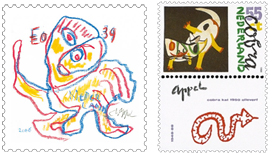
Reported as missing or stolen long ago, more than 400 works by Dutch painter, sculptor and poet Karel Appel were found in a bunch of crates, in a British warehouse.
The artist, who died in 2006 at age 85, was one of the founders of the Cobra movement. Just before he died in 2006, he designed a postage stamp for an exhibition on visual artists entitled ‘Kunst’ (‘Art’), the last work of art he ever made.
Now we wait and soon find out what kind of goodies we missed.
You’d think a mobile euthanasia unit or a pedophile political party would be taboo in the Netherlands, but one of the biggest taboos I know of is about Dutch women not being able to earn enough money to pay their way through life. The irony is, according to a recent report by Delta Lloyd Group Foundation, 70% do believe it is important to be able to take care of themselves, but in actual fact, they don’t or don’t want to. (Some 75% of Dutch women work part-time and 40% of the population still believes that women with children should not work full-time.)
I’ve heard all kinds of arguments and personal stories from Dutch men and women in all kinds of situations (kids, no kids, divorce) that have made me understand why some women ‘cannot’ work (they lose money!) still today in 2012, and the government can be blamed for a lot of it: a too high standard of living as compared to other EU countries relies on the ‘informal’ network (moms, grandparents babysitting, neighbours caring for elderly), much like big companies used to abuse the environment and let governments pay to clean it up.
But not ‘wanting’ to work or work more in a recession — we are officially in one today — is making someone else (husband, partner, society) pay for you, when you should be helping yourself out, if not your family. It makes men and women continue to think that more than half of Dutch women are not equal to men. The entire Western world works, has families, raises children and runs businesses, so what’s the hold up?
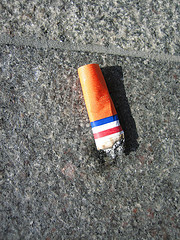
Street combing is cool, but then so is calling rubbish art and exhibiting it at big venues, including the city hall of Heerlen, Limburg. Starting today, visitors there can have a look all kinds of things collected by cleaners who are trying to attract attention to issues such as being paid for sick leave and getting more respect.
This travelling exhibition already seen in The Hague, Groningen and Utrecht tells stories about some 1,000 found objects such as a gold bracelet, a can of cola, a teddy bear and a syringue. The idea is that cleaners reflect our society and are indispensable, while they are not treated fairly despite the relatively well-organised Dutch labour system. Cleaners all over the country have been striking as well to get their point across.
Loek Canton graduated with honours as a design engineer in Delft last Friday with the design of a table that produces light. In cooperation with psychology students from the Vrije Universiteit Amsterdam, he studied the effects of his table on dementia sufferers.
According to the Delft University of Technology, “fifteen elderly people took part. [Loek Canton] observed the effects of the light tables on the residents by interviewing participants and care staff. ‘The initial results provide a positive indication that the light tables have the desired effect on the activity and mood of participants’, says Canton. ‘When using the tables, residents sleep less, are more active and communicate more. The light tables were well received by participants, as they interacted with the objects.’”
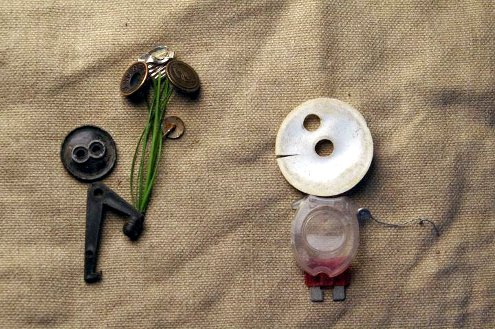
Krista Peeters calls herself the straatjutter, the ‘street comber’, and every day she makes one small art piece of stuff she finds on the street.
She keeps track of where her finds come from. The piece shown here is called ‘Why, thank you, they’re lovely! Let me get a vase…’, and was created from garbage found on 10 February 2012 on the Dapperstraat in Amsterdam: fake grass, a plastic thingamajig, 3 buttons, a lamp holder, a thumbtack, a plastic cap, half a bike light, something technical, and a bent safety pin.
According to Bright the artist is currently looking for a place where she can exhibit a year’s worth of works by March.
A lower jaw created by a 3D printer has been fitted to an 83-year-old woman’s face in what doctors say is the first operation of its kind.
The transplant was carried out in June in the Netherlands, but is only now being publicised. The implant was made out of titanium powder – heated and fused together by a laser, one layer at a time.
The operation was performed in a hospital in Sittard-Geleen in Limburg. The jaw was made by a company called Layerwise from Leuven, Belgium, which published this video of the process:
According to De Pers, the woman got to go home after just 4 days in the hospital. She will receive matching teeth ‘soon’.
The Dutch extreme right-wing party, part of the elected coalition government, has set up a website where people can ‘denounce’ the violence, crimes and other bad things ‘allegedly’ done by Poles, Bulgarians, Romanians, and other Eastern Europeans. Never mind the obvious discriminatory nature of the site, it also does not allow anyone to elaborate on why they think that one Pole stole their job, just a radio button that says ‘yes’ or ‘no’, which is more unreliable that a teenager magazine quiz about your ex boyfriend.
Instead of getting all freaked out, the more sane part of the Dutch population starting coming up with parody sites, including Contact point for Limburgers (poking fun at the head of the right-wing party’s background and support base), Contact point for Belgians, dissing French-speaking Belgians, and Contact point for Dutch people, which is obvious. There are more, and probably more to come as well.
My favourite which I read about on Twitter, is meldpuntwaardevollegezelligheid.nl (roughly, ‘good fun’), set up by Polish-born Dutch rapper Mr Polska who turned the site’s idea on its head to promote himself and partying with Eastern Europeans, an excellent marketing coup. Too bad his sexist view of women in his music is so underdeveloped, he almost provides ammo for the first site.
UPDATE: If anyone wants to read complaints about the Dutch, just pick an English-language expat site.
Filed under: General,Music by Orangemaster @ 3:59 pm
Last December, hiphop café De Duivel in Amsterdam had a shoot out where two people were wounded. Four suspects were arrested and the reasons for the violence were not confirmed, but I’m sure it’s all sorted by now.
Daniel Eeuwens, owner of the café, who just sent round a long explanation about how he is trying to reopen his café, is being stonewalled by the local police, although he’s been in talks with the city for weeks. The café was asked to come up with a serious plan to avoid any kind of future incidents, and so the café lawyered up and wrote a serious plan that the cops are now blocking.
The owner is particularly worried about what the cops are saying about his patrons, which is why he sent the letter round. The cops accused the café of sometimes playing gangsta rap and that attracts ‘a specific crowd’, which is code for ‘criminal-like people of the non white persuasion’. But come on, blaming a café for playing a song or two of gangsta rap, as if nobody else does that anywhere else, is not a reason to close a place down, it’s an excuse and a racist one at that.
I know for a fact that De Duivel played anything from old Ice-T tracks to the Jeugd van Tegenwoordig and had a mixed bag of visitors, mostly locals of different age groups, none of which ever made me feel like I was in the wrong place. People were very much chilling and swaying to all the low BPM music and singing along to the Dutch stuff.
Granted, I don’t really want to hang out in places that have shoot outs, but hey, there was a shoot out in front of my door last November, a lower middle class mixed neighbourhood, and I didn’t hear the police making any racist remarks about the neighbourhood.
Here’s some old Osdorp Posse with ‘Where is the cop’.
Parking enforcement officers in Amsterdam, and surely in other cities, cause nuisance to cyclists and pedestrians on their scooters. They drive side by side, sometimes against cycling traffic, and faster than the allowed 25 km/h. They have no reason or right to do any of this, either. Let me remind you that scooters and mopeds cause 10 to 20 percent of all accidents in the Netherlands.
And that’s not all. According to Nieuws uit Amsterdam, they don’t wear helmets and drive a polluting type of scooter, while the city pushes for traffic safety and clean air. You can imagine why cyclists union Fietsersbond highly recommends these parking enforcement officers do their jobs on a bicycle just like a whole bunch of other working people do.
Ever since the cold spell started well over a week ago, the beloved ticket givers have traded in their scooters for taxis. That’s right: the city is paying for them to be driven around town with taxpayers’ money by taxi. In Canada they’d just walk around wearing warm clothes, but oh no, snow is dangerous here! Why don’t they just have cars?
True, scootering around on icy streets is dangerous, and cycling is also not a good idea, but what’s wrong with walking? It’s like nobody thought of it. Tons of people work outdoors day in day out despite the cold, why are these people so special? Before ‘do you it yourself and see how cold it is’ pops up in the comments, I was a bike courier in Montréal, Canada for three years also during the winter with temps of -25 celsius. Dress warmly and keep moving.