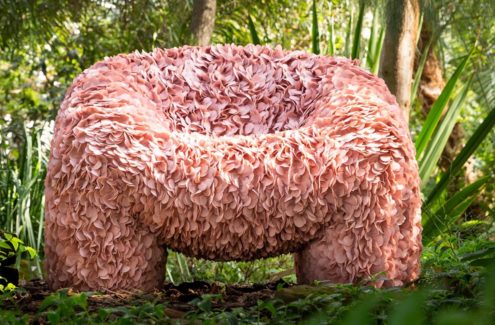
The chair on the right is ‘Cinderella’s Chair’, a follow up of designer Anna Ter Haar’s 2007 graduation project ‘Buitenbeentje’ (meaning ‘odd man out’, but literally translated ‘outside leg’).
“Glass is a malleable material when heated, so the glass was blown onto the chair, which provides every chair with its own unique prosthesis.”
The chair on the left is from the original ‘Buitenbeentje’ project. Anna Ter Haar also designs other types of chairs, shoes, movies and more.
Filed under: Design, IT by Branko Collin @ 4:01 pm
A classy looking table with a built-in computer, projector (HD, i.e. 720 lines) and touch screen. According to commenters at Engadget who have used this device it has some spots where the touch screen doesn’t work well. Intactlab from Amsterdam is nevertheless not afraid to charge a 1,000 euro daily rental fee for the Remix.
The owner of an Amsterdam canal apartment had to suffer the indignity of just seeing a wall whenever he looked out of his bathroom window, so interior designers i29 fixed that for him: they added a vertical garden to the wall.
This was enough to land them the Bathroom Design Award 2010 in the Home category. (Unfortunately, the entire ’site’ is made of Flash, so I cannot link to the 2010 page directly. Just click “Winnaars 2010.”)
The other category, Hotel, was won by Marjolein Garritsen for the bathroom in the Ilyushin Il-18 based hotel room we wrote about two weeks ago.
(Photo: Horizon Photoworks, used with permission. Link: Bright.nl)
Filed under: Art, Design by Orangemaster @ 11:29 am
Designed by Belgian artist Carsten Höller, you are looking at a revolving hotel room installed in Rotterdam’s Boijmans van Beuningen Museum. You can book this art hotel room for somewhere between 275 and 450 euro a night and have access to the entire museum to visit and enjoy in peace. The big glass plates that the furniture is placed on is what revolves very slowly.
This hotel room is part of an exhibition by Höller entitled Divided Divided, running until 25 April.
Filed under: Design, Food by Branko Collin @ 9:31 pm
The Metrobowl is a serving dish by 2001 Eindhoven Design Academy graduate Frederik Roijé shaped in the form of a city map.
Frederik has made two models, one based on Amsterdam (the semi-circular onion skin lines are the famous canals), and one based on the grid of Manhattan. The bowls are made of cast aluminium, cost 200 and 240 euro respectively, and are sold by Frederik himself through his on-line shop.
The name may be unknown to foreigners, or even to the Dutch themselves, but the designs of Ootje Oxenaar are deeply familiar to any Dutch person over the age of 10. It was Oxenaar who designed the Dutch banknotes between 1966 and 1985.
Unlike the drab money used in most of the rest of the world his designs were extremely colourful. Where Oxenaar could go for aesthetics instead of respectability, it appears to have been mostly because the Dutch bank, after some initial run-ins, let him be just a designer.
In this video he talks about his relationship with the Dutch bank, rejected designs, and the many Easter eggs he put in his banknotes. The exhibition at the Museum for Communication in the Hague runs until 10 April, 2010. It focuses on both his money and stamp designs.
Oxenaar’s Euro note designs were rejected, but can still be found on the web. Oh, how I would have loved to have unicorns on our bills!
Trendhunter has an interesting overview of 40 of the stories it published on recent Dutch innovations, from chairs made of used napkins to nude exercising, and from supercars to artificial islands.
We’ve covered some of these stories before, but there is still lots to discover.
One of the stories highlighted is a recent one about Maaike Roozenburg’s christmas baubles, made to look like root vegetables such as potatoes and turnips. There are 24 of them, for sale at Moooi.
Amsterdam designers Studio Roelof Mulder and Bureau Ira Koers (both sites under construction, almost a pun) have won the Serve and Facilitate (Public) Great Indoors Award for their project University Library of the University of Amsterdam. You have to see all the pictures to get a feel for it.
It claims the date of completion is August 2009, but that has to be a typo.
Eiko Ishizawa, a Japanese designer living in Amsterdam designed this fun sleeping bag that doubles as a bear suit or maybe it’s the other way round, I can’t tell. If you do get attacked by a bear — surely not in the Netherlands — you can’t sue him, he explains. “Leave your bear sleeping bag in the tent and don’t turn the light on for the bear’s sake”.
I think someone’s been watching too many nature films, but inspiration is inspiration. I can see before me an entire cool collection of fun sleeping bag for kids if someone hasn’t picked up on this idea already.
Filed under: Design, Fashion by Branko Collin @ 8:11 am
This merry-go-round coat rack by Wieki Somers won the overall prize for the best Dutch design project at the Dutch Design Week 2009. It is already in use at the Museum Boijmans – Van Beuningen in Rotterdam.
Other winners were the rain barrel by Bas van der Veer that we wrote about last week, which won the René Smeets award, the prize for the best project of this year’s Design Academy Eindhoven graduates.
Other interesting designs were those of Digna Kosse, who experimented with how much material you can leave out of a dress and still call it a dress (may be NSFW), and Austrian Eindhoven Design Academy graduate Sonja Bäumel, who experimented with clothes that grow themselves in the areas of the body that most need the warmth by letting bacteria do the heavy lifting.