

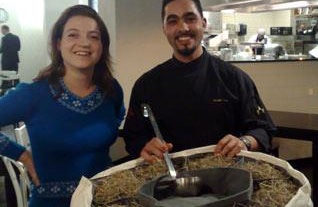
This week, patrons of the restaurant De Witte Tafel in Eindhoven will be served their meals on a hay box cooker. The restaurant wants to show people how to save energy and so they pulled out the old-fashion hay box cooker.
In this box, covered in hay, food can be simmered and kept warm, saving on gas use. According to Mounir Toub, one of the chefs, the box of hay is great for cooking.
Being very curious orange at 24 oranges, here’s what I learned about the hay box cooker:
Haybox or retained heat cooking is simply cooking a liquid based food like a soup or stew in its own heat. During WWII, cooking oil was rationed for the war effort, and so this method became popular as a way to conserve cooking fuel. They used hay in a box because the air spaces in the hay trapped in heat and allowed the soup or stew to cook in its own heat. Hay, shredded news paper, rice hulls, cotton balls, corn husks, etc., will work as long as it is packed loosely and creats air spaces.
And then of course, there probably is a risk of fire, but the green point is definitely well-made.
(Link and photo: omroepbrabant.nl)

 Visitors to the Netherlands have noticed the phenomenon before, but now a judge has confirmed it: English has become common in the Netherlands. So common, that the use of an English word in a trademark no longer makes that trademark automatically unique. The owner of the “Runner Hardloopcentrum Groningen” trademark found this out last year when it tried to stop a competitor from trading under the name “Runnersworld” through the courts.
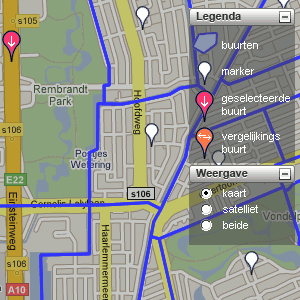 Statistics Netherlands (CBS, Centraal Bureau voor Statistiek), the government agency for statistical research, has launched a website called
 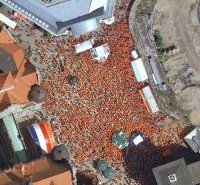 This image is a top down view of the Burgplatz (platz = square in German) in Leipzig on June 11, 2006 as seen on Google maps. We know the date, because all the people on the square are clad in orange, the colour that Dutch sports fans don whenever they wish to cheer on their national team. On June 11, the Dutch national football team was in Leipzig to play the team of Serbia-Montenegro during the 2006 world championships. The Dutch team won 1-0. (The red, white and blue flag across what I presume is the podium is a dead give away too, but probably not as visible from higher up as the orange square.)

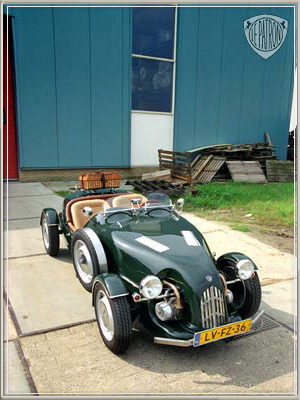 Godfried van den Bergh from Ophemert, Gelderland, has been selling his