July 26, 2008

Fence divulges all about man-nature relationship

Filed under: Architecture,Design,Nature by Branko Collin @ 7:50 am

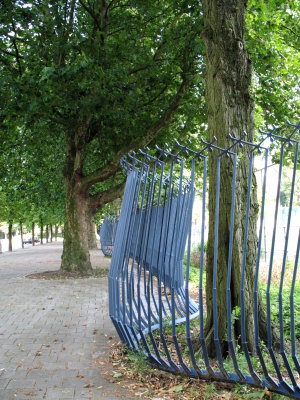
The Olympiaplein in Amsterdam is located in my neighbourhood, the Olympic Quarter. I must have walked and biked past this spot dozens if not hundreds of times. And yet when I did so last week, the oddness of this fence struck me for the first time. Its builder and designer has taken special care to curve the fence around some of the trees, but has locked other trees out. It is clear that this was done on purpose, but not why.

Perhaps this is a reflection on the power of man over nature. Trees cannot walk, but even if they could, people would get to decide where. Or, more likely, it is a statement of the power of man over man. We, the city council, decide where our fences run. If we want them to zigzag, we’ll make them zigzag. If we want them to form obscene drawings to observers in outer space, obscene drawings it is. Or perhaps the architect merely mused on the nature of borders in general, with the rows of trees forming one border, and the rows of steel mixing in in an oddly compromising way.

In the end, the solution is far more prosaic. This fence, designed by Ruud-Jan Kokke, replaced its modest predecessor in 2007. The district council had decided to cut down 78 trees to make room for the fence, and this decision led to a storm of protest. Once the district of Oud Zuid had decided to give in to the complaints, the fence builders had already started (Dutch). The decision was then reached to have the fence curve out whenever it met with a tree. And so all my philosophies proved right, in the end, though not in a way I expected.

The city commissioned Gabriele Merolli to make a series of photos of The Fence, and he put them on the web.
Tags: , , , , ,

July 23, 2008

Old mills being put back to work

Filed under: Architecture,Food & Drink by Branko Collin @ 11:26 am

The New York Times is taking a look at old Dutch windmills that are being used again for their original purposes:

Some of the renewed interest in mills is driven by the search for traditional food and drink. Patrick Langkruis, whose bakeshop, Het Bammetje, features 28 different kinds of bread and 35 different rolls, uses only flour ground by a traditional mill. “The taste is fuller, there’s more flavor,” he said. “It’s also because the grains are ground slowly.”

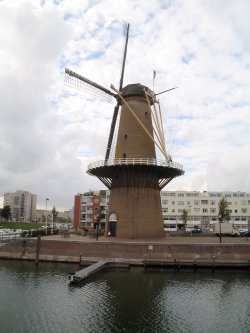
His supplier is Karel Streumer, who has been grinding out ordinary and exotic grains for the last eight years at his mill, De Distilleerketel, or distillery pot, in Delfshaven, on the edge of Rotterdam. He uses technology — huge mill stones and enormous wooden gears that make visitors feel they’re inside an immense and ancient clock — that has not changed since the mill was built in 1727.

De Distilleerketel caught fire in 1940 during fights between the Dutch army and the Nazis. It wasn’t rebuilt until the 1980s after much hemming and hawing. Because of the delay, city planners had already planned houses almost right next to the mill, which was subsequently moved 11 metres, according to the Nederlandse Molendatabase (Dutch).

Photo of De Disitilleerketel by M.Minderhoud, distributed under the GNU FDL 1.2.

Tags: ,

July 19, 2008

Why people buy the wrong house

Filed under: Architecture,Science by Branko Collin @ 2:53 pm

Earlier this year researchers from the Radboud University in Nijmegen published a paper that explored why people make wrong decisions when choices are complex, for example when buying a house or choosing a vacation. According to the authors, we over-think things. For instance, when we buy a house, we might attach a higher weight to a large room (“grandmother can sleep there when she stays over”) than to a long commute. The longer we think about this, the more scenarios we think up of what we might use the room for, adding more weight to that choice.
But the real-life importance of the room does not increase with all the uses we can imagine—it’s still going to be used a few days on average each year—whereas the long commute will become a royal drag after a while.

Another problem of over-thinking is that it tends to exaggerate framing effects. Framing is what you do when you look at choices from a certain angle. The choice for a large house can be viewed in terms of space, but also in terms of energy costs. It turns out that different frames lead to different choices, and that more framing leads to wrong choices.

The scientists suggest that if you want to make a complex decision, you still weigh all the factors, but then sleep on it for a while, until the decision just—poof—pops into your head.

(Via The Frontal Cortex. Photo by Doratagold, distributed under a Creative Commons Attribution-Share Alike 2.0 Generic license)

Tags: , ,

July 9, 2008

Biggest indoor golf venue to be built “somewhere in the Netherlands”

Filed under: Architecture,Sports by Branko Collin @ 7:42 am

One John S. Standing is planning on opening the world’s largest indoor golf centre in 2010, “somewhere in the Netherlands.” The building, shaped like a golf club, is designed by architects Zwarts & Jansma from Amsterdam who’ve worked on large sports venues before. The “head” would house the golfing facilities whereas the “shaft” would contain a hotel.

Some 20 golf simulators, a rooftop driving range with 34 bays, a restaurant, a shop, and 14,000 square meters of synthetic grass to practice one’s short game complete the picture. The centre would be called Indoor Golf Arena. According to Gizmag.com, “the location of the center has not yet been finalized, but […] talks are underway with local councils in The Netherlands […] to establish a site for the facility which is expected to attract up to 150,000 visitors a year.”

Tags:

June 24, 2008

Chapel in Utrecht converted into design flat

Filed under: Architecture,Design by Orangemaster @ 9:51 am
Zecc Architecten

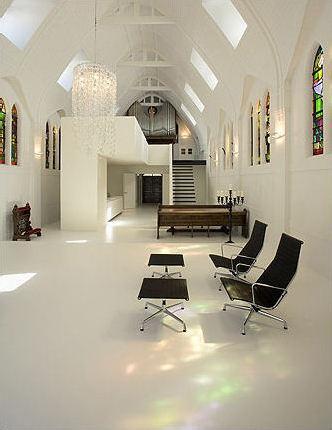
“Another great conversion by ZECC Architecten, this time an apartment in a converted chapel located in Utrecht, The Netherlands. It’s on the second floor (added?), and because there were no windows at floor level, the firm designed one to be cut into the front on the street side to bring in more light – it vaguely resembles a Mondriaan painting. Together with the original stained-glass windows and the white painted interior, the whole effect is simply amazing. The bedroom and bathroom were left dark. The original organ remains as a reference to the history of the building – it’s a nice conversation piece, that’s for sure…”

(Link and photo materialicio.us, tip: Laurent )

Tags: ,

June 5, 2008

Homeless person moved together with “his” building

Filed under: Architecture,Weird by Branko Collin @ 12:45 pm

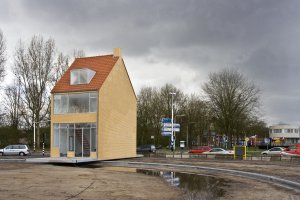
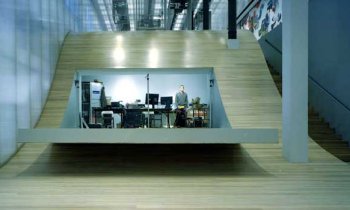
Last week a silo being moved to its final destination on the Ciboga terrain in the city of Groningen had a curious passenger, Blik op Nieuws reports (Dutch). A homeless man who had made the empty building from 1910 his home refused to leave it for the transport. The movers then decided to leave the man where he was and transport the building with him in it. The silo was put in its old location, except that it now has a parking garage underneath.
Tags: ,

April 23, 2008

Rem Koolhaas to design Prada museum

Filed under: Architecture,Design by Orangemaster @ 8:37 am
prada1.jpg

Dutch architect Rem Koolhaas has been asked to design a museum for Prada’s art collection, according to the website of Office for Metropolitan Architecture (OMA), Koolhaas’ architectural firm.

Designer Miuccia Prada and her spouse Patrizio Bertelli have bought hundreds of modern art pieces over the years and need a place to display them. They have found a place in Milan where Koolhaas is going to design three new buildings, including a tower with exhibition halls. Koolhaas has already designed the Prada flagship store in New York City (see photo).

(Link: gelderlander.nl)

Tags: , , ,

April 16, 2008

Watercity to be built in Zeeland

Filed under: Architecture by Branko Collin @ 11:54 am

[Visualisation of the new city]

Architect Taco Tuinhof proposes this city on piles to be built in the sea near Goes in Zeeland according to Bright (Dutch). The city would be called Westerschelde Water Stad. Tuinhof is currently looking for investors.

Image: Bright/RDH.

Tags: ,

April 5, 2008

Rotating house as artwork

Filed under: Architecture,Art by Branko Collin @ 1:43 pm

John Körmelings’ house on rails was unveiled yesterday in Tilburg. The artwork is an actual, yet uninhabited house on rails that travels along the inside of a roundabout, the Hasseltrotonde. Originally the speed was planned at one round per hour, and currently it is turning at that speed for testing purposes. However, the city council thought that was too fast and the house will be slowed down to 0.000758 RPM (or 1.09 rounds per day) later on.

Körmeling’s idea behind the house was to reverse roles: at a roundabout the cars tend to run circles while the background remains static.

Via Jong Nieuws (Dutch) and Eindhovens Dagblad (Dutch). Photo: Stinkfinger Producties. More photos here and here.

Tags: , ,

March 29, 2008

Anything is possible in Almere

Filed under: Architecture,Design by Orangemaster @ 11:36 am
ornithologist1.jpg

Friday, March 28, an interesting exhibition was opened at the Casla in Almere, Flevoland. It features the winning projects of the third edition of the ‘Eenvoud’ (‘Simplicity’) competition for an experimental neighbourhood in Almere. The previous editions, ‘De Fantasie’ (‘Fantasy’) and ‘De Realiteit’ (‘Reality’) were kept in the 1980s and their results are still worth seeing.

The goal of the Eenvoud competition which started in 2006 was to design a freestanding and simple low-cost house, expressing living desires and ideas. The winners were given the opportunity to build their design on a beautiful open spot in the woodlands of Noorderplassen-West. The houses have to have a permanent character, with a minimum of building regulations.

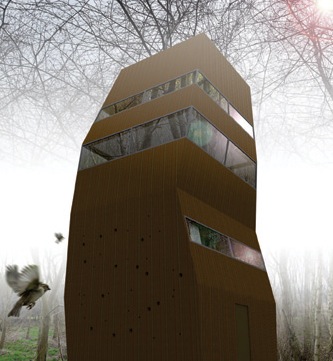
That last bit is quite ironic, considering the plethora of building regulations imposed throughout the country and the fact that Almere, a city built moslty on reclaimed land, is literally sinking. The photo shows the Ornithologist’s house, birds and all.

(Link: dysturb.net, Photo ‘Het Huis van de Vogelaar’ by Anouk Vogel and Johan Selbing)

Tags: , ,