April 7, 2008

Buran passes through the Netherlands

Filed under: Design,History by Branko Collin @ 12:02 pm


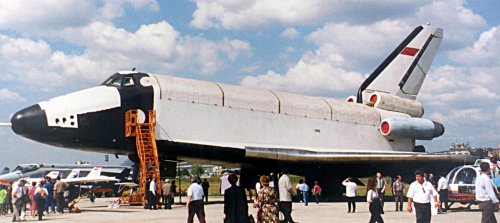
Illustration: the Buran space shuttle on display at the MAKS air show, 1997. Public domain photo by Kobel.

One of the 10 Soviet space shuttles ever built traveled through the Netherlands last weekend on its way to its final destination in Germany. The shuttle, an atmospheric test model code-named OK-GLI or BTS-02, was shipped from Bahrain to Rotterdam, and from there was moved by river barge over the Rhine to the Technik Museum Speyer in Mannheim, German.

The story of the Soviet space shuttle is one of the most interesting of our time. The Soviets saw the Americans build a space shuttle, but could not figure out what it was for. So they built their own, and found out what NASA was desperately trying to hide: that in terms of effectiveness and launch costs, the shuttle is an inferior solution to current non-reusable launch technology (nowadays NASA shuttles costs USD 1 billion per launch). Astronautix even concludes: “The cost of Buran—14.5 billion rubles, a significant part of the effort to maintain strategic and technical parity with the United States—contributed to the collapse of the Soviet system and the demise of the spacecraft.”

The OK-GLI model was never intended to be launch tested. Instead, it was fitted with jet engines so that it could take off and land on its own, and was used to test atmospheric handling of the Buran shuttles. Later it was used as a demonstration model at airshows. It was bought by an Australian company which wanted to use it for the same purpose, but while the OK-GLI was in transit in Bahrain, its owner went bankrupt and the shuttle was stored for four years in parts at a junkyard.

The re-built shuttle drew crowds on its tour through the country, according to Blik op Nieuws (Dutch). Yesterday it passed Nijmegen, its tail clipped to fit under a bridge filled with onlookers.

Tags: , , , , , , ,

March 29, 2008

Anything is possible in Almere

Filed under: Architecture,Design by Orangemaster @ 11:36 am
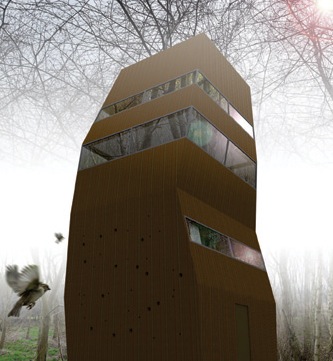
ornithologist1.jpg

Friday, March 28, an interesting exhibition was opened at the Casla in Almere, Flevoland. It features the winning projects of the third edition of the ‘Eenvoud’ (‘Simplicity’) competition for an experimental neighbourhood in Almere. The previous editions, ‘De Fantasie’ (‘Fantasy’) and ‘De Realiteit’ (‘Reality’) were kept in the 1980s and their results are still worth seeing.

The goal of the Eenvoud competition which started in 2006 was to design a freestanding and simple low-cost house, expressing living desires and ideas. The winners were given the opportunity to build their design on a beautiful open spot in the woodlands of Noorderplassen-West. The houses have to have a permanent character, with a minimum of building regulations.

That last bit is quite ironic, considering the plethora of building regulations imposed throughout the country and the fact that Almere, a city built moslty on reclaimed land, is literally sinking. The photo shows the Ornithologist’s house, birds and all.

(Link: dysturb.net, Photo ‘Het Huis van de Vogelaar’ by Anouk Vogel and Johan Selbing)

Tags: , ,

March 28, 2008

Superbus gets road trial in June

Filed under: Automobiles,Design by Orangemaster @ 10:26 am
superbus1.jpg

The Superbus, designed by former Dutch astronaut Wubbo Ockels, will get its first road trial on 25 June. The bus, which can woosh by at 250 km/h, is set to trial run on a 27-kilometer stretch of highway between Harlingen and Leeuwarden, Friesland. The highway will of course be closed for the occasion. Ockels announced the trial last Wednesday during a meeting at the head office of transport company Connexxion, one of the sponsors of the Superbus.

And yes, the Superbus does look like the famous alien designed by the H.R. Giger.

Read more about the Superbus project.

(Link: volkskrant.nl)

Tags: , ,

March 20, 2008

Sawn up furniture by Ward van Gemert on Marktplaats

Filed under: Art,Design by Branko Collin @ 2:23 pm

[photo of a sawn up chair, parts freely separated]

Rotterdam-based artist Ward van Gemert takes furniture from Marktplaats (the Dutch eBay subsidiary), saws it up into interesting compositions and sells the resulting art pieces back at Marktplaats as a set of parts. The unusable chair shown here – hanging from invisible strings – was made for Van Gemert’s final art school exam.

These days, Van Gemert creates actual, usable furniture, but still according to the same principle of redesigning the familiar. The “stretch” table below was sawn up, then reconstructed into an actual table using see-through casting resin. His art/design may look familiar if you have seen the work of Paul Verode, the man who sawed up Ferraris, whom Van Gemert once studied under.

[photo of a functional sawn up table]

Via Bright.

Tags: , , , ,

March 2, 2008

Light reading light

Filed under: Design by Branko Collin @ 12:22 pm

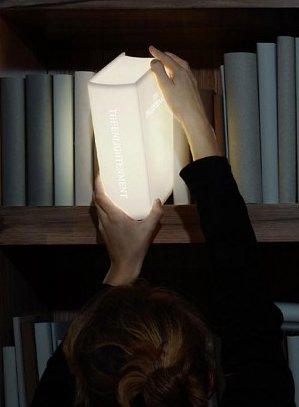
Ad agency Studio Meiboom in Harderwijk came up with this lamp in the shape of a book.
“The Enlightenment is made of white acrylic glass. It is 24 centimeter high, 17 centimeter wide and 8 centimeter deep, and is supplied with a 9 watt compact fluorescent lamp.”

“The purchase price is 89 euro. Ten percent of this goes to charity.”

Via Osocio.

Tags: , ,

March 1, 2008

Symbols as furniture in high school

Filed under: Architecture,Design by Branko Collin @ 8:17 am

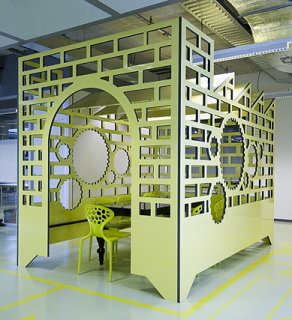
The frog once sang: it’s not easy being green. This ultra-cool reception area that Tjep designers came up with for a high school in Apeldoorn raises the question how easy it is being in green. Students get to sit on buttons of an old fashioned calculator, get to hang in “key” areas, and get to have meetings in a tiny see-through factory, all executed in bright green. The floor plan looks like a wonderful circuit board, with symbols from the realm of economics replacing plain old conductive pathways. The reception area is in the new economics building of ROC Apeldoorn, that’s why.

The design was nominated for a 2007 Dutch Design Award in the category interior design, where it was beaten by the reception area for chemicals company DSM — the ceiling-wide mirror of which just screams “illicit office sex” to me. But perhaps that’s just me. I’ll shut up now. Go watch the pretty pictures.

Source image: Dezeen Magazine.

Thank you for the tip, Laurent.

Tags: , ,

February 24, 2008

Paul Faassen: colouring outside the lines

Filed under: Art,Design,Photography by Branko Collin @ 1:59 pm

Paul Faassen is a cartoonist who juxtaposes techniques to make a point. I came across his work yesterday when I was reading an article in the online Volkskrant when something in the accompagnying cartoon (no longer available) drew my eye. It took a second but then I realized what it was: the faces of the two men men in the image were drawn fairly realisticly, but the rest of their bodies was sort of sketched in. The drawing reminded me most of connect-the-dot type drawings, where some details are already filled in. But instead of dots there had been empty space, which the child-like artist had filled in.
The rest of his cartoons are like that too. The artist has used the connect the dots idea before, though in reverse: a fully naked man is looking down at his erect … well, what is? Connect the dots and find out (NSFW?). From a photo taken at a beach of a father carrying his son, the father has been erased; the subtitle suggests that the father was a Jew. (“Daddy, am I also one of the chosen ones?” the son asks.) And then he takes it even a step further, and uses an immediately recognisable stereotype of the emancipation of graphic design: a man at cocktail party has had facial surgery, but things didn’t come out quite right; the face is all stretched out. Faassen obviously achieved the effect by using the stretch tool in Photoshop. Says the man in the cartoon: “Did it myself! On the computer!”

Tags: ,

February 21, 2008

Bonsai tree table by Anke Weiss

Filed under: Design by Orangemaster @ 7:00 am
bonsai-table1.jpg

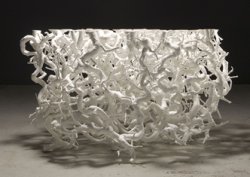
“This table, which uses 150 bonsai trees, is the result of a research project about scale. The ‘network’ structure can be found in every scale: by looking in as far as possible (cells, molecules, etc.), or by looking on the natural human scale (veins, lungs, trees, riverbeds, maps etc.), or by looking as far out as possible (solar system, galaxies). Even representations of the virtual world (the Internet) resemble this structure.”

It’s nice and scary somehow, all at the same time.

(Link: dezeen.com)

Tags: ,

February 19, 2008

Hay good looking, watcha got cooking?

Filed under: Design,Food & Drink,Sustainability by Orangemaster @ 10:17 am
wittetafel1.jpg

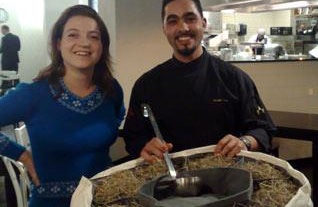
This week, patrons of the restaurant De Witte Tafel in Eindhoven will be served their meals on a hay box cooker. The restaurant wants to show people how to save energy and so they pulled out the old-fashion hay box cooker.

In this box, covered in hay, food can be simmered and kept warm, saving on gas use. According to Mounir Toub, one of the chefs, the box of hay is great for cooking.

Being very curious orange at 24 oranges, here’s what I learned about the hay box cooker:

Haybox or retained heat cooking is simply cooking a liquid based food like a soup or stew in its own heat. During WWII, cooking oil was rationed for the war effort, and so this method became popular as a way to conserve cooking fuel. They used hay in a box because the air spaces in the hay trapped in heat and allowed the soup or stew to cook in its own heat. Hay, shredded news paper, rice hulls, cotton balls, corn husks, etc., will work as long as it is packed loosely and creats air spaces.

And then of course, there probably is a risk of fire, but the green point is definitely well-made.

(Link and photo: omroepbrabant.nl)

Tags: , ,

February 6, 2008

The Netherlands to become a floating waterworld

Filed under: Architecture,Design by Orangemaster @ 10:35 am
floatinghouse

Besides making the typical mistake of saying that Holland is a country (Holland refers to two provinces, North Holland and South Holland where people do live under sea level), this is what the future might look like.

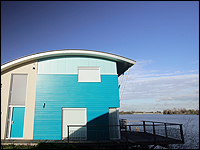
The inevitable rise in sea level that comes with climate change is going to make it increasingly difficult to control flooding in low-lying Holland. But instead of cursing their fate, architects are designing a new Holland that will float on water, and the Dutch government seems willing to try out the scheme. Holland has made other countries begin to question, too. Who says you have to live on dry land?

Chris Zevenbergen work at the Dura Vermeer firm. “The whole idea is, in our designs, we should always take into account what will happen when there’s an extreme event,” Zevenbergen says. In the past, the Dutch only built homes in places where dikes made flooding unlikely. “The concept that in fact you build in an area where a flood may occur is completely new,” Zevenbergen says.

At his office in The Hague, Koen Olthuis drums his fingers on his desk while he is fielding calls from people all over the world interested in water architecture. Olthuis is bursting with energy. He’s the co-founder of a firm called Waterstudio, a small office with a dozen or so youngish employees.

Olthuis’ projects go beyond the idea of simply keeping the house and its contents dry.

“The next step: we not only make the house floating, but we make the complete garden floating,” Olthuis says.

Why not? Why lose all those pretty Dutch tulips just because it floods? After all, Olthuis says, building floating foundations is a snap. Just fill a concrete box with some kind of plastic foam, flip it over, and you’ve got a stable platform that’s ready to float. And the more of these platforms you join together, the more stable they are. So Olthuis doesn’t plan to stop at single family homes.

“You see a floating foundation, with a garden on top of it, a swimming pool on top of it, and a house on top of it. And you can fix those floating gardens to each other, and make a floating village of it,” he says.

(Link: npr.org)

Tags: , , , ,