August 1, 2008

RFID tags used to monitor hikers’ health

Filed under: Health,Science by Branko Collin @ 8:26 am

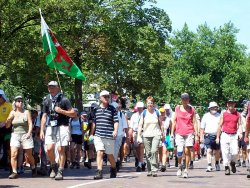
Researchers from the Radboud University in Nijmegen used RFID tags during the recent Four Day Marches to experiment with health monitoring. Volunteers were asked to swallow an RFID pill which sent the hiker’s body temperature to a receiver in their back pack every 10 seconds. The receiver would then relay that information via Bluetooth to a GPS-enabled mobile phone which in turn would forward the data to the operations centre at the university’s teaching hospital.

Using the data, the researchers could track the walkers on Google Maps, and even alert nearby walkers should a volunteer be in trouble. Radboud University was in the news earlier this year when researchers cracked and cloned London’s Oyster travel card and the Dutch public transportation card, which both used NXP’s Mifare RFID chip.

Via Engadget. Photo by Maurits Vink, published using a Creative Commons license.
Tags: , , , ,

July 29, 2008

Party tents lead 2007 summer insurance claims list

Filed under: General by Branko Collin @ 8:41 am

Party tents that got blown to shreds lead the list of 2007’s summer claims at insurance company Fortis ASR, according to Z24.
The top 5:

  1. Wind destroying party tents
  2. Laundry stolen from washing lines
  3. Stolen garden furniture
  4. Broken window panes because of sun shades blowing over or away
  5. Singe or burn damage caused by barbecues

If the wind was such a contributing factor in 2007, then why conclude that those clothes and garden furniture got stolen? Perhaps they just blew away. It’s sloppy quoting from press releases like this that gives thieves a bad rep. (That, and the fact that thieves steal).

Read what appears to be the full press release disguised as a serious journalistic article at Blik op Nieuws. Photo: Hedwig Storch, used under a Creative Commons Attribution ShareAlike 3.0 Unported license.

Tags: , , , , ,

July 28, 2008

City in a crater: Project Indigo

Filed under: Art by Branko Collin @ 4:48 pm

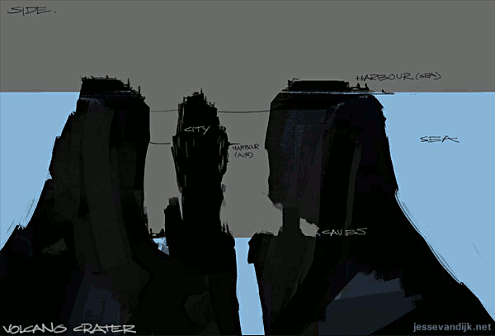
There are some beautiful images of this fantasy city, a 2007 personal project of visualizer Jesse van Dijk, at the artist’s portfolio. Van Dijk writes about this wondrous city where daylight is something only the rich can afford:

My principle idea for this city came down to a (somewhat) harmonious society with huge differences in standards of living. Because flat ground is so expensive, only the super-rich can afford to live on top of the pillar, where the climate is nice and sun-hours are plentiful.

As one descends into the pit, the hours the houses are exposed to direct sunlight daily decrease, making house prices lower, which is why the poorest groups of society live at the bottom of the pit. However, people are not neccessarily unhappy at the bottom, there are still children playing in the water, etc. While there is crime (and more of it in the poorer/lower districts) it’s a time of peace, not war.

Thanks Laurent.

Tags: , , ,

July 27, 2008

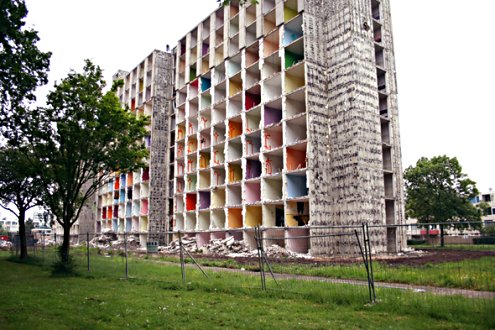
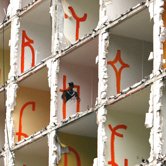
Living room colours ‘freed’ by partial demolition of apartment building

Filed under: Architecture,Art by Branko Collin @ 8:49 am

Artist Rutger de Vries, displays these images in his portfolio and offers no other explanation than the project’s name: “Art school made me do this.” (I’ve mailed him some questions, but he hasn’t answered them yet.)
Update 5-8-2008: Rutger tells some more about the project in the comments.

Via Trendbeheer.

Tags: ,

July 26, 2008

Fence divulges all about man-nature relationship

Filed under: Architecture,Design,Nature by Branko Collin @ 7:50 am

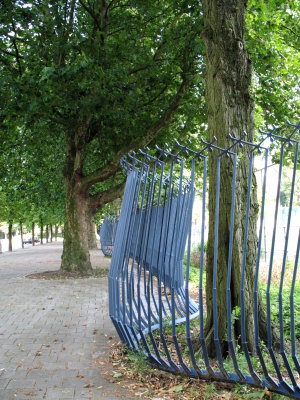
The Olympiaplein in Amsterdam is located in my neighbourhood, the Olympic Quarter. I must have walked and biked past this spot dozens if not hundreds of times. And yet when I did so last week, the oddness of this fence struck me for the first time. Its builder and designer has taken special care to curve the fence around some of the trees, but has locked other trees out. It is clear that this was done on purpose, but not why.

Perhaps this is a reflection on the power of man over nature. Trees cannot walk, but even if they could, people would get to decide where. Or, more likely, it is a statement of the power of man over man. We, the city council, decide where our fences run. If we want them to zigzag, we’ll make them zigzag. If we want them to form obscene drawings to observers in outer space, obscene drawings it is. Or perhaps the architect merely mused on the nature of borders in general, with the rows of trees forming one border, and the rows of steel mixing in in an oddly compromising way.

In the end, the solution is far more prosaic. This fence, designed by Ruud-Jan Kokke, replaced its modest predecessor in 2007. The district council had decided to cut down 78 trees to make room for the fence, and this decision led to a storm of protest. Once the district of Oud Zuid had decided to give in to the complaints, the fence builders had already started (Dutch). The decision was then reached to have the fence curve out whenever it met with a tree. And so all my philosophies proved right, in the end, though not in a way I expected.

The city commissioned Gabriele Merolli to make a series of photos of The Fence, and he put them on the web.

Tags: , , , , ,

July 24, 2008

DNA test posthumously inflicted on athlete

Filed under: History,Sports by Branko Collin @ 11:00 am

Foekje Dillema, the runner banned for life after undergoing a humiliating and undisclosed gender test in 1950, underwent another test posthumously this year. Commissioned by Dutch TV programme Andere Tijden Sport, and with permission of the athlete’s family, researchers of the Erasmus Medisch Centrum in Rotterdam found out that Dillema was a woman with a form of chromosomal mosaicism, which caused her to have two X chromosomes for every Y (possible in XX and XY configurations, though the show doesn’t tell). According to the researcher that was an extremely rare condition. The programme’s presenter claimed that nowadays Dillema would be able to compete without problems in women’s track and field events.

Reporter Max Dohle who is writing a biography on Dillema withdrew his cooperation for the Andere Tijden show after he found out about the DNA test: “The last thing you should do to Foekje is subject her again to a sex test. She would have never wanted that.” After the first test in 1950, Dillema felt extremely humiliated and she withdrew for always from public life.

Tags: , ,

July 23, 2008

Old mills being put back to work

Filed under: Architecture,Food & Drink by Branko Collin @ 11:26 am

The New York Times is taking a look at old Dutch windmills that are being used again for their original purposes:
Some of the renewed interest in mills is driven by the search for traditional food and drink. Patrick Langkruis, whose bakeshop, Het Bammetje, features 28 different kinds of bread and 35 different rolls, uses only flour ground by a traditional mill. “The taste is fuller, there’s more flavor,” he said. “It’s also because the grains are ground slowly.”

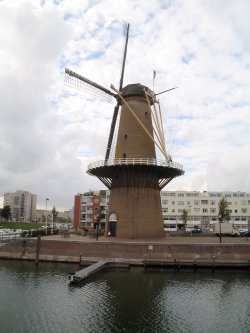
His supplier is Karel Streumer, who has been grinding out ordinary and exotic grains for the last eight years at his mill, De Distilleerketel, or distillery pot, in Delfshaven, on the edge of Rotterdam. He uses technology — huge mill stones and enormous wooden gears that make visitors feel they’re inside an immense and ancient clock — that has not changed since the mill was built in 1727.

De Distilleerketel caught fire in 1940 during fights between the Dutch army and the Nazis. It wasn’t rebuilt until the 1980s after much hemming and hawing. Because of the delay, city planners had already planned houses almost right next to the mill, which was subsequently moved 11 metres, according to the Nederlandse Molendatabase (Dutch).

Photo of De Disitilleerketel by M.Minderhoud, distributed under the GNU FDL 1.2.

Tags: ,

July 21, 2008

Bike your house around

Filed under: Bicycles,Design by Branko Collin @ 8:46 am

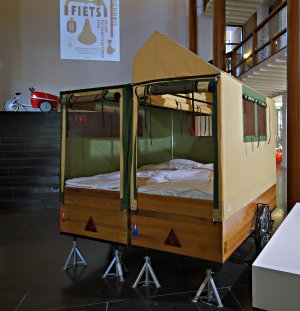
As any European can tell you, nothing says “Dutch” more than caravans … except bicycles. And so it was bound to happen that somebody would try and combine the two. That somebody was design agency Reggs’ Thijs Bouman, whose Fietscaravan reached the final round of design competition Het Beste Idee van Nederland last year. Two of these trailers can be connected to form a double bed. For something so small this looks mighty comfortable to me, although I could use some pockets for books and a reading light at the head end.
You can view this trailer and many, many modern bikes at the Designhuis exhibition Fiets, from June 22 to October 5 in Eindhoven. Via Trendhunter, which has also got photos of the bicycle roller coaster that anybody can try at the exhibition.

Photo by Designhuis / Patrick Meis. See also this Youtube video of the bicycle travel trailer.

Tags: , , ,

July 20, 2008

Gay marriage leads to new word for “maiden name”

Filed under: Dutch first by Branko Collin @ 8:01 am

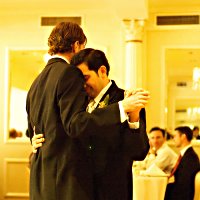
Civil servants who felt that the term “maiden name” might not be appreciated by the participants in an all-male wedding asked the Nederlandse Taalunie (Dutch Language Union) to come up with a new phrase. The Union is not in the habit of creating words but asked around (Dutch) and found out that some people had already started using “geboortenaam” (lit. birth name, and not, as one commenter at the Queerty blog would have it, gay birth name). :-)
An alternative, “geslachtsnaam” (inherited name) was rejected for being cumbersome and old-fashioned, according to the Onze Taal blog (Dutch).

Photo by CarbonNYC, distributed under a Creative Commons Attribution 2.0 Generic license.

Tags: , ,

July 19, 2008

Why people buy the wrong house

Filed under: Architecture,Science by Branko Collin @ 2:53 pm

Earlier this year researchers from the Radboud University in Nijmegen published a paper that explored why people make wrong decisions when choices are complex, for example when buying a house or choosing a vacation. According to the authors, we over-think things. For instance, when we buy a house, we might attach a higher weight to a large room (“grandmother can sleep there when she stays over”) than to a long commute. The longer we think about this, the more scenarios we think up of what we might use the room for, adding more weight to that choice.

But the real-life importance of the room does not increase with all the uses we can imagine—it’s still going to be used a few days on average each year—whereas the long commute will become a royal drag after a while.

Another problem of over-thinking is that it tends to exaggerate framing effects. Framing is what you do when you look at choices from a certain angle. The choice for a large house can be viewed in terms of space, but also in terms of energy costs. It turns out that different frames lead to different choices, and that more framing leads to wrong choices.

The scientists suggest that if you want to make a complex decision, you still weigh all the factors, but then sleep on it for a while, until the decision just—poof—pops into your head.

(Via The Frontal Cortex. Photo by Doratagold, distributed under a Creative Commons Attribution-Share Alike 2.0 Generic license)

Tags: , ,