Just like the model cars you built as a kid, only bigger! I stumbled on this artwork on the Oude Haagseweg in Amsterdam during a walk around the Nieuwe Meer last Sunday. The rust and graffiti suggest it’s been there for a while. Does anybody know who the artist is?
Update: I posted a couple more (small) photos from this walk here. I’ll post the larger versions on Flickr if and when I have the time.
Filed under: Art,Film,History by Branko Collin @ 12:05 pm
In 1998, Piet Schreuders and “a team of computer graphics experts” from Utrecht dedicated their time to recreate Main Street, Culver City in digitized 3D form. They used “historical records to design a digital version of Culver City as it looked in 1920s-era Laurel and Hardy films and other motion pictures from the Hal Roach studio,” as BoingBoing says.
Can you promote eating Dutch smoked sausage as a vegetarian? The animal activists at Wakker Dier don’t seem to have a problem with that. Jan Vayne, currently the main celebrity plugging Unox smoked sausage on television, was nominated as one of the sexiest vegetarians of the Netherlands. (Personally, I would vote for columnist Leon Verdonschot, but that’s just me.)
On the list of Dutch celebrities that claim not to eat meat, the description of Vayne reads “With his wild hair, Jan Vayne would rather sit at the piano keyboard than sit down for a plate of dead animal.” If I remember correctly, he made it pretty clear more than a year ago that sitting down for a plate of dead animal was mmm mmm profitable. You don’t see him eating any sausage on television though.
Wakker Dier is very much against the bad bad bad meat industry, but not when it comes to their annual most sexy vegetarian contest, which is quite odd. Both Wakker Dier and the Netherlands’ political party Partij voor de Dieren (Party for the Animals) held a huge campaign last year against Unox because they use pork from pigs that were not castrated under anaesthesia.
I once had a boss who claimed and acted superior because he did not eat meat, but showed up at work once, back from visiting the United States with fire engine red snake skin boots. They had midlife crisis part deux written all over them. When I told this to my best friend she said, “he doesn’t eat animals, he just wears them”.
An unnamed musician got fined recently by a social networking site (Muzikanten-in-jouw-stad, Musicians in your city) after she had aborted the registration process, according to a report by Volkskrant blogger Satuka. Though the site’s administrators would not tell the musician what the fine was for, they did present her with a list of finable offenses, among which:
Posting meaningless texts and random characters
Using bad grammar
Using something other than the local language
Muzikanten-in-jouw-stad presents itself as the online meeting place for local musicians, but Satuka’s blog entry suggests it’s mostly a place for extracting hard-earned cash from those unlucky enough to register. Last week she wrote that a friend was fined 10 euro after not finishing her registration. The friend had gotten tired of the large number of obligatory fields on the sign-up form, and had started to enter non-sensical texts. When the site told her—still during the “free” sign-up process—to call an 0900 number and record some demo music for the mere sum of 40 euro, the friend decided to abort.
As a result she received an e-mail “a little while later” (Satuka’s entry is nothing if not vague), which claimed that she had violated the site’s General Terms & Conditions and that she therefore had to pay a ten 10 fine.
You should send a reminder before you fine people, not during,
If you want to fine people you should not leave any mention of fines out of the T&C, and
The T&C are invalid in their entirety because they are presented in a pop-up window without the possibility of saving the T&C to a local medium.
I’d like to add that the musician never finished the registration process, so you have to wonder what legal obligations she has towards the site. I’d guess none, but IANAL. Also, I was told by reputable legal scholars that only courts can impose fines. Engelfriet suggests Satuka’s friend tell the networking blog to take a long walk off a short pier, though in politer and legally binding terms.
Today’s special rich creamy irony sauce: the letter that claims the social networking site can fine you for bad grammar is full of, yes, you guessed right, examples.
Yes, it’s been on for a while, but the current exhibition Bureaucratica, quoted by The Wall Street Journal as “a surprisingly compassionate view of the ways in which individuals inevitably resist all efforts to impose one single standard of behavior,” is on display at the Kunsthal in Rotterdam until 14 December 2008.
The exhibition features the work of photographer Jan Banning who photographed bureaucrats from countries such as India, France, Liberia, the US, and Russia from 2003 to 2007.
Stolen credit card data for sale in user-friendly web shop
Zembla, the news show of Labour broadcaster VARA, bought stolen credit card data from a Russian website and used those data to purchase goods. Director Ton van der Ham told Webwereld: “The site is hidden behind a login. You can search credit cards by country and card type, and then you select a data package which you can pay for online. It’s almost unreal.”
The program got permission from the credit card holders before making the what Webwereld calls “fraudulent” purchases. Either Webwereld knows something about fraud that I don’t, or it’s trying hard to become the Telegraaf of Dutch tech news sites.
In 2006 investigative news show Zembla took claims of 9/11 conspiracy theorists serious by testing them. It concluded most of the claims were unfounded. The show is also famous for “exposing” (the news was not news to a limited circle) that politician Ayaan Hirsi Ali had lied in her asylum claim, which led to her resignation from parliament.
Serious satire
Perik is a copywriter who, when he noticed that he could write 2000 words about anything, decided to quit and become a bartender. The writing bug has never left him though, and now he is blogging satirical pieces at Sargasso. And darn it, he is good! Today he caught me unawares with his (fake) report about a banned ad in which fathers are encouraged to spend more quality time with their children. The ad is titled: “Who is this whiny broad anyway?” and in Perik’s world raised a storm of protest from the child protection board, which, as everybody knows, “has been campaigning for a radical feminization of the child rearing domain for almost a century.”
Disclaimer: the entire 24 Oranges editorial team has shared alcoholic beverages with Perik, so our conclusion that he’s a good egg might be somewhat clouded by the aforementioned beverages.
What Dutch space travel would look like
(From a 1983 ad for pot plants.)
Via Trendbeheer. Disclaimer: we’ve also shared alcoholic beverages with Trendbeheer contributor Jaap Verhoeven. At the same parties! What can I say? We like our drinks, and we go to the right parties.
OK, so I am going to throw these numbers at you without any attempt to explain why they are what they are, and without stating whether I think these reflect well or not on Dutch society, as my experience is that people tend to interpret such statistics along political lines anyway, regardless of my interpretations. TNO released a study last week that shows the Dutch would prefer to work somewhere between 25 and 28 hours per week. Earlier studies (Dutch) showed that the Dutch already put in the least amount of hours per week across Europe: 33 hours. A relatively large percentage of the Dutch work part-time (40%), and the Dutch also belong to the Europeans with the most irregular hours.
The Netherlands is also the country where most of the wages are fixed: paying somebody according to how productive they are hardly occurs here. The preferred increase of working hours is a function of the amount of hours a person already works (duh!). Interesting to see in TNO’s graph though is that only the more or less unemployed would like to work more, and only those that put in more than 40 hours a week would like to work less. People that work from anywhere between 8 and 40 hours a week seem pretty OK about the time they put in.
The study called Nationale Enquête Arbeidsomstandigheden (National Poll Working Conditions) is a collaboration between TNO and Statistics Netherlands, is repeated each year and involves questioning 25,000 members of the Dutch work force. The European working conditions study over 2007 referred to by Intermediair is fascinating reading.
“The ban on the sale of fresh hallucinogenic mushrooms in the Netherlands is set to come into effect on December 1, the AD newspaper reports today. The paper says ministers are expected to vote in favour of the plan at today’s cabinet meeting. The sale of dry mushrooms in ‘smart shops’ is already banned. Health minister Ab Klink said last year he planned to ban mushroom sales following a string of incidents involving tourists. According to Amsterdam health service figures, ambulances were called out 128 times last year to deal with people who had eaten hallucinogenic mushrooms.”
Filed under: Automobiles by Branko Collin @ 8:25 am
Last year the government raised the age limit for compulsory education from 16 to 18 years, but 16 year old Robbin Robijn probably could care less. He no longer has to go to school, because the government has just given him an exemption. Reason: the success of his company. Robijn, living in a village called De Kiel in Drenthe, turned 16 last month, and for the past year has been selling microcars of a type known as brommobiel—a car that’s legally a moped, and that’s not allowed to go faster than 45 kph.
The teenager discovered a market for microcars when he bought one off the internet last year, fixed it, and sold it for a handy profit. “Selling is in my blood,” he told Z24, “I’ve been doing it since I was ten. First chickens and rabbits, and now microcars.”
A Dutch friend of mine, Bente, who now lives and works in New Orleans (of all places!) and who didn’t sleep much last night, hung out at a few places, and everywhere she went, she watched the results with a full house of serious Obama fans.
Allow me to freely translate some of her thoughts:
It’s a historical day in America. More than we sober Dutch people realise. Today a black president was elected.
That Obama is not a real African-American – his father was a Kenyan student in Hawaii and his mother was a white American – barely makes a difference. The man has coloured skin so he’s black and here this means that you’re “one of us” (at least for African-Americans). For many conservative white people, it’s just as bad: the man is black and therefore evil.
That the colour of one’s skin is so important never ceases to amaze me, but here it’s a fact. Obama’s tint has united many and as of today every black kid can grow up with the idea that they too can become president.
I was never this happy about an election result in the Netherlands, but this really touched me. Not because I think the man is a saint or will bring about worldly changes. No, he’s going to have a tough time, and if he survives this, I’ll be impressed. However, the hope he gives people, especially African-Americans is something no one can take away from them. And who knows, maybe something will really change.
UPDATE: The photo credit is always of who takes the picture, not of who is in it!





 An unnamed musician got fined recently by a social networking site (
 Stolen credit card data for sale in user-friendly web shop
 OK, so I am going to throw these numbers at you without any attempt to explain why they are what they are, and without stating whether I think these reflect well or not on Dutch society, as my experience is that people tend to interpret such statistics along political lines anyway, regardless of my interpretations. TNO released
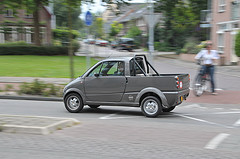 Last year the government raised the age limit for compulsory education from 16 to 18 years, but 16 year old Robbin Robijn probably could care less. He no longer has to go to school, because the government has just given him an exemption. Reason: the success of his company. Robijn, living in a village called De Kiel in Drenthe, turned 16 last month, and for the past year has been selling microcars of a type known as brommobiel—a car that’s legally a moped, and that’s not allowed to go faster than 45 kph.