


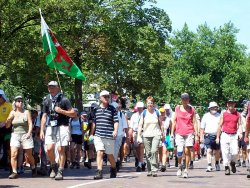
 Researchers from the Radboud University in Nijmegen used RFID tags during the recent Four Day Marches to experiment with health monitoring. Volunteers were asked to swallow an RFID pill which sent the hiker’s body temperature to a receiver in their back pack every 10 seconds. The receiver would then relay that information via Bluetooth to a GPS-enabled mobile phone which in turn would forward the data to the operations centre at the university’s teaching hospital.
Using the data, the researchers could track the walkers on Google Maps, and even alert nearby walkers should a volunteer be in trouble. Radboud University was in the news earlier this year when researchers cracked and cloned London’s Oyster travel card and the Dutch public transportation card, which both used NXP’s Mifare RFID chip.
Via Engadget. Photo by Maurits Vink, published using a Creative Commons license.

 Party tents that got blown to shreds lead the list of 2007’s summer claims at insurance company Fortis ASR,


 Artist Rutger de Vries, displays these images
 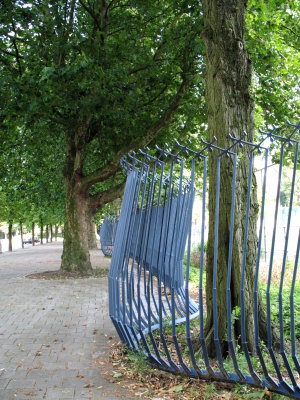 The Olympiaplein in Amsterdam is located in my neighbourhood, the Olympic Quarter. I must have walked and biked past this spot dozens if not hundreds of times. And yet when I did so last week, the oddness of this fence struck me for the first time. Its builder and designer has taken special care to curve the fence around some of the trees, but has locked other trees out. It is clear that this was done on purpose, but not why.
 Foekje Dillema, the runner
  The New York Times is taking a look at

