

 Former parliamentarian James Sharpe of the right-wing extremist Freedom Party (PVV) won an injunction against free newspaper Spits last week.
Spits is no longer allowed to call James Sharpe a ‘porn baron’. The epithet is ‘biased and unnecessarily hurtful’, internet lawyer Arnoud Engelfriet alleges.
One imagines the porn industry will be elated to see itself officially disassociated from Sharpe by a court of law.
Sharpe, son of a black immigrant and married to a Romanian woman, won a seat in parliament on a platform of hatred against immigrants, but resigned his seat when it became clear that he had lied about his Hungarian porn empire having a run-in with the law. This was during a time when Freedom Party front man (and single member) Geert Wilders still tried to get rid of representatives with a shady past—until he realised that this way he would soon be running out of viable candidates.
(Image: the Freedom Party logo. Any association with the logo of the Dutch Nazi party is, I am sure, as coincidental as flying the Dutch Nazi party flag.)
 Free newspapers have been a successful part of the Dutch landscape for a while now, and sometimes a bit too much so. The railway stations and trains especially are littered with discarded copies. Sometimes that can be useful (if you do not have the time to grab a copy from an official dispenser), at other times finding a place to sit among a sea of paper can be a nuisance.
  A row in Dutch comics land! About a month ago newspaper Parool called for fresh cartoonists and then told them that it would not pay them for their work.
 The amount of children under the age of 18 in psychotherapy has increased by 50% in two years, Volkskrant reports. The paper writes that “insurers such as CZ and Achmea” have noticed the trend.
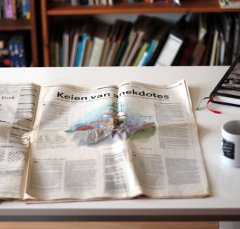 Last Thursday, the Dutch national library opened its repository of digitized Dutch newspapers from the period 1618 to 1995.
 No law or decree has ever been valid in this kingdom until after publication in the Staatsblad (laws) or Staatscourant (other government decisions with the force of law). That is, until July 1st of this year, when the paper editions of Staatsblad and Staatscourant were abandoned and a law came into force that allowed electronic publication of laws and decrees.