European inland navigation has language problems. Unlike international aviation, which uses English as the language of communication and has had plane crashes when people have not been able to speak it properly, inland navigation doesn’t have a rule about using a set language and so accidents continue to happen.
Many inland navigation organisations feel that the common language should be German simply because most inland waters are in German-speaking territory. However, speaking German instead of English with seafaring ships isn’t practical.
As of 1 January 2010, the Dutch Ministry of Transport and Waterways can issue fines to boats who don’t meet language requirements. What those are, nobody knows: learning terms off by heart or being able to chat about the weather? The Dutch Ministry issued a 240 euro fine to a French ship earlier this month for not being able to communicate enough in either English, German or Dutch. Needless to say the captain was really pissed, after 20 years of navigating to the Netherlands without any incidents. He didn’t know about these requirements because he had no problems before. And then other ships were also fined. The Dutch immediately thought that the French would reciprocate, which is not surprising. Never mind communicating on water, apparently the Dutch government isn’t able to communicate with Dutch shippers or European ones properly either.
One of the comments mentioned that it was silly for the Dutch to speak English among themselves if the official language was to be English. Again, aviation does that too. You first clear your business with the tower about where and when you will land, nasty accent and all, and then you can throw in a sentence of local language to show you’re friendly. It doesn’t bother pilots at all, it shouldn’t bother shippers either, eventually.
Filed under: Nature,Science by Orangemaster @ 3:13 pm
The island of Ameland off the Dutch coast is a popular tourist destination for the Dutch and many a foreigner. To get there you take a ferry boat, which sounds like a lot of fun, especially in the summer. I wouldn’t really know about the ferry, as on a 30 degree Celsius day a few years back, I had the chance to fly there and this was my view. Seeing the hordes of bunny rabbits scurry when a plane lands is hilarious and the runway has white plastic cans to ‘indicate’ where the runway is.
Mathilde Jansen researched the Ameland dialect for years and came to the following conclusions. ‘Amelands’ is mostly Frisian (an actual language, not a dialect) mixed with modern Dutch. Contrary to dialects on nearby Dutch islands, Amelands is also spoken by the kids, and not just the old folks. There are also East-West differences, only discernable to the real pros.
And about the old men: they still speak the most authentic version of the dialect, according to Jansen. She also says that previous research shows that men in general prefer to speak local dialect, while women opt for ‘regional and standard variants’.
Husein Mujagić survived the Omarska camp in the Bosnian war and now lives in the Dutch province of Limburg. To help him deal with his memories, he wrote a Dutch-Bosnian/Serbian/Croatian dictionary. This description didn’t come over as straightforward, so I will elaborate. Roughly, Bosnian is what people speak in Bosnia and Herzegovina, Serbian is spoken by Serbs and Croatian by Croatians. It’s way more complex, as Serbo-Croatian was long taught as one language, but that is slowly being spilt apart for cultural reasons. Yes, everybody understands each other, but there were reasons why the country split up into so many parts.
Mujagić was a math teacher in his own country and since he could not easily find work without speaking good Dutch, he worked as a janitor at a school. He’s always wanted to help children learn, and this two-part dictionary was his way of helping them do so, as he started with words his children would know. Both his sons are well-employed and are doing well, something Mujagić is very proud of.
After 10 years, his dictionary has more than 3,000 pages, but he only had some 100 copies printed for friends and family, Bosnian and Dutch. He alo reassures the Dutch that with his dictionary, they can make themselves understood in Bosnia and Herzegovina, Montenegro, Croatia and Serbia, now all seperate countries.
Different but yet similar, last year we posted about a Dutch missionary in Malawi who wrote a English-Chichewa dictionary.
Filed under: Literature by Orangemaster @ 11:14 am
In November, we told you that Twitteren (‘to Twitter’) was chosen as the Dutch Word of the Year by the Onze Taal (’Our Language’) congress in Utrecht.
Well, now that the year is almost over, Onze Taal together with newspaper De Pers and Van Dale (they make the Dutch dictionary) have chosen ‘ontvrienden’ (‘to unfriend’) as the Word of the Year 2009. The New Oxford American Dictionary’s Word of the Year 2009 is also ‘unfriend’, which like in Dutch means “to remove someone as a friend on a social networking site”. When they explain it they use Facebook as an example of a social networking site and in Dutch they keep it local and say Hyves.
Whether you prefer ‘Twitteren’ or ‘ontvrienden’, they both go to show how much of an impact social media has had on language, never mind IT as a general rule over the last 20 years. Like the Oxford people say, ‘unfriend’ definitely has ‘lex-appeal’.
Filed under: Literature by Branko Collin @ 8:05 pm
I just got back from the Onze Taal (‘Our Language’) congress in Utrecht, where the word ‘twitteren’ was elected Word of the Year 2009.
The word, which simply means ‘to twitter,’ was chosen over Koninginnedagdrama, the deeply racist kopvoddentax, Mexicaanse griep and vuvuzela by 600 of the attendants. Another candidate was mama appelsap, for a misheard lyric. Mama appelsap literally means “mother apple juice,” but is Michael Jackson’s misheard lyric “Mama-se, mama-sa, ma-ma-coo-sa.”
The 27th congress featured talks about language by Princess Laurentien, writer Kristien Hemmerechts, and performances by comedians Paulien Cornelisse and Kees Torn.
The Tokkie family is suing dictionary makers Van Dale—the Dutch Duden / Larousse / Webster / what-have-you—for 50,000 euro over the inclusion of their family name with the definition “anti-social behaviour.” The Tokkies are also suing weekly Revu according to Telegraaf (Dutch), although the newspaper doesn’t quite explain why.
The Tokkies gained national fame notoriety in 2003 when they had a friendly chat with their neighbours set their neighbours’ house on fire. This drew the attention of the IKON broadcaster who followed the family around for a documentary series (Dutch). Turns out that the few families that occupy that particular part of the Slotermeer neighbourhood in Amsterdam have been living in a state of war for twenty years.
The documentary drew the attention of the country, and while a court evicted the Tokkie clan for anti-social behaviour, the family capitalized on their newly gained fame by making a Christmas song, a carnival song and hiring themselves out as famous Dutch persons. But their fame dried up, and when earlier this month the city of Rotterdam introduced a behavioural test for anti-social tenants that it dubbed the Tokkie-toets (NRC, Dutch), the family declared it had enough of its bad image, and sued the dictionary makers.
Filed under: Food,General by Branko Collin @ 2:22 pm
Dunglish.nl, one of Orangemaster’s many ventures, posted this brilliant ad for Unox pea soup a while ago. In it, you see some sort of sales manager walk through a company cafeteria while holding a bluetooth-enabled phone conversation in that lingua franca of the Dutch business world, English with sprinklings of Dutch. When it matters though — that is, when he wishes to order pea soup — he switches to all-Dutch.
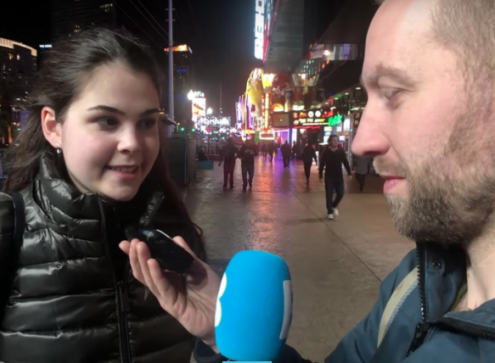
Yesterday on telly (Nova) I saw a report about how Poles were getting on in Rotterdam. Once they showed the Polish food store (ethnic groups are often automatically associated with their food), I watched the rest. What I heard was well educated, normal looking Europeans who just happen to have crappy jobs that apparently pay less than minimum wage in 40% of cases and homes that are overpriced and crowded. As well, some 50% want to stay in the Netherlands because their chances are simply better. Some politicians says this will prepare them for the next wave of Eastern Europeans (Bulgarians and Romanians) who are due to arrive soon. These people are more often than not highly educated, speak several languages and do jobs the Dutch apparently have the luxury to refuse to do. They are not illiterate housewives or too old to integrate.
Then I found this recent article that reads “Poles speak English too well”, which is some weird complaint. On telly, they said that many Poles came to the Netherlands from England and Ireland, so it is logical that they speak some English. The article, however, basically points out that setting up Polish lessons for employers (known as reverse integration and highly criticised) is a waste of time if the Poles speak English. The people setting up these courses could have known this if they 1) bothered to get information from the Polish community like the telly did and 2) looked further in Europe than their own miniscule backyard.
And remember, when the Poles do stay they are obliged to learn Dutch anyways, so communication will be even easier! It seems the municipalities and the people setting up courses could use some serious cultural communication lessons themselves. Poles often speak Polish, some Russian and/or German, English and even other languages like French. Ah but learning Polish was a way to make money which backfired big time hence the complaint.
Filed under: Dutch first by Branko Collin @ 8:01 am
Civil servants who felt that the term “maiden name” might not be appreciated by the participants in an all-male wedding asked the Nederlandse Taalunie (Dutch Language Union) to come up with a new phrase. The Union is not in the habit of creating words but asked around (Dutch) and found out that some people had already started using “geboortenaam” (lit. birth name, and not, as one commenter at the Queerty blog would have it, gay birth name). :-)
An alternative, “geslachtsnaam” (inherited name) was rejected for being cumbersome and old-fashioned, according to the Onze Taal blog (Dutch).
A Flemish study which showed that the Dutch talk faster than their Southern neighbours was shot down rapidly by Dutch experts when it was first published in 2004. But four years later linguist Hugo Quené from the University of Utrecht has proved his Flemish colleagues right. Quené used new methods to pick apart the 38-hour speech corpus and used a recently developed statistical method, multi-level analysis. As it turns out long “phrases” (bits of speech separated by pauses) take relatively less time to pronounce than short ones. Even so, the Dutch tend to use shorter phrases than the Flemish. Also when phrases of the same length were compared, the Dutch proved to be the fast talkers.