
Cardboard Mechanics Installation from Sasj on Vimeo.
Cardboard Mechanics mady by Saskia Freeke, Fin Kingma, Davy Jacobs and Sonja van Vuure of the Utrecht School of Art and Technology.
(Link tip: The Presurfer)


June 16, 2010
Cardboard Mechanics Installation from Sasj on Vimeo.
Cardboard Mechanics mady by Saskia Freeke, Fin Kingma, Davy Jacobs and Sonja van Vuure of the Utrecht School of Art and Technology.
(Link tip: The Presurfer)
June 15, 2010

On Wednesday 16 June, the Dutch defense department will be showing off the very first helicopter that flies on biofuel. A Boeing Apache AH-64D helicopter of the Royal Netherlands Air Force will fly on biofuel above the military Gilze-Rijen Air Base, located in Noord-Brabant, between the cities of Tilburg and Breda.
During the demonstration flight, one of the Apache’s engines will run on a mixture of fossile fuel and biokerosene, of which 90% of this kerosene comes from discarded cooking oil and 10% algenol, biofuel made from algae that is still very new.
This is a picture of an Apache, most probably somewhere in the United States.
(Link: blikopnieuws, Photo of AH-64 Apache helicopter by nathanm, some rights reserved)
Tags: biofuel
June 14, 2010
Dutch World Cup ads continue to rib the Germans. Paint manufacturer Histor came up with a ‘paint whisperer’ who can tell how happy a room is:
Tags: advertising, football, Germany, orange, paint
 The number of Dutch tourists planning to spend their summer holiday in Greece is down 10% from last year. Competing countries like Spain and Turkey are up from last year, travel agent Steven van Nieuwenhuizen of D-Reizen told De Pers.
Competitor Jonas de Groot of Sunweb has noticed the same trend. “The people who are still picking their destination at this time of the year aren’t too choosy about where they go. They will gladly pick another Mediterranean beach.” According to De Groot, the booking rate for Greece stayed the same throughout the news of the impending bankruptcy of the country, but it was the news of the massive unrest and strikes that has cooled the Dutch tourist’s enthusiasm for Greece.
Hundreds of thousands of Dutch people spend their holidays in Greece each year.
(Photo by Jon Rawlinson, some rights reserved)
Tags: economic crisis, Greece, holidays, travel
June 13, 2010
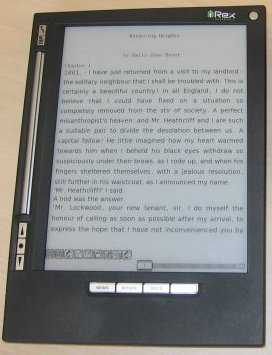 In 2006 I borrowed Orangemaster’s camera, hopped on the train to Eindhoven, and visited a start-up at Philips’ famous High Tech Campus to look at its single, yet to be released product, the Iliad e-reader. Today I learnt through newspaper FD that the former start-up Irex has filed for and received bankruptcy (Dutch).
The Iliad was an E Ink based tablet computer suited mainly for reading, hence the name. At the time, only Sony had a comparable device, the Librié.
Irex’s goal was to replace paper, not necessarily to compete with similar e-readers for consumers. To that effect, its reader had a larger screen and it could also be written to using a stylus. The company left selling books to third parties, expecting content providers to bundle the Iliad with their products. The intended customers for the device weren’t novel readers, but students, lawyers and others used to toting around kilos of text books and note pads each day.
Later, Irex also turned to the consumer market, where it had to compete with the Kindle, the Apple Ipad and the newer Sony devices, and even the Bebook, another Dutch brand of e-reader. Apparently, trying to introduce its latest consumer device in the USA is what broke the camel’s back. Disappointing sales due to a late FCC approval (only after the Christmas season) meant that Irex’s cash flow dried up,
The good news is that besides its cash flow problem, Irex is apparently in good health, and has a lot of intellectual capital. The type of bankruptcy that they have filed for and received last Tuesday, called surseance van betaling, does not mean the end of the company but merely a temporary stop of its obligation to pay bills. Irex owes more than 5 million euro, mostly to Deutsche Bank. FD reports in a follow-up article that lots of other companies are interested in buying the outfit.
See also:
June 12, 2010
Job Cohen, Dutch Labour Party leader and until March this year Mayor of Amsterdam, shows us his football moves. Yes, it’s an old film, but hey, sharing is caring.
The action kicks in at 0:32
That was only one game, of course, but it seemed to bring into focus what I had been observing at the Ajax youth academy, as well as learning about American soccer. How the US develops its most promising young players is not just different from what the Netherlands and most elite soccer nations do — on fundamental levels, it is diametrically opposed.
Americans like to put together teams, even at Pee Wee level, that are meant to win. The best soccer-playing nations build individual players, ones with superior technical skills who later come together on teams the US struggles to beat. In a way, it is a reversal of type. Americans tend to think of Europeans as collectivists and themselves as individualists. But in sports, it is the opposite. The Europeans build up the assets of individual players. Americans underdevelop the individual, although most of the volunteers who coach at the youngest level would not be cognizant of that.
Michael Sokolove (what’s in a name?) takes a long hard look at what makes the youth academy of Amsterdam’s professional football club Ajax tick, and how this contrasts with the system in the USA.
A very interesting read, even though (or perhaps because of) the author at times keeps a lot of distance from what he essentially describes as something close to modern slavery.
(Photo by Patrick de Laive, some rights reserved. Shown here are Wesley Sneijder and Rafael van der Vaart in national garb. Both players rose through the ranks of the Ajax youth academy to become world stars. Link: Eamelje.net.)
Tags: Ajax, Amsterdam, business, children, football, slavery
June 11, 2010

A woman from Hoogezand near Groningen recently showed up angry at the doctor’s office with the cremated remains of her dead husband who died seven months ago. She had been receiving reminders from the doctor for her husband to get a flu shot and for a bone density scan.
The ‘missing link’ in this story is that for whatever reason, the doctor’s office did not know or had not yet entered the death of this woman’s husband in their mailing database. The assumption is that this was communicated to them, but not dealt with, although it could be the woman’s fault, I don’t know.
“My husband could only participate in the bone density scan if he had recently shrunk by three centimetres and weighed less than 60 kilos. Since he’s been in an urn for months, he meets the requirements,” said the widow.
This is dry Dutch humour at its best. The nurse who handles the scans apparently didn’t appreciate the humour at all.
(Link: rtvnoord.nl)
Tags: humour
June 10, 2010
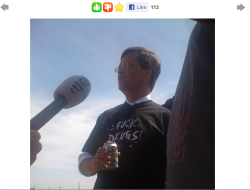
Here’s a Skype conversation between two 24oranges bloggers yesterday, while watching the Dutch national election results:
Branko: “that is so not shopped” (the above picture)
Orangemaster: “It isn’t!! I saw the item on telly!”
Here’s proof: another photo, taken by a legitimate news source.
Branko: “I guess he just doesn’t give a shit anymore. Is he the guy who coveted a job in Europe?” (as in, if I can’t be Prime Minister (power is addictive), I’ll try for some job at the EU level, which he didn’t get because people don’t like him there either!)
Orangemaster: “He’s going doooown tonight.”
Freshly ousted Dutch Prime Minister Jan Peter Balkenende (in the pic), who has just caused a historic loss for his Christian-values peddling party, is wearing a T-shirt with a big swear word and is drinking the worst drug kids will probably ever encounter in their lives: alcohol.
Balkie, as we call him, was visiting the picturesque fishing village of Volendam, where ironically, the youth are bored to tears, drink themselves into a stupor and take lots of drugs when beer doesn’t do the job. But much like Balkie himself, they close their eyes to how people view these problems (total lack of self-relfection), look at the scenery of their touristic village and act like every is fine.
I gladly use this photo taken by Michael Sijbom, ironically (and I laugh writing this), campaign strategist for Balkie’s political party who needs as much image rebuilding as Rotterdam did after WWII.
Tags: beer, drugs, Jan Peter Balkenende, Volendam
June 9, 2010

Coming to a theatre near us: On 1 July, surgeons of Amsterdam’s Slotervaart hospital are going to perform a laparoscopic gastric bypass, a stomach operation that is done through small incisions, and project it live in the capital’s Pathé Tuschinski theatre. The operation is a big matinee from 8:30 to 11:30 and will be performed on someone who is obese and needs the operation to survive. According to the hospital, it is a ‘very difficult operation that is only performed by a few Dutch hospitals’.
The audience will be able to ask questions about the operation to a doctor in the room who will then ask the surgeons performing the surgery.
Tickets are free, scroll down here to Gastric Bypass to send an e-mail and score some tickets.
(Link: Depers.nl)