Miep Gies, the woman who was important in Anne Frank’s life and pivotal in what we now know about Anne Frank turned 100 yesterday. In 1942, when the Frank family looked for a place to hide, Miep Gies, her husband Jan and three others helped the Franks stay hidden in the Achterhuis. Then, when through betrayal the Franks were taken to concentration camps, Gies managed to hide Anne Frank’s diary from the Nazis with the idea of giving it back to Anne after the war.
As a result, the world can now put a face to one of the millions that were murdered.
Even without the meddling of evildoers not many are given to live to a hundred. Sometimes karma just works. Miep, I hope you had a very good 100th birthday.
You may have heard yesterday that New York City is celebrating is 400th anniversary and Amsterdam’s Mayor Job Cohen was there to give a speech. You may also have heard about the gift the Dutch are going to build in the form of a pavilion called New Amsterdam Plein & Pavilion, designed by Ben van Berkel. It will be built in Battery Park, the Southern most point of Manhattan and “be shaped like a flower or a windmill, depending on your perspective.”
“Pioneers from Amsterdam settled into the Manhattan area and planted the seeds of democracy, entrepreneurial spirit, freedom of expression and freedom of religion in what we now know as New York, the unofficial capital of the world,” Mayor Cohen of Amsterdam said. “Amsterdam and New York share a commitment to quality of life. Amsterdam and New York share the same DNA.”
It doesn’t matter at all that Henry Hudson was an English explorer who just happened to be on a Dutch vessel trying to find a passage to Asia. Location, location, location.
The municipality of Haren in Groningen is considering outlawing the use of metal detectors, Groninger Internet Courant reports (Dutch). The town council wants to prevent people from digging up corpses and ammunition in the Appelbergen forest, where the Nazis buried 34 people they shot in retribution. Fifteen of those victims were never found.
A spokesperson of the municipality told GIC.nl that “The police regularly discover treasure hunters who think its exciting to search the forest. Though the chance is small, we don’t want them to start digging and find human remains. There’s a much bigger possibility they will find ammunition, also because the forest is a practice area for the army. That could lead to dangerous situations.”
The daughter of photojournalist Nico Koster found a series of unique pictures in some box with old baby pictures of the world-famous ‘Bed-In’ that John Lennon and Yoko Ono held in March 1969 at the Hilton Hotel in Amsterdam. Koster, who works for the Dutch paper De Telegraaf, had lost the precious negatives of an exclusive photoshoot he had in Room 902 (some sources say 702) of the Hilton Hotel.
And when you’re Canadian like me you know more about the Montreal Bed-In, which took place in May 1969 because of the song that was spontaneously recorded there, Give Peace a Chance.
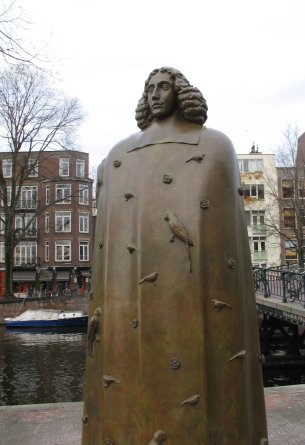
The unveiling of a very prominent statue of philosopher Baruch Spinoza in Amsterdam took place Monday, 24 November in the presence of the city’s mayor, Job Cohen. It has been placed on the Zwanenburgerwal near the Stopera (the city’s opera house), which is at the entrance of the former Jewish quarter where Spinoza grew up. The statue was crafted out of bronze by Nicolas Dings and the head was specifically made to match the one on the former 1000 gulder banknote.
Our very own roving reporter and photographer Branko Collin says that, “according to a radio item this morning, the symbols on the cloak – the roses, parakeets and sparrows – stand for Spinoza himself, immigrants (a reference to the parakeets in Vondelpark) and natives (sparrows are a diminishing breed).”
Filed under: Art,Film,History by Branko Collin @ 12:05 pm
In 1998, Piet Schreuders and “a team of computer graphics experts” from Utrecht dedicated their time to recreate Main Street, Culver City in digitized 3D form. They used “historical records to design a digital version of Culver City as it looked in 1920s-era Laurel and Hardy films and other motion pictures from the Hal Roach studio,” as BoingBoing says.
Amsterdam is 200 years older than is commonly assumed, says historical geographer Chris de Bont. The settlement was originally started in 1000 AC instead of 1200 AC, which is still pretty young. De Bont bases his conclusion on the patterns formed by old brooks. “I found the same patterns elsewhere in the region where farmers lived around the time,” De Bont told print daily Metro, “so it’s logical to assume that farmers also created the patterns in Amsterdam.”
According to Volkskrant, De Bont also claims that parts of the rivers Amstel and Zaan were dug, and that the IJ used to be a big swamp instead of a waterway. De Bont’s assertions are part of his PhD thesis which he gets to defend next Tuesday at Wageningen University.
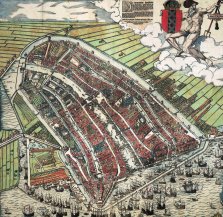
Illustration: one of the earliest city maps of Amsterdam (1544) by Cornelis Anthonisz. after one of his own paintings. Check the larger version at Wikimedia Commons, it’s pretty detailed and a great demonstration of how little the inner city has changed in 500 years (they built a McDonald’s in the Kalverstraat and that new-fangled ‘palace’ on Dam Square, and that’s about it).
According to De Telegraaf, The Dutch government had no objections to the house where Anne Frank wrote her wartime diary being torn down in the 1950s. The place where the young Jewish girl described life hiding from persecution by the Nazis was not considered worthy of preservation, De Telegraaf said, quoting from a letter written by Joseph Luns, the foreign minister at the time.
Luns said the house where Anne and her family hid from 1942 until her betrayal in 1944 was “not a historical monument of the Netherlands” and unremarkable from an architectural point of view. The letter, dated May 3, was sent to the Dutch ambassador to the United States, informing him of the official position of the Ministry of Education, Art and Science towards the Anne Frank House. The newspaper said the letter was discovered recently when the part of the ministry’s archives was being moved to a new home.
According to the Anne Frank Foundation, it was apparently written in response to questions by Americans why the house was not declared an historic building. Located on Amsterdam’s Prinsengracht, the house began attracting its first visitors shortly after the book Anne Frank – The Dairy of a Young Girl was published in 1947. In the mid-1950s, a real estate firm proposed knocking it down to make way for a modern building, but dropped the idea after a series of protests.
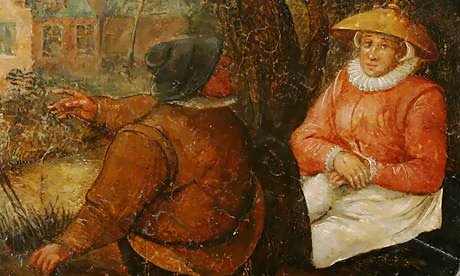
It cost the equivalent of £560 when it was snapped up in a Dutch flea market almost 50 years ago. Now the owner of a small round painting of two peasants has been told she owns an unknown work by the 17th-century Flemish artist Pieter Brueghel the Younger.
The owner took it to experts on the Dutch TV show Between Art and Kitsch, similar to the Antiques Roadshow. They immediately recognised the importance of the signed, 16cm-wide picture of a farmer and his wife resting next to a tree, valuing it at €80,000 to €100,000 (£63,000 to £79,000).
The painting was discovered during a recording of Tussen Kunst en Kitsch at the Rijksmuseum Twenthe in Enschede. The round panel from 1620 depicts a couple of farmers resting near a tree after harvest. Broadcaster AVRO reports that the signature is applied to the stem of the tree and can be read from top to bottom. The show’s expert of old paintings, John Hoogsteder, notes that the way the paint has risen because of the shrinking of the wooden makes him sure that it’s an original. AVRO will broadcast the episode with the Brueghel discovery sometime in March.
Filed under: Art,History by Orangemaster @ 7:29 am
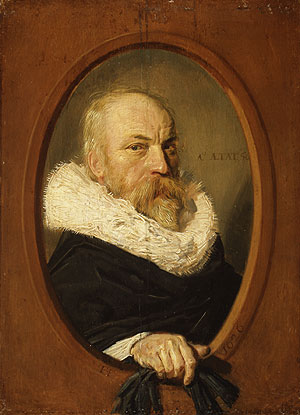
The Frans Hals Museum in Haarlem claims to have found five new paintings by the master. Research shows that one of the paintings, a portrait from 1640, was previously considered as not being one of Hals’ works, while the other four were unknown until now. The portrait was discovered recently at the Dutch embassy in Paris.
All the paintings are currently being restored and will be on display at the museum as of 11 October.



 Miep Gies, the woman who was important in Anne Frank’s life and pivotal in what we now know about Anne Frank turned 100 yesterday. In 1942, when the Frank family looked for a place to hide, Miep Gies, her husband Jan and three others helped the Franks stay hidden in the Achterhuis. Then, when through betrayal the Franks were taken to concentration camps, Gies managed to hide Anne Frank’s diary from the Nazis with the idea of giving it back to Anne after the war.
 The municipality of Haren in Groningen is considering outlawing the use of metal detectors,
 Amsterdam is 200 years older than is commonly assumed, says historical geographer Chris de Bont. The settlement was originally started in 1000 AC instead of 1200 AC, which is still pretty young. De Bont bases his conclusion on the patterns formed by old brooks. “I found the same patterns elsewhere in the region where farmers lived around the time,” De Bont told print daily Metro, “so it’s logical to assume that farmers also created the patterns in Amsterdam.”