May 11, 2016

Van Gogh painting replicated using plastic bottles

Filed under: Art,General by Orangemaster @ 1:41 pm

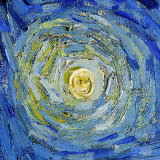
A painting by Vincent van Gogh, ‘The Starry Night’, has been replicated by a Taiwanese company using four million colourful plastic bottles with the goal of promoting recycling.

Taking up 53 hectares of the Starry Paradise park on the outskirts of Keelung City, the installation was opened to the public early this year to mark the 125th anniversary of van Gogh’s death.

“We were thinking of combining the idea of environmental protection with PET bottles and this landscape to create a piece of art, so that everyone can get to know another side of recycling,” explained Aisin Yeh, of the Unison Developing Co. Ltd, which undertook the project.

The project cost USD 2.6 mln and took four months to complete, according to the video. Have a look:

(Link: www.reuters.com)

Tags: , , ,

May 10, 2016

Dutch Eurovision rehearsal video leaked by Russia

Filed under: Music by Orangemaster @ 1:29 pm

We told you about the Dutch Eurovision entry from 23-year-old Douwe Bob from Amsterdam and we thought this year there wouldn’t be any fuss about wardrobe malfunctions or plagiarism, but oh no, there’s a scandal.

Apparently the Russian jury members leaked a video of them rating Douwe Bob’s entire performance at the general rehearsal, which was not supposed to happen. Большое спасибо, Russia!

Some people are pissed that the video was leaked, others like the bookies get some inside information about Douwe Bob’s chances. As we said recently, ‘Slow Down’ is nice, but not an earworm.

UPDATE: Douwe Bob has made it to the final.

Here’s the leaked video:

,

(Link: www.rtvnh.nl, Photo of Microphone by visual dichotomy, some rights reserved)

Tags: , ,

May 7, 2016

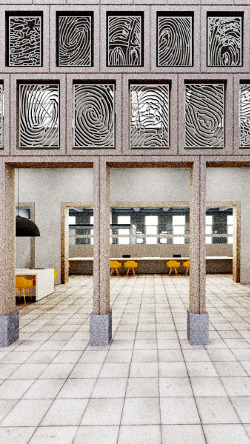
Citizens’ fingerprints adorn windows of new Deventer city hall

Filed under: Architecture by Branko Collin @ 6:06 pm

stadhuis-deventer-portraitTwo weeks ago the city of Deventer officially got a new city hall.

One of its prominent features is an artwork by Loes ten Anscher called Raamwerk Deventer which consists of the blown-up metal fingerprints of 2,264 citizens that cover windows both on outside and inside walls.

An early design for a new city hall had a number of difficulties to overcome. It was protested ten years ago for being obtrusive and the brouhaha even brought down two successive city governments. The architects of that design, Neutelings Riedijk from Rotterdam, were asked to return to their drawing boards, which they did. They came up with something better, something that impressed NRC.next: “Design driven by political noise usually ends up being a tepid compromise or an outright failure […]. But the City Hall Quarters, as the collection of old and new buildings is called, has become an exemplary complex in both an architectural and an urban design sense. The city hall is an example of how well a new building can function in an old city centre.”

Loes ten Anscher hopes that by using their fingerprints, the citizens will come to feel that the new building also belongs to them.

A more cynical person, like me, might see the usage of thousands of fingerprints more like a celebration of the utter disdain with which Dutch governments sometimes treat their citizens’ right to privacy. But hey, it looks really pretty, right?

(Photo: Deventer Stadhuiskwartier)

Tags: , , , , , ,

May 5, 2016

Pancakes with fries and more in Rotterdam

Filed under: Food & Drink by Orangemaster @ 10:27 am
fries1

Last weekend in Paris, a French woman asked me at the dinner table what food was like in the Netherlands. Examining the party of eight around me with a Dutch cook on my right (from Limburg, where they actually enjoy food), I diplomatically answered that the Netherlands have great basic ingredients, but seem to struggle to put them together nicely.

In an environment where snack food goes disco and having a romantic dinner at a junk food chain went viral, here’s a questionable junk food mashup: a pancake with ‘friet speciaal’ (fries topped with chopped onions, mayonnaise and curry ketchup), which can be had at a mini-golf course in Rotterdam.

“It’s not a joke and it’s very tasty,” claims cook Brian de Jong. They call it the ‘pannenkoek Xtra speciaal’, which goes for €7,50 and was in fact inspired by the disco snack food mentioned above. In case you got hit hard by a wayward golfball during your stay, you can also order the pancake Turkish pizza (aka ‘lahmacun’) or the pancake satay.

(Link: www.hln.be)

Tags: , , ,

May 4, 2016

Dutch take measures against neighbouring nuclear reactors

Filed under: Health by Orangemaster @ 10:00 am

Last week, the Dutch government announced it was going to hand out 15 million iodine pills to protect people living near worrisome ageing Belgian and German nuclear reactors. The seven Belgian reactors in Doel and Tihange were built in the late 1960s to late 1970s, with closures planned for 2022 to 2025, while Germany’s Emsland plant, built in 1982, is scheduled to shut down in 2022. As a contrast, the Netherlands only has one operational nuclear power plant in Borssele, Zeeland, built in 1974, with no plans to close, except rumours of ‘possibly before 2033’.

First Belgium announced its plan to distribute iodine pills to its population of 11 million people in 2017 in case of a nuclear accident after which Dutch health minister Edith Schippers announced that her government would distribute its share of pills to the Dutch. Once tablets are distributed to children and pregnant women, the rest of the 15 million could be made available to everyone caught up in a potential accident, including tourists, visitors and workers, Schippers explained. Iodine pills help reduce radiation build-up in the thyroid, and tablets are available to everyone aged 40 and under within 20 kilometres of a plant.

“Belgium’s creaking nuclear plants have been causing safety concerns for some time after a series of problems ranging from leaks to cracks and an unsolved sabotage incident.” And if that wasn’t enough cause for concern, investigators last year found surveillance footage of a Belgian nuclear official in the apartment of a suspect linked to the Brussels and Paris attacks.

(Link: phys.org, Photo by Tom Varco, published under a Creative Commons Attribution ShareAlike 3.0 Unported license)

Tags: , ,

May 3, 2016

King’s Day was also about collecting urine

Filed under: General by Orangemaster @ 9:41 am
Urilift

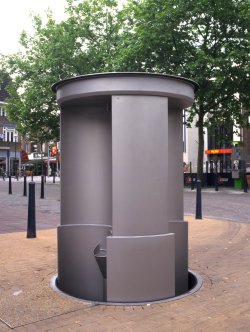
Some 23,000 litres of urine were collected at three locations during King’s Day in Amsterdam this year in order to make phosphate fertiliser. The urinals were placed at the Nassau Festival, Kingsland and in Vondelpark, and the old 1928 Olympic Stadium collected some urine as well. The urine was then brought to a phosphate factory in Amsterdam-West.

By collecting urine in urinals where no additional water is used, the urine stays ‘pure’. The phosphate is needed to produce fertiliser, which is apparently becoming increasingly more difficult to acquire from natural sources, so much so that urine may one day be the only solution.

And so the urine produced after – I’m just guessing here! – the drinking of quite a bit of beer by men is being turned into manure. Phosphate in Amsterdam has been collected from sewage since 2013, enough to fertilise some 10,000 football pitches.

(Link: nos.nl, photo: urilift)

Tags: , , , , , ,

May 2, 2016

John Cleese opens Silly Walks tunnel in Eindhoven

Filed under: Architecture,Art,General by Orangemaster @ 3:34 pm

SillyWalks

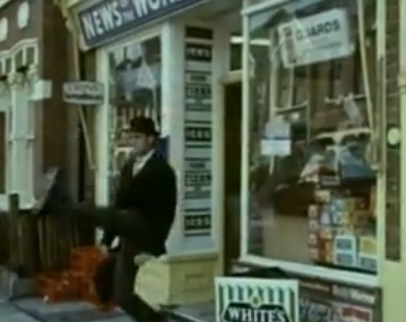
Hundreds of fans of British comedy legend John Cleese huddled in the cold today to greet the man who played a bowler hatted civil servant working for the The Ministry of Silly Walks. Handshakes and autographs were handed out by the 76-year-old actor, invited by Studio Giftig to officially open the renovated Dommel tunnel where graffiti artists have painted all kinds of references to the famous Monty Python sketch.

Cleese showed up in some sort of Australian slippers with no socks, having said that nobody would show up to such a ‘meaningless event’, but he was apparently surprised by all the fuss. Cleese didn’t perform any silly walks himself, also claiming he never was a fan of the sketch in question. Don’t let that rain on your parade and watch the full sketch.

(Link: www.ad.nl, Screenshot of YouTube sketch)

Tags: , , ,

May 1, 2016

Inventor of bike sharing explains why his plan never caught on in Amsterdam

Filed under: Bicycles,Sustainability,Technology by Branko Collin @ 4:59 pm

white-bikes-hoge-veluwe-ellywaAlthough bike share systems are increasingly popular all over the world, they have failed to catch on in Amsterdam, the city where bike sharing was invented.

British newspaper The Guardian asked the inventor of bike sharing, Luud Schimmelpennink, about the reason behind this lack of popularity.

In the mid-1960s members of the Provo movement were asking all kinds of questions of the Dutch establishment (the name Provo stands for provocation) and they were not liking the answers they were getting. Young engineer Luud Schimmelpennink was tackling the question of personal transport. In 1965 he proposed and implemented an alternative to the “gaudy and filthy motor car”, the white bicycle.

Schimmelpennink envisioned bikes that weren’t locked and that would be left wherever their riders needed to be. Provo painted 20 bicycles white and left them in the city, but these bikes were promptly impounded by the police.

“The first Witte Fietsenplan was just a symbolic thing,” Schimmelpennink told the Guardian last week. “We painted a few bikes white, that was all. Things got more serious when I became a member of the Amsterdam city council two years later.”

“My idea was that the municipality of Amsterdam would distribute 10,000 white bikes over the city, for everyone to use. I made serious calculations. It turned out that a white bicycle – per person, per kilometre – would cost the municipality only 10% of what it contributed to public transport per person per kilometre.”

The council soundly rejected his plan and told him that they saw a great future for the private motor car. This inspired Schimmelpennink to work on his White Car Plan instead – still using clean(ish) energy.

There is a phrase in Dutch – de wet van de remmende voorsprong, meaning ‘the law of the handicap of a head start’. The fact that Amsterdam was the first to experiment with bike sharing perhaps helps explain why it is late in its implementation. Or perhaps Amsterdam doesn’t need a bike share scheme, because everybody either owns a bike or can readily rent one from OV Fiets or the many bike shops in the city.

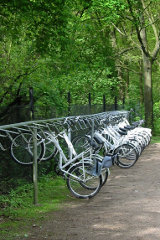
Schimmelpennink’s vision wasn’t wasted though, as he inspired other cities throughout the world to implement their own bike sharing schemes. And even his own plan got implemented, just not in Amsterdam. The Hoge Veluwe nature reserve has bikes that have been painted white and that are free to use. The program started in 1974 with 50 bikes and exists to this day. It currently consists of 1,800 bicycles.

(Photo of white bicycles in Hoge Veluwe by Ellywa, some rights reserved)

Tags: , , , , , , ,

April 30, 2016

100 days of Dutch things

Filed under: Design by Branko Collin @ 1:23 pm

jacqueline-storm-100-days-nl

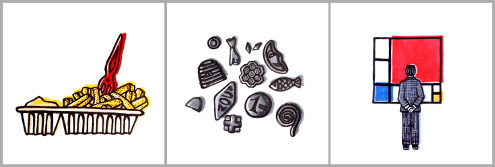
Designer Jacqueline Storm has embarked on a project to make a drawing of a different iconic Dutch subject every day.

Some of her subjects such as wooden shoes and the king are perhaps a bit clichéd, but that makes it the more interesting to see if she can keep it up. How many things exist that simply scream ‘Dutch’? We’re about to find out.

Storm started her project on Facebook on 19 April and so far she has covered subjects ranging from Miffy to black liquorice to fries with mayonnaise to the national bird, the black-tailed godwit. At the time of writing she has created 12 drawings in the series.

Tags: ,

April 28, 2016

King’s Day 2016 in Amsterdam through the lens of René Louman’s camera

Filed under: Event,Photography by Branko Collin @ 4:58 pm

kings-day-2016-rene-louman

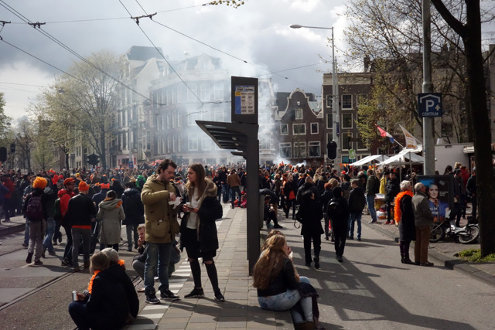
Rain and wind disrupted this year’s King’s Day. The rain largely passed by Amsterdam, but it was still cold enough that visitors had to dress warmer than usual.

Amsterdam-based photographer René Louman took to the streets and captured the rainy streets of the day before, the King’s Day Eve concert of the Amsterdam Klezmer Band and the King’s Day festivities in the city. He also has a good comparison of how busy it was last year and how quiet this year.

Telegraaf speculates that the weather kept many people indoors. Last year’s daytime broadcast of the royal visit to Dordrecht drew 2.5 million viewers, this year’s broadcast of King Willem-Alexander’s visit to Zwolle had 3.4 million viewers.

Like every year Orangemaster and I went to the area around Apollolaan in Amsterdam to look for good deals on the nationwide flea market. I managed to score a camera bag for 2 euro that still had a camera in it!

(Photo: René Louman)

Tags: , ,