December 25, 2009

Oxenaar exhibit in Museum for Communication, The Hague

Filed under: Design,History by Branko Collin @ 1:57 pm

The name may be unknown to foreigners, or even to the Dutch themselves, but the designs of Ootje Oxenaar are deeply familiar to any Dutch person over the age of 10. It was Oxenaar who designed the Dutch banknotes between 1966 and 1985.

Unlike the drab money used in most of the rest of the world his designs were extremely colourful. Where Oxenaar could go for aesthetics instead of respectability, it appears to have been mostly because the Dutch bank, after some initial run-ins, let him be just a designer.

In this video he talks about his relationship with the Dutch bank, rejected designs, and the many Easter eggs he put in his banknotes. The exhibition at the Museum for Communication in the Hague runs until 10 April, 2010. It focuses on both his money and stamp designs.

Oxenaar’s Euro note designs were rejected, but can still be found on the web. Oh, how I would have loved to have unicorns on our bills!

See also:

(Source video: Youtube user spykeroles. Link: Bright)

Tags: , ,

December 24, 2009

Manually operated clock in Rotterdam

Filed under: Art,Gadgets by Branko Collin @ 8:49 am

A team of nine people was necessary to run this wooden clock on November 27 for twenty-four hours in Rotterdam, at the place where the central railway station used to be.

Every minute the foreman called out the time, and his helpers then deconstructed and reconstructed the required digits. The clock was designed by Mark Formanek and produced by Mothership. Other volunteers filmed the complete running of the clock, the result being another clock.

(Video: Mothership. Link: Switched)

Tags: , ,

December 20, 2009

Apple shuns marijuana finder

Filed under: Online by Branko Collin @ 1:56 pm

Good news, potentially, for tourists visiting our fair capital. Martijn Wuite and friends have developed an iPhone app called Coffeeshopr that will let you find the nearest place in Amsterdam they will sell you the happy weed.
The bad news is that though Apple did allow the program to be sold, for now it can only be had from itunes.nl where tourists typically won’t shop, Wuite told Parool (“Censorship Apple hurts weed tourist“).

Coffeeshoppr is like a restaurant guide, except that with us, users can give their opinion about coffeeshops using the iPhone. We put Amsterdam’s 50 most important coffeeshops in the program. Visitors can judge the quality of both the venue itself and of the marijuana sold there.

We have tried to make the whole affair fool-proof, considering our reviewers will probably all be stoned.

Besides the coffeeshop locator and the review function, Coffeeshopr also contains instruction videos on how to use marijuana, and information on the Dutch legal situation.

Coffeeshop is the Dutch word–borrowed from English–for a place where marijuana is both sold and used. The Dutch word for a place that primarily sells coffee is koffiehuis.

(Image: Coffeeshopr.com)

Tags: , , , ,

December 19, 2009

Turnip-shaped Christmas baubles and 39 other Dutch inventions

Filed under: Architecture,Design by Branko Collin @ 6:54 pm

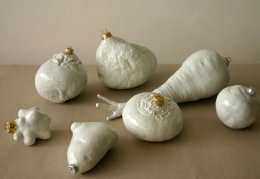
christmas_balls-maaike_roozenburgTrendhunter has an interesting overview of 40 of the stories it published on recent Dutch innovations, from chairs made of used napkins to nude exercising, and from supercars to artificial islands.
We’ve covered some of these stories before, but there is still lots to discover.

One of the stories highlighted is a recent one about Maaike Roozenburg’s christmas baubles, made to look like root vegetables such as potatoes and turnips. There are 24 of them, for sale at Moooi.

(Photo: Maaike Roozenburg)

Tags: ,

December 14, 2009

Kees van der Westen’s espresso machine

Filed under: Gadgets by Branko Collin @ 8:59 am

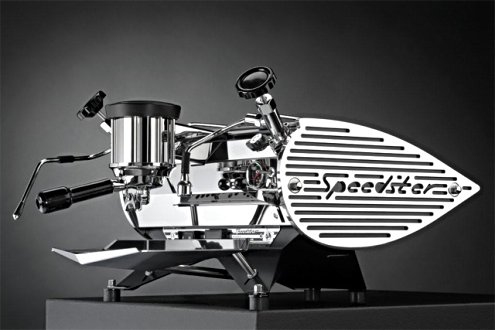
For those who grumbled about my taste in coffee before, here is the other end of the spectrum. Kees van der Westen (first name pronounced like ‘Case’) from Waalre, Noord-Brabant, has been creating coffee makers since the 1980s. This is one of his latest, the Speedster.

A previous incarnation of the Speedster was made in a limited series of 6, sold to friends and relatives. The price of the current version? A mere 5,000 euro.

We strongly emphasize the need to contact an experienced espresso machine technician locally. The Speedster is a commercial machine that needs to be installed properly. Also for maintenance/service later in its life, a technician who knows espresso machines is essential.

Coffee Geek says, and I paraphrase, that the Speedster is a decent espresso machine. (“Just about perfect,” I believe that is their exact wording.)

(Link: Bright. Photo: vanderwesten.com.)

Tags: ,

December 13, 2009

Collection of 2,400 ecstasy pills stolen

Filed under: Weird by Branko Collin @ 4:11 pm

When Jan from Eerbeek, Gelderland noticed last Thursday that his extensive ecstasy collection had been stolen, he immediately notified the police. Even though it is believed that the collection is illegal, the 46-year-old sounded the alarm because he fears some of the pills may be poisonous.

The man started his collection 20 years ago. The last 10 years he has hardly worked on it, according to an article in De Stentor. The collector, who tried ecstasy once but didn’t like it, hopes for clemency from the Department of Justice.

“It is a great pity I lost the collection. I would have liked to preserve it for the ages.”

Ecstasy pills are often colourful and come in a great variety of prints. BoingBoing moderator Arkizzle explains the magnitude of the loss of the collection of 2,400 pills:

Pill marks in illicit drug manufacturing are lovely ephemeral things, that come and go as the brand is made and fades. Drugs, obviously, don’t tend to get saved for posterity, so this collection was probably unique. Also, I understand that owning the stamping dies is legally akin to having forgery plates, so they are unlikely to be reproducible.

I once saw a fantastic exhibition of acid blotters in London; original and reprints. Lots of ‘Dead-style artwork, amongst cartoon characters and repeating geometric shapes.

(Photo: DEA. Link: Edmonton Sun / AP / Toby Sterling.)

Tags: , , , ,

December 12, 2009

Lost Leyster discovered

Filed under: Art,History by Branko Collin @ 8:31 am

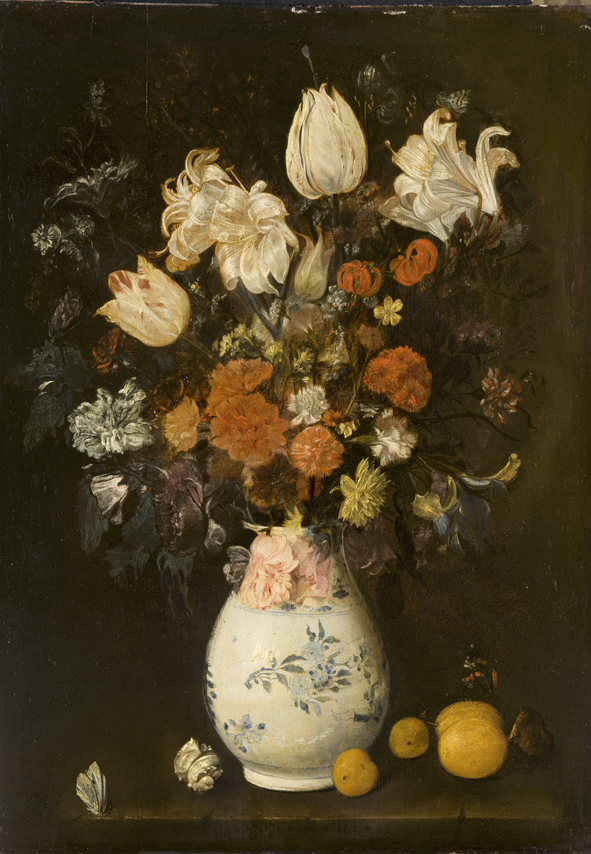
The Frans Hals Museum recently discovered this lost painting by Judith Leyster (1609-1660), the first female Dutch master painter.

The painting depicts a still life of a Chinese vase with flowers. Its Belgian owner, Mrs Luc from Ostend, alerted the museum in August of its existence. Although she was aware art collectors knew about the painting (it is listed in an inventory in Leyster’s husband’s possessions), she was waiting for the right moment to reveal the work, which she originally bought for about 500 euro in the 1970s.

Leyster became a master painter in 1633, the first woman in the West to do so. Her paintings seem inspired by Frans Hals, showing jolly drinkers, musicians and playing children. Both Leyster and Hals had their studios in Haarlem. After Leyster married fellow painter Jan Miense Molenaer in 1636, her output dwindled to a trickle, her last known painting being from 1643 until a few months ago.

The Frans Hals Museum quotes Leyster expert Frima Fox Hofrichter:

Many art historians have often assumed that Judith Leyster gave up painting upon her marriage. With the discovery of the flower still life and its date of 1654, we now have documentation that she continued her career as a painter. It is likely that Leyster moved to still-lives and botanical studies after her marriage, perhaps to split the market with her husband.

The Frans Hals Museum will host a Leyster exhibition from 19 December 2009 till May 9, 2010.

(Link: Parool. Source image: Frans Hals Museum.)

Tags: , , ,

December 10, 2009

Low Countries map in shape of a lion

Filed under: Art by Branko Collin @ 9:02 am

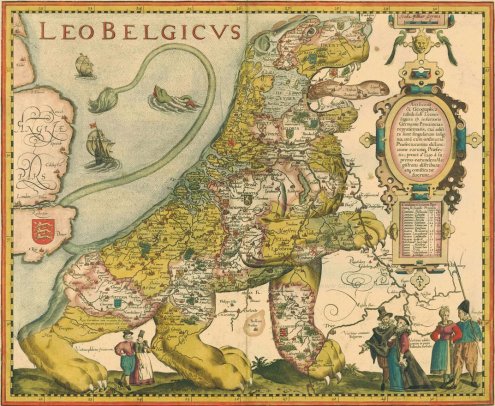
Strangemaps talks a bit about this popular 16th century depiction of the Netherlands and Belgium as a lion, known as the Leo Belgicus:

The Leo Belgicus is a lion transposed on a map of the area, its ferocity symbolizing the belligerence of a nation fighting for its life. […] In the 16th century, that general area was also known as the Seventeen Provinces, first under Burgundian and later Spanish tutelage. As the plural description suggests, these provinces were a loose confederation with little or no unifyingly ‘national’ sentiment.

That changed when religious upheavals pitted the increasingly protestant and independent-minded locals against their staunchly catholic Spanish overlords. The old Roman toponym Belgica was used to provide the entire Low Countries with a single geographic denominator.

The Austrian cartographer baron Michael Aitzinger, probably inspired by the prevalence of lions in the coats of arms of many of the Seventeen Provinces, drew the first Leo Belgicus in 1583, fifteen years into the Eighty Years’ War of the Spanish in the Netherlands. The long war soon became a stalemate, with neither party able to achieve total victory.

I remember the story being told slightly differently in history class, with emphasis being laid on Charles V being a good egg, on account of him being a local boy (born in Ghent), but his son Philip being a degenerate Spaniard with whom we wanted to have nothing to do.

(Link tip: Clogwog.)

Tags: , , , ,

December 7, 2009

Cutting of Anne Frank tree planted near Amsterdam

Filed under: General by Branko Collin @ 11:38 am
annefrankstatue1.jpg

A clone of the famous Anne Frank chestnut tree was planted in a park South of Amsterdam last Friday. Alderman Marijke Vos and the CEO of the Anne Frank Foundation, Hans Westra, planted the young tree in the Amsterdamse Bos in Amstelveen, Metro reports.

Anne Frank used to look out on the tree when she was hiding for the Nazis, and wrote about it in her famous diary. Lately, the tree has been developing a disease, which led to the foundation deciding to plant 150 cuttings before it was too late. The other 149 chestnuts will be planted over the upcoming years.

Link: BN/De Stem.

Tags: ,

December 6, 2009

Spin polarisation achieved at room temperature

Filed under: Science,Technology by Branko Collin @ 2:04 pm

We could hardly contain ourselves either, but then we found out what Engadget is getting so excited about, and it is pretty nifty.

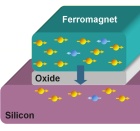
Electronic particles don’t just have or constitute a charge, but also a spin direction. If you have a medium, say a hard disk that works by setting the charge of particles, you can add an extra dimension of information by also storing and reading its spin direction (polarisation). It appears that by doing so, you can speed up reading a hard disk by several orders of magnitude.

The only problem so far was that all this reading and writing required an environment dozens of degrees Celsius colder than even the basement of the loneliest computer geek. Scientists from the University of Twente apparently have now come up with a way of doing all this spinning at room temperature, which has the added bonus of not scaring away their dates, thus improving their sex lives. And you were wondering what science was good for!

The University of Twente also mentions huge energy gains that can be acquired this way.

(Source of sciency looking image: University of Twente)

Tags: ,