

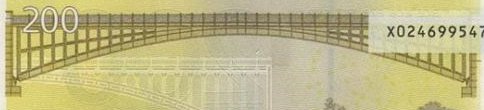
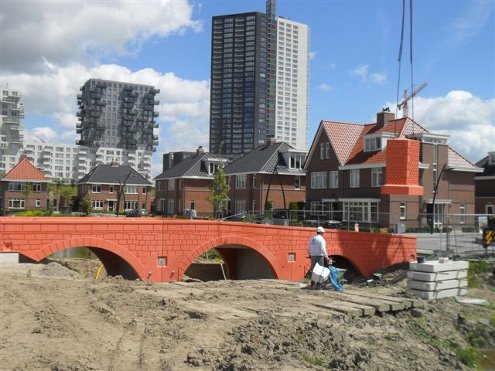
As we wrote a couple of days ago, Robin Stam is making real bridges of the fictional ones you can find on the euro banknotes. His playground is a new neighbourhood in Spijkenisse near Rotterdam (bordering the Oude Maas river) called ‘t Land (the Land), which is still very much under development.
Robin gladly answered a few of our questions:
The first two bridges are almost finished, and the rest will be built in sync with the realisation of the neighbourhood.
The properties are sold in shifts, so unfortunately it will take a while for the project to be completed. The first two bridges will be ready at the end of September. The drawings and calculations for the other bridges are almost done. The way things are looking now the 200 euro bridge will be built at the start of next year. This will become a small pedestrian bridge, built exactly like on the banknote, meaning that the scale will be completely out of proportion.
Mark van Wijk, Joeri Horstink and I are working on a number of projects under the label Rotganzen. Currently a project of ours that is getting a lot play in the blogosphere is Party, about stylized broken party tents.
Completely off topic: an exhibit of big party tents in Dutch would be called an ‘evenementententententoonstelling’. I’d like to see other Germanic languages come up with compound words like that. I bet you cannot! I bet you are too scared!
 * Several provinces have instated hunting bans for a variety of animals because of the cold weather. Zeeland, Drenthe, Noord Holland and Limburg have ordered a general hunting ban, while others have limited their bans to a selection of animals. The Party for the Animals (PvdD) has called for a nationwide ban,
 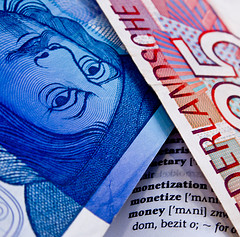 Before the euro was introduced as a pan-European currency in 2002, the Netherlands used the venerable guilder.
 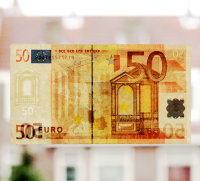 In 2007 the Dutch mint started with a pilot project that made it the first in Europe to print money using cotton for which the producers have not been exploited. So far, the 20 and 50 euro bills produced by De Nederlandsche Bank have contained 10 to 14% fair trade cotton.