September 19, 2008

Recently discovered Jewish interior will not be wrecked for now

Filed under: Architecture,History by Branko Collin @ 5:30 pm

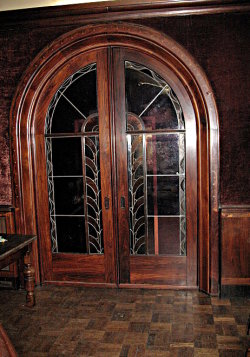
A uniquely preserved WWII Jewish living room in Amsterdam will stay intact a little bit longer. The room which we wrote about last week, was discovered last year by a student at that time Alexander Westra (currently of the University of Amsterdam). AT5 reports that Lebo, the company that now owns the house, has stopped the wrecking works of the property.

The house used to belong to banker Korijn who died in 1942, after which his entire family was deported to the concentration camps where they died at the hands of the Nazis. One source called the room “more authentic than the Anne Frank House.” After the war, the house at the J.J. Viottastraat in Amsterdam came into the hands of Catholic theology students who barely touched the room, although Westra apparently did uncover some traces of parties.

In the next month and a half the owner will look at possibilities to preserve the room which is built in the Amsterdamse School style. One possibility is to turn the luxurious room into a museum.

According to a spokesperson for Het Schip, the museum for the Amsterdamse School, focus for this architectural movement usually lies on exteriors. To answer a question asked earlier by one our readers, Jay Vos, the spokesperson did not know of any books that focussed solely on Amsterdamse School interiors, although the museum is currently working on a book that will also document these interiors.

The students who lived there recorded a corny video invitation to their new year’s bash in the living room last year, which 24 Oranges discovered at that wonder-wasteland of archeology, YouTube.

Photo: Alexander Westra, republished with permission. Westra sent us several photos, a selection of which we showed in our earlier article.
Tags: , , , ,

September 11, 2008

Preserved interior of Jewish family home found

Filed under: Architecture,History,Religion by Orangemaster @ 9:44 am
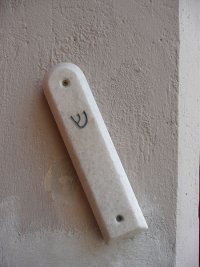
Mezozah

Researchers have found a house in Amsterdam-Zuid on the J.J. Viottastraat that has an almost intact 1940s interior which used to belong to a Jewish family. The living room, the most important and usually biggest room of Dutch houses, is apparently more authentic than the Anne Frank House. Alexander Westra, university teacher of heritage studies at the Universiteit van Amsterdam, confirmed this yesterday.

Westra stumbled upon this unique find last year when he was working on a project on historic interiors in the capital. The family of Jewish banker Lodewijk Korijn left the home in 1942 when they were carted off to concentration camps. And since then, the interior has barely been touched.

Westra believes that the home should be protected heritage. After the war, the house was used by theology students. The living room was their common room. In the vestibule there is still an original dresser integrated to the wainscoting on the wall. Even the lighting from that era still works, which is rare, says Westra. The backroom also features a few original details even though a fire raged through it once. The interior was made in Amsterdam school style.

(Link: parool.nl)

Update 11:30, by Branko: Alexander Westra, the scientist who made the discovery, sent us some photos he took from the interior. You will find them below the fold. Thanks, Alexander! According to him, the statues of saints and the crucifix were put there by later residents.

(more…)

Tags: , ,

August 30, 2008

A peek at the Amsterdam Begijnhof

Filed under: Architecture,History by Branko Collin @ 9:09 am

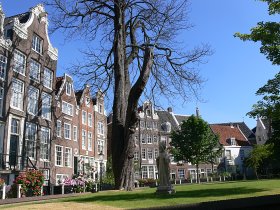
Apartment Therapy visited the 70 square metre home of American radio maker Ruth at the beguinage in Amsterdam. The complex, simply called Begijnhof (Dutch for beguinage), lies smack in the middle of the city and is open to the public. Located just off one of the busiest streets in the country, the Kalverstraat, it’s a sea of calm on the inside.

A begijnhof, or beguinage, is a secluded garden around which devout women lived a life dedicated to their faith, outside the formal structure of the church. Unlike nuns, beguines took no vows and kept any property they might have. There are dozens of former beguinages in the Low Countries. Although the houses were typically small, beguinages are still sought-after property because of their court-yard lay-out.

De Begijnhof is no longer home to beguines, but still only women live there. Should you wish to do the touristy thing, and should you be able to find De Begijnhof, access is free, and the beguinage has a couple of trumps up its sleeve other than just being there and being unique. It sports one of the two remaining wooden houses in the center of Amsterdam (1470). The panels of the pulpit of the English Church were made by Piet Mondriaan, and there’s a second, Catholic church hidden somewhere behind the gables.

Photo by Andreas Praefcke, some rights reserved.

Tags: , , , , ,

August 24, 2008

East India Company themed bicycle bags

Filed under: Bicycles,Design,History,Weird by Branko Collin @ 9:59 am

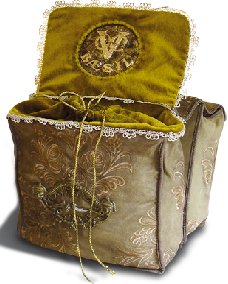
Does steering your bike into Dutch traffic make you feel like you’re navigating a stormy ocean, hundreds of miles away from the nearest shore? Are you consumed by dark longings of burning villages on Java? Does the idea of paying shareholders with pepper and cinnamon instead of cold hard cash turn you on? Relive the days of the Dutch East Indian Company with these handsome VOC bicycle bags!

Quoth the manufacturer:

The “Vereenigde Oostindische Compagnie” (often abbreviated till VOC) was an extreme successful Dutch Company which transported goods oversea. Transporting goods is for many Dutchmen still a daily job, with this difference that nowadays it takes mostly place by bike. Enough reason for Basil – the producer of bicycle bags – to translate this into an unique concept: the double bag VOC! This VOC-bag has an archaeological tinge and refers to the period of the VOC, the time the Dutch ruled the seas.

Basil will show the double bag VOC at Eurobike 2007 in Friedrichshafen, Germany, from August 30 till September 2. No word on when it will be sold.

Via Dagelinks (Dutch).

Tags:

July 30, 2008

‘Hidden’ Van Gogh painting uncovered

Filed under: Art,History,Science by Orangemaster @ 3:10 pm

Van Gogh

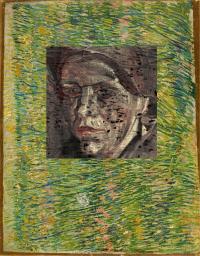
A new technique allows pictures which were later painted over to be revealed once more. An international research team, including members from Delft University of Technology and the University of Antwerp, has successfully applied this technique for the first time to the painting entitled ‘Patch of Grass’ by Vincent van Gogh. Behind this painting is a portrait of a woman.

It is well-known that Van Gogh often painted over his older works. Experts estimate that about one third of his early paintings conceal other compositions under them. A new technique, based on synchrotron radiation induced X-ray fluorescence spectroscopy, reveals this type of hidden painting. The techniques usually used to reveal concealed layers of paintings, such as conventional X-ray radiography, have their limitations. Together with experts from the Deutsches Elektronen-Synchrotron in Hamburg and the Kröller-Müller Museum, TU Delft materials expert and art historian Dr Joris Dik, and University of Antwerp chemistry professor Koen Janssens therefore chose to adopt a different approach. The painting is subjected to an X-ray bundle from a synchrotron radiation source, and the fluorescence of the layers of paint is measured. This technique has the major advantage that the measured fluorescence is specific to each chemical element. Each type of atom (e.g. lead or mercury) and also individual paint pigments can therefore be charted individually. The benefit of using synchrotron radiation is that the upper layers of paint distort the measurements to a lesser degree. Moreover, the speed of measurement is high, which allows relatively large areas to be visualised.

(Link and photo: eurekalert.org)

Tags: , , , ,

July 24, 2008

DNA test posthumously inflicted on athlete

Filed under: History,Sports by Branko Collin @ 11:00 am

Foekje Dillema, the runner banned for life after undergoing a humiliating and undisclosed gender test in 1950, underwent another test posthumously this year. Commissioned by Dutch TV programme Andere Tijden Sport, and with permission of the athlete’s family, researchers of the Erasmus Medisch Centrum in Rotterdam found out that Dillema was a woman with a form of chromosomal mosaicism, which caused her to have two X chromosomes for every Y (possible in XX and XY configurations, though the show doesn’t tell). According to the researcher that was an extremely rare condition. The programme’s presenter claimed that nowadays Dillema would be able to compete without problems in women’s track and field events.

Reporter Max Dohle who is writing a biography on Dillema withdrew his cooperation for the Andere Tijden show after he found out about the DNA test: “The last thing you should do to Foekje is subject her again to a sex test. She would have never wanted that.” After the first test in 1950, Dillema felt extremely humiliated and she withdrew for always from public life.

Tags: , ,

July 3, 2008

Sixties slaughterhouse film saved from oblivion

Filed under: Animals,Film,Food & Drink,History by Orangemaster @ 8:01 am
Meat

Dutch television station VPRO has found an old film from the 1960s in their archives depicting the live slaughtering of cows in an Amsterdam abbatoir. The film ‘Vleesch’ (old Dutch spelling of ‘vlees’, which means ‘meat’) is a five-minute film made by vegetarian filmmmaker Wim T. Schippers, who is known for many things including the voices of Ernie, Kermit and more on the Dutch version of Sesame Street.

Long story short, the film was originally banned because it was not suitable for children. It was postponed a few times and again deemed unsuitable for children. Eventually, some child psychiatrists viewed the movie and said it was fine to let kids watch it. However, the film was never shown. Until now.

‘Vleesch’, made on 9 October 1967, is now being shown for the very first time. The VPRO has also brought out a DVD with this and other lost bits of archives from the same era, albeit surely less straightforward.

Before anyone starts a discussion about how horrible this is you’ve been warned: a cow is being killed in this film so that people will eat it. I glanced at the film myself.

See the film for yourself: Vleesch

(Link: vleesmagazine.nl)

Tags: , , ,

June 21, 2008

Bicycles from the turn of the 20th century

Filed under: Bicycles,Design,Gadgets,General,History by Branko Collin @ 8:55 pm

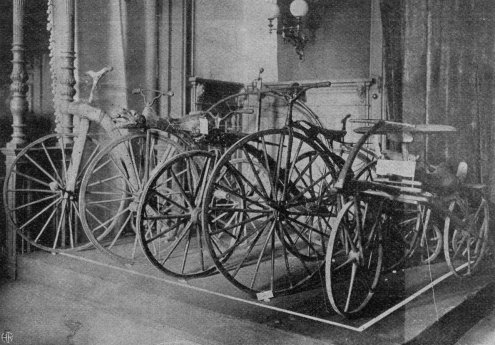
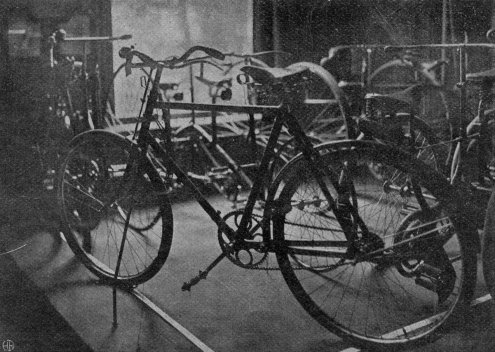
I came across a 1908 illustrated magazine yesterday at a second hand store. It opened with an article about the festivities surrounding the 25th anniversary of the Dutch automobile association ANWB (Dutch), then just a bicycle riders’ union. Part of these festivities was an exposition of both old bicycles and the very newest ones. Displayed here is the folding bike (second photo) of captain Van Wagtendonk, with his newly invented folding bike stand. Or, as the magazine writes it:

A steel rod which under ordinary circumstances is attached next to the frame, but which is lowered when the bicycle is parked. This way the bicycle can be parked freely, resting on this rod as a third leg. In order to prevent the wobbling or even keeling over of the front wheel, the lowering of the rod also causes a small metal brace to be released which locks the front wheel into place and protects the bicycle from falling over.

I’ve been scanning the magazine while typing this, and will upload it to the Internet Archive either today or tomorrow. Expect ads for oriental breast enlargement pills and Swan fountain pens. Has anything actually changed in the last hundred years?

Update: scans of the magazine Het Geïllustreerde Leven can be found at www.archive.org/details/het_leven_3_30.

Tags:

April 12, 2008

Colour photos of WWII soon online

Filed under: General,History,Photography by Orangemaster @ 8:36 am
wwii.jpg

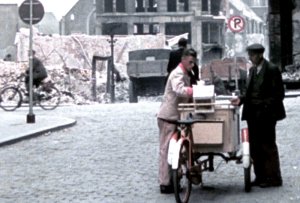
The Netherlands Institute for War Documentation in Amsterdam has been given 1,500 colour photos from WWII by Alphons Hustinx, a rich photographer from Roermond, Limburg who used the rare technique at that time of colour slides. When we think of photos from WWII, we usually picture black and white images, but this new collection will actually add colour to an otherwise grey era.

The entire collection will be available for viewing online at the end of April.

(Link and photo: rtl.nl)

Tags: ,

April 7, 2008

Buran passes through the Netherlands

Filed under: Design,History by Branko Collin @ 12:02 pm


Illustration: the Buran space shuttle on display at the MAKS air show, 1997. Public domain photo by Kobel.

One of the 10 Soviet space shuttles ever built traveled through the Netherlands last weekend on its way to its final destination in Germany. The shuttle, an atmospheric test model code-named OK-GLI or BTS-02, was shipped from Bahrain to Rotterdam, and from there was moved by river barge over the Rhine to the Technik Museum Speyer in Mannheim, German.

The story of the Soviet space shuttle is one of the most interesting of our time. The Soviets saw the Americans build a space shuttle, but could not figure out what it was for. So they built their own, and found out what NASA was desperately trying to hide: that in terms of effectiveness and launch costs, the shuttle is an inferior solution to current non-reusable launch technology (nowadays NASA shuttles costs USD 1 billion per launch). Astronautix even concludes: “The cost of Buran—14.5 billion rubles, a significant part of the effort to maintain strategic and technical parity with the United States—contributed to the collapse of the Soviet system and the demise of the spacecraft.”

The OK-GLI model was never intended to be launch tested. Instead, it was fitted with jet engines so that it could take off and land on its own, and was used to test atmospheric handling of the Buran shuttles. Later it was used as a demonstration model at airshows. It was bought by an Australian company which wanted to use it for the same purpose, but while the OK-GLI was in transit in Bahrain, its owner went bankrupt and the shuttle was stored for four years in parts at a junkyard.

The re-built shuttle drew crowds on its tour through the country, according to Blik op Nieuws (Dutch). Yesterday it passed Nijmegen, its tail clipped to fit under a bridge filled with onlookers.

Tags: , , , , , , ,