


New Zealand gallery Muka came up with the idea of Youth Prints, selling art by “internationally renowned artists” to children for low prices. Grown-ups are not allowed in the exhibition room, and no artwork carries a name tag, so that children decide their purchases purely on what they like. Apart from New Zealand, Youth Prints exhibitions are held in Germany, Belgium and the Netherlands. From May 27 to June 7 a Youth Prints exhibition will be held at Museum Bommel van Dam in Venlo under the name Verboden voor boven de 18.
March 29, 2009
March 28, 2009
Photos by Marleen Sleeuwits and Marsel Loermans
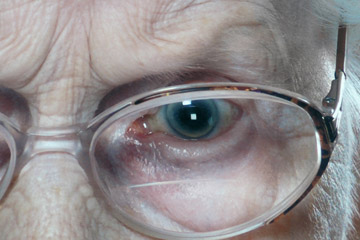 An exhibition of the photographic work of Marleen Sleeuwits and Marsel Loermans will run until April 25 at gallery Liefhertje & De Grote Witte Reus in the Hague.
Sleeuwits photographed brightly lit empty spaces, where without knowing the context you get to wonder why such a spot deserves bright lights in the first place. Loermans made highly detailed portraits of nuns called the Dochters der Wijsheid (Daugthers of Wisdom).
Says Trendbeheer (Dutch):
They appear opposites. The work of Marleen Sleeuwits has eliminated man completely, whereas Marsel Loermans and Anton Spruit are only about the human factor, but at Lief Hertje & Grote Witte Reus their work is displayed side by side.
[…]
Loermans, Spruit and Sleeuwits share a love for sharpness and detail, and the resulting photos seem to lose realism because of that. Sleeuwits’ rooms appear almost alien, and the portraits of Loermans and Spruit look as if they’ve already been embalmed.
Tags: Anton Spruit, exhibitions, lighting, lights, Marleen Sleeuwits, Marsel Loermans, nuns
March 26, 2009
Van Leeuwenhoek microscope to be auctioned
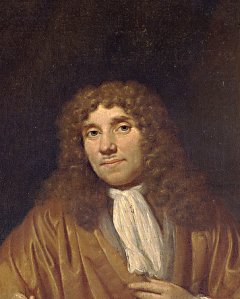 One of only three surviving silver microscopes of the Father of microbiology, Renaissance scientist Antonie van Leeuwenhoek (1632-1723), will be sold on April 8 at an auction at Christie’s in London, writes De Telegraaf (Dutch). The auction house expects to sell the silver device for somewhere between 75,000 and 105,000 euro.
The other two surviving Leeuwenhoek microscopes are at the Deutsches Museum in Munich and the Museum Boerhaave in Leiden.
Van Leeuwenhoek built his own microscopes, superior to what was available at the time (the first microscope was invented in Middelburg seven years before his birth), but kept the secret to his lenses meticulously hidden, and only in the 1950s did scientists manage to reconstruct them. It turned out that rather than grinding lenses, Van Leeuwenhoek seems to have used a glass fusing method, which allowed him to quickly make a microscope, of which he constructed around 400 during his lifetime.
The Internet Archive has The Select Works of Antony van Leeuwenhoek, translations into English of Van Leeuwenhoek’s many observations, unfortunately without his drawings. Fascinating stuff, almost like being alive in the 21st century.
The silver microscope that will be sold at Christie’s was used by Van Leeuwenhoek to discover sperm cells. The current owner found it during the 1970s among old laboratory equipment.
Portrait of Van Leeuwenhoek by Jan Verkolje (1650-1693).
Tags: Antonie van Leeuwenhoek, auctions, Delft, microscopes, renaissance, silver
Dutch municipalities reticent to comply with freedom of information act
 Several municipalities have not only refused to comply with a WOB request (Dutch freedom of information act), but are actively discussing with each other how to frustrate the process. Webwereld reports this (Dutch) where Brenno de Winter is trying to find find out in how far municipalities are using Free and Open Source software.
On a closed mailing list, the municipality of Boekel (Noord Brabant) pointed out that not only would these WOB requests generate a lot of work, but also have “far reaching consequences,” whatever they may be. Boxtel and Schijndel, also from Noord Brabant, apparently replied that they too have received “nonsensical questions.” One of the suggestions was to hire an IT savvy lawyer. The name of Arnoud Engelfriet, formerly of Eindhoven, Noord Brabant, was dropped, who told Webwereld that he has no interest taking a job that “endangers a citizen’s right to freedom of information.”
In the meantime, De Winter has been replying in Webwereld’s comment section, and he seems to be suggesting that most municipalities that have responded, have done so in a positive manner: “[…] several municipalities have answered already. […] My phone is ringing all the time, and every time we manage to get to get a positive outcome.”
A 2008 informal study by journalist Jeroen Trommelen (Dutch) revealed that of 51 WOB requests sent to several ministries, only one came from an actual journalist.
Disclaimer: according to Webwereld De Winter’s WOB requests were made on behalf of him and the Vrijschrift foundation. I am an advisor to the latter.
Tags: freedom of information, government, law, Noord-Brabant, WOB
March 23, 2009
First bar where smoking is legal?
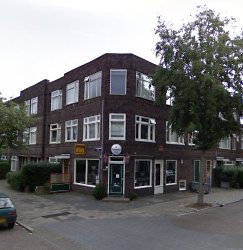 When the smoking ban for bars was introduced last year, it hit Groningen bar De Balk as hard as any other café. Owner Aethne McGhie, originally from Scotland, turned a storage room into a smoking room, but the result was that the bar area itself looked absolutely dead. Her remaining customers came up with an idea: why not turn things around, move the actual bar into the storage room, and the former bar area into the smoking area. And so it was done. The result is that people now have to walk to the former storage room to get their drinks, but, McGhie told Parool (Dutch), even the toughest customers soon learned how to play nice.
The professional busy bodies who have to enforce the ban on fun, the Voedsel en Warenautoriteit (VWA), grudgingly admitted to De Telegraaf (Dutch) that this ploy is actually legal. “But we wouldn’t necessarily call it a legal bar,” a spokesperson said. Turns out that they found a technicality with which they can still cause problems for De Balk. Apparently, the law that says that a room where drinks are served must have a minimal size hasn’t been adapted to take the new circumstances that the smoking ban created into account.
Another entity that won’t call De Balk “the first legal smoking bar” is perhaps not surprisingly Hiermaghetwel.nl (Dutch), the website that keeps track of all the bars in the Netherlands where you can legally smoke. They point out that Café Populair in Amsterdam was the first to come up with the idea of a small bar section and large smoking area, way back in September last year (AT5, Dutch).
Source photo: Google Street View, a Dutch version of which was introduced a couple of days ago.
Tags: bars, Groningen, Scotland, smoking, War on Fun
March 22, 2009
Brick flowers in a brick barge on a brick gable
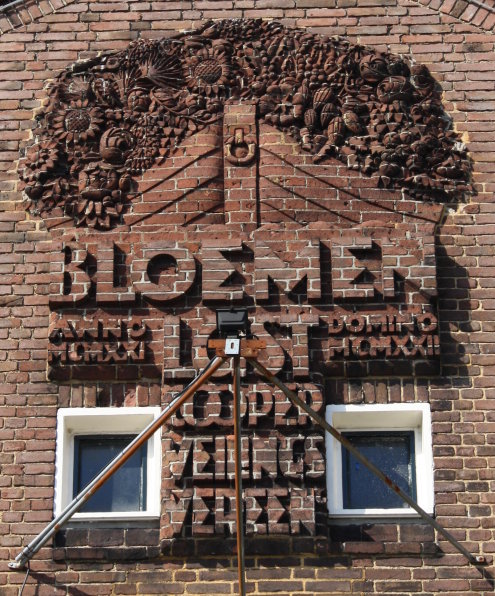
This is a gable decoration on the building of the Bloemenlust flower auction house on the Oosteinderweg in Aalsmeer just South of Amsterdam. I ran into it today while biking through the neighbourhood. It’s carved entirely out of brick. The text—abreviated here and there—reads Bloemenlust Coöperatieve Veilingsvereeniging (Bloemenlust co-operative auction association).
After a merger in 1968 with the Centrale Veiling and a subsequent move to a new location, the 1922 building became a restaurant. The new auction would go on the become the largest in the world for flowers, housed in the second largest building in terms of floor space.
March 21, 2009
Bailliff to leave PC, TV behind
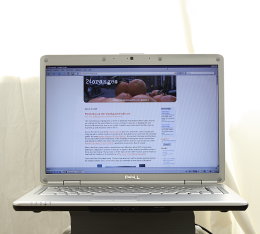 The trade association of deurwaarders (bailiffs, court appointed debt collectors) has decided that its members should leave PCs, TVs and refrigerators untouched from now on when collecting debts because they are considered basic needs. The association, KBvG, which represents all 900 bailiffs in the Netherlands, has a list according to Algemeen Dagblad (Dutch) of basic necessities that a bailiff should not repossess, but the list stems from the nineteenth century and only contains items such as beds, books and food.
KBvG chairman John Wisseborn pointed out that people need a PC nowadays to apply for jobs and fill out tax forms.
Sociaal Raadslieden (municipal advisers) is happy about the change. According to them bailiffs can use their own discretion on what to take and what to leave behind, and have apparently figured out that just the threat of taking the PC can be a powerful means of putting pressure on the debtor.
Tags: computers, debts, law, possessions
March 19, 2009
Keukenhof flower exhibition turns 60
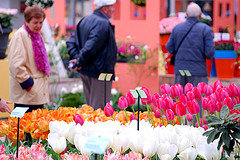 The Keukenhof flower exhibition, what Wikipedia calls “the world’s largest flower garden,” turns 60 this year. Last Wednesday Queen Beatrix opened this sixtieth edition, according to Blik op Nieuws (Dutch), which is themed ‘USA, New Amsterdam – New York, 400’ in honour of the claiming of the region by Henry Hudson in 1609, followed 15 years later by the foundation of New Amsterdam, which is now called New York.
Part of the exhibition is a giant flowerbed depicting the Statue of Liberty, which is not in bloom yet.
Photo by Nguyen Dai, some rights reserved.
Tags: anniversaries, bulbs, flowers, New York, public relations, Queen Beatrix, tulips
March 18, 2009
Mini-me
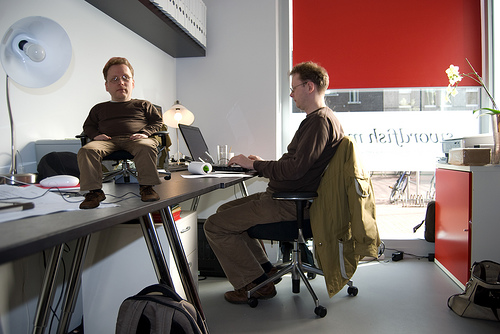
The two fat guys in the picture are both me at a client’s where the photographer,
Michele Boccamazzo, is working as a Web 2.0 guru. He has started a Flickr pool where all can play, so please don’t let me hold the world hostage for One Million Dollars all by myself!. [Insert obligatory “Muhahaha!” here.]
Tags: Internet
March 16, 2009
Artist Shinkichi Tajiri dies
 Sculptor Shinkichi Tajiri died a Dutchman in his home town of Baarlo in Limburg last Saturday, reports NOS Journaal (Dutch). The artist of Japanese-American descent who escaped the WWII concentration camps in the US by joining the army, left for Europe in 1948, disgusted that even a decorated hero like him was still considered just a Jap in his own country. However, he never renounced his nationality, feeling that he could only rightfully criticize America as an American. For most of his life he lived in Baarlo, Limburg, where he befriended my parents, and where last year he finally obtained Dutch citizenship.
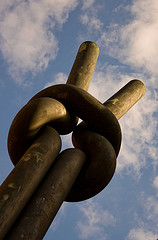
Tajiri is perhaps best known for his large statues of knots, but one of my earliest memories were paintings and drawings of fantastic contraptions that could either be guns or cameras, preparing me for what nowadays is called steampunk. Sketches for some of these drawings can be found on Tajiri’s website under Drawings 1963 – 1968.
In his later years, Tajiri returned to these violent images, and a few years ago, he built four metal guardians that watch over the bridge between Blerick and Venlo, my birth town. Kunst in de Regio has a well illustrated story (Dutch) about the building of these statues.
To Ogendicht he explained his art (Dutch):
My warriors are attempts to suppress those fears, to cast off demons and to deal with nightmares. Only a small part of the 442 Regimental Combat Team, of which I was a part, survived the war. Many talented young people died on the battlefield, sometimes right next to me. That affected me deeply, along with the shootings, explosions and bayonet fights. For the past 60 years I have tried to provide shape to the psychological scars that all these impressive experiences have left.
Photo of a Tajiri knot by Marja van Bochove, some rights reserved.