December 7, 2010

An interactive history of KLM’s house-shaped genever bottles

Filed under: Architecture,Aviation,Design,Food & Drink by Orangemaster @ 1:29 pm

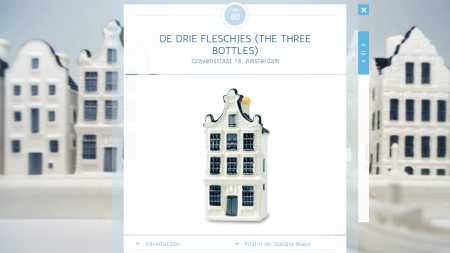
First you follow the link to the cute little Delft blue houses, and then you can click on any of the 91 bottles and find out what house it is and where. Most of them can be found in Amsterdam, but a few of them are from towns like Amersfoort, Delft, Breda and Schiedam.

I spontaneously clicked on number 81 and got ‘proeflokaal’ (roughly ‘tasting pub’) De Drie Fleschjes (The Three Bottles) in Amsterdam pictured above (here is what it looks like today). Ironically, it is a place to sample gin and have a drink.

What I thought was odd though is that there is the same house twice (11 and 23), another ‘proeflokaal’ in Amsterdam, Wijnand Fockink. I think the makers of the site made a mistake, as 90 is a much nicer number.

(Link and image: klom.com, via amsterdamadblog.com)

Tags: , , , , , , ,

November 9, 2010

Visiting a neighbourhood built by Hitler

Filed under: Architecture,History by Orangemaster @ 7:00 am

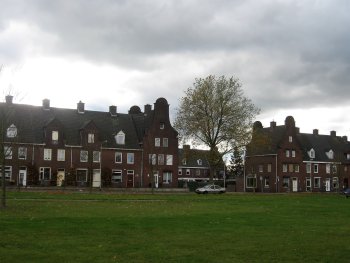
Built in 1941, but only completed after WWII in 1947, the Maria Christina neighbourhood in Heerlen, Limburg, was designed by German architects Karl Gonser and Hans-Georg Oechler by order of Hitler and has been protected heritage since 2008. The locals have long referred to this neighbourhood as the ‘Hermann Göring’ neighbourhood, as the story goes that he actually visited the area before construction started. Although thousands of houses were originally planned, the neighbourhood ended up with 240 homes of different sizes, clearly meant for families with many children (many small rooms upstairs and big gardens by local standards), in this case German mine workers that were to take over the mines from the Dutch.
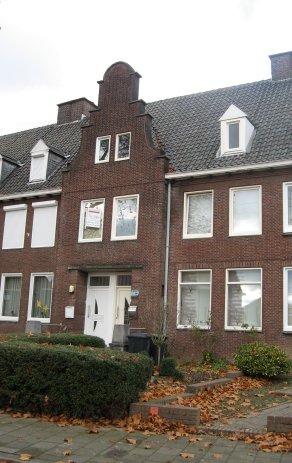
A plaque I read while visiting the neighbourhood explains that the houses with big attics had saddle roofs masoned with rare bricks called ‘vechtsteen’, bricks made of clay that came from the region along the river Vecht. There is also a rumour that houses were broken down in the province of Zeeland, all the way across the country just to building these houses, which is plausible considering that there was ‘vechtsteen’ to be had in Zeeland.

As you can see in both pictures, some houses have a 17th century Dutch bell gable. The first picture shows a row of houses with prominent bell gable houses, while on other streets, the bell gable house is in the middle of the row. My personal impression was that I was looking at row houses in Ireland, and that I was not in the Netherlands.

Many houses on either side of the bell gable house in the second picture are for sale and surprising inexpensive: 135,000 euro on average for 125m2 of living space. To give you an idea of how affordable that is, neigbours of mine in Amsterdam, the country’s most expensive city only rivalled by Utrecht, are trying to sell their 110m2 house for 335,000 euro, down from 349,000.

(Links: rijckheyt and nrcnext)

Tags: , , ,

October 31, 2010

Highest climbing wall in the world

Filed under: Architecture,Sports by Branko Collin @ 10:06 am

What do you do if your countryside is so flat, even the holes duck for cover? Why, build the highest climbing wall in the world of course.

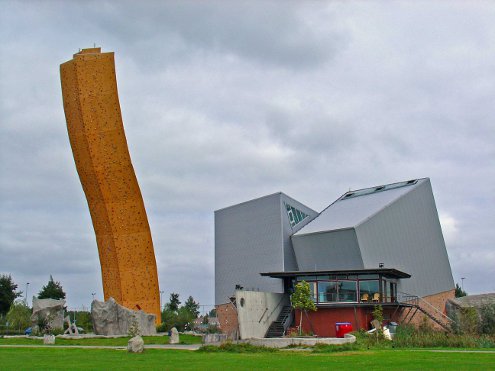
Meet Excalibur, the 37 meter climbing extravaganza of Bjoeks Klimcenter in Groningen. The tower was built in 2004 by Polsar, also from Groningen—the same owners in fact.

(Link: Damn Cool Pics, which has some interesting photos of the tower made by cameras dangling from kites. This photo by Jan Lafeber, who released it into the public domain.)

Tags: , ,

October 16, 2010

How the shortest highway of the Netherlands disappeared

Filed under: Architecture,Bicycles by Branko Collin @ 12:37 pm

Or: the return of the city moat of Utrecht.

Mark Wagenbuur has a video up that explains how the city of Utrecht wanted to replace the old city moat with a ring road in the 1970s, and how this plan met with vehement protests, so much so that only a small part of the road was actually ever built—nicknamed the Shortest Motorway in the Netherlands. Forty years on that road is being ripped out again, to be replaced by the water that once flowed there.

Wagenbuur is that odd duck, a cycling activist in the Netherlands, so he says things like, “it is clear that heavy motorized traffic simply does not belong here” without explaining why this apparently clear thing is so clear (the cyclirati know why—because cars are Evil). But he forgets to mention that since the mid-1990s, the years of heavy river flooding, giving the Dutchman his water back has become very fashionable. You have to wonder what marvellous things a new old brook, canal or moat can do to property prices, and whether this influenced Utrecht’s decision in any way.

Nevertheless, Wagenbuur’s videos come as highly recommended as ever.

(Source video: YouTube)

Tags: ,

September 19, 2010

Zaandam turning green

Filed under: Architecture,Art by Branko Collin @ 6:34 pm

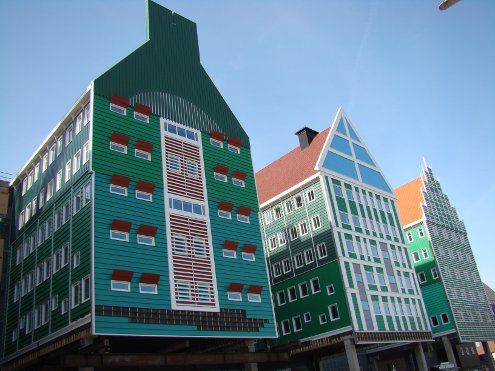
No, the headline is not about environmental technology but about paint. We wrote earlier about the hotel in Zaandam that is made to look like it’s constructed of dozens of the green wooden houses that are typical for the area. It turns out that this was just part of a plan to give a much larger part of the inner city that look, including city hall.

Trendbeheer has more photos of the work in progress.

Alderman Hans Luiten told De Volkskrant in March: “There have been times where I wondered if I could deal with this much identity.” The new city centre is a response to the neglect of the old one. Luiten: “In the past you would not have wanted to be found dead there.”

The man behind the reshaping of the centre of Zaandam into a green Disneyland/nightmare/whatever is architect Sjoerd Soeters who was also responsible for Java Island in Amsterdam. “All his works have been discussed vehemently among architects, but are also appreciated much by their users”, Volkskrant adds. It appears that behind Soeters’ façades lurks a strong vision of livable streets. Which may be why the main street on the aforementioned Java Island is a foot and bike path.

(Photo of the new city hall in Zaandam by Wikimedia user Arch who released it in the public domain)

Tags: , , ,

September 14, 2010

Delft University library desk

Filed under: Architecture,Design by Branko Collin @ 10:14 pm

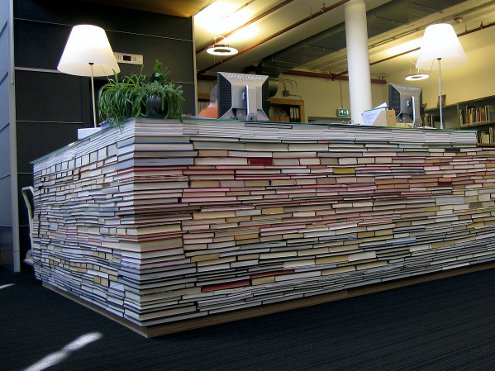
This is the service desk of the architecture library at the University of Delft. Neat, eh?

(Photo by Flickr user IK’s World Trip, some rights reserved. Link, with more photos: Recyclart.)

Tags: ,

September 5, 2010

Temporary reduction of sales tax on renovations

Filed under: Architecture by Branko Collin @ 12:03 pm

Government ministers De Jager (Finance) and Middelkoop (Housing) have announced a temporary lowering of the sales tax on home make-overs from 19% to 6%.
The reduction is to take effect on October 1, 2010 and will last until July 1, 2011, Telegraaf reports. The care-taker government hopes that this will soften the blow of the crisis for the building sector.

Some of the rules for the lower tax are:

  • Only for houses of two years and older.
  • Only for labour costs.
  • Only for improvements that will raise the resale value of your house.

(Photo by Yola de Lusenet, some rights reserved)

Tags: , , , , ,

August 1, 2010

Unesco pulls trigger on Amsterdam

Filed under: Architecture,General,History by Branko Collin @ 1:35 pm

Amsterdam’s city hall scored a major victory in the War on Fun today when Unesco added the city’s historical centre to its World Heritage list.
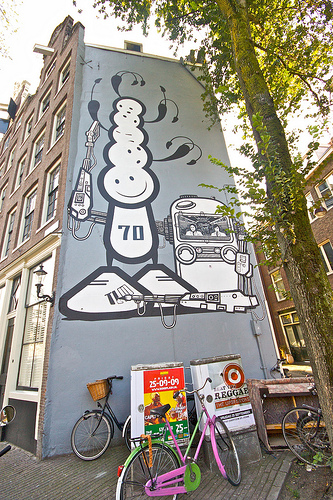
The appointment fits right into the city government’s fantasies of turning the city into Anton Pieck‘s wet dream. A group critical of—and therefore silenced by—the municipality, pointed to the damning example of staid Bruges in Belgium earlier.

Publicist Rogier van Kralingen told Radio Netherlands: “People don’t visit Amsterdam just because it gives them a flavour of the past, but because it has a strong spirit of freedom. The city has an open-hearted, liberal feel to it. If a city wants to create a good environment for its residents and international businesses – which, let’s face it, will have to provide most of our income – you need to maintain a healthy balance between tourism, recreation and people’s freedom to do what they want.”

It’s not like the city and borough councils needed more ammunition: here’s a list of things they have already outlawed. And what’s keeping the Robert-Jasper Grootveld statue?

The Unesco decision makes downtown Amsterdam the seventh World Heritage site in the kingdom.

(Photo by Colleen Taugher, some rights reserved)

Tags: , , , , ,

July 16, 2010

Bureaucrats want to remove commissioned wall graffiti

Filed under: Architecture,Art by Orangemaster @ 3:11 pm
3928009539_073b9eb039

An entire year after having been commissioned by the City of Amsterdam, a wall graffiti with annexed garden downtown on the Prinsengracht by The London Police apparently has to be painted over, as it doesn’t ’embellish’ the area of downtown Amsterdam it is in. Nonsense!

Seasoned Amsterdam residents know that this bit of nannyism is bureaucrat code for ‘we’re still trying to get Amsterdam on the Unesco list and this probably won’t help’.

Why was it put up in the first place? Why take one year to devalue something you’ve ordered? Who complained about it? Does it have something to do with Amsterdam’s new, slightly more conservative mayor Eberhard van der Laan? Was someone bored at work?

Funny, Miami, New York, Munich and other big cities around the world have no problems with their London Police wall graffiti at all.

(Link: parool, Photo of Graffiti by London Police by Pierrot, some rights reserved)

Tags: , ,

June 27, 2010

Lily shaped tower in Wuhan, China

Filed under: Architecture by Branko Collin @ 2:50 pm

Smack in the middle of China on the Yangtze Kiang river lies the huge capital of Hubei province, Wuhan. Nicknamed one of the ‘four furnaces’ of China because of its oppressive humid heat in the summer, the city will become home to this lily shaped tower, shaped so that it can stand in its own shade.

Soeters Van Eldonk architects designed the building in collaboration with Grontmij engineering for Wuhan University, and it will house the New Energy Centre. Since it is to become an environment for studying new energy technologies, Soeters van Eldonk hope to have the tower both emit zero carbon and use zero energy. The huge roof consists of solar panels and a solar chimney for cooling.

Construction will start at the end of the year.

(Link: Inhabitat.com. Photo: Soeters Van Eldonk architects)

Tags: ,