May 9, 2012

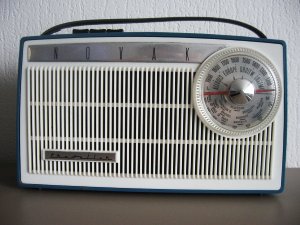
Dutch world radio service goes off the air

Filed under: General,History by Orangemaster @ 2:04 pm

Some 65 years after it all started, Radio Netherlands Worldwide’s Dutch service will go off the air this week on Friday 11 May. To mark the shut down, it will feature a 24-hour live radio marathon starting on Thursday 10 May at 8 pm UTC (10 pm local time) and run until Friday 11 May at 8 pm UTC (10 pm local time).

Hosts Karin van den Boogaert, Anouk Tijssen and Wim Vriezen will talk about the station’s beginnings, playing wartime audio from Radio Oranje and many RNW newscasts of important events in Dutch and world history. They’ll also touch upon special programmes on culture and language as well as shows aimed at expats, seafarers and truck drivers.

Although the Dutch service is signing off for good, they’ll also talk about the future of Radio Netherlands Worldwide, promoting free speech in places where freedom of the press is under threat. Basically, this is what they are being ask to push after the budgets cuts, making the best of a bad situation.

RNW is going off the air due to huge budget cuts, losing some 70% of their usual funding. Tons of people will lose or have already lost their job, while Editor-in-Chief Rik Rensen and his second in command Ardi Bouwers, quit in April over the cuts. RIP.

(Links: www.rnw.nl, www.rnw.nl – cuts)
Tags: ,

May 2, 2012

British RAF pilots cycle to the Netherlands for memorial

Filed under: Aviation,Bicycles,History by Orangemaster @ 10:28 pm

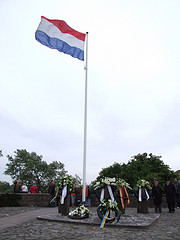
A group of nine pilots from the 99th RAF Squadron arrived in Landsmeer near Amsterdam today after four days of cycling from the UK. They were welcomed with a fanfare by the mayor like heroes. Every year they go to the monument to commemorate their deceased Squadron members. And since the British army is cutting back on expenses, the nine men couldn’t fly over and so they decided in true Dutch style to bike 750 kilometres.

The first question RTVNH (Radio and Television North Holland) had for one of them in true British understatement style was “how are your buttocks?”.

(Link: www.rtvnh.nl, Photo of Memorial by Bjorn V., some rights reserved)

Tags: ,

May 1, 2012

Remembrance of the Dead gets controversial

Filed under: History,Literature by Orangemaster @ 11:29 pm

First, there was the banning of a poem about a teenage boy’s SS uncle deemed inappropriate to be read at the annual Amsterdam ceremony, now the town of Vorden, Gelderland, which has one of the only graves in the Netherlands with German soldiers buried in it that wants to commemorate them. Basically, it’s fashionable to blur the lines between victim and perpetrator: it’s cool to be on the wrong side of things. And there’s so much bad taste going around these days, you need to pick your battles.

The Remembrance of the Dead on 4 May is to commemorate civilians and soldiers of all kinds who died in WWII, Dutch or foreign, but since the 1960s it has also included other wars and major conflicts. The boy’s poem was also meant to commemorate a Dutch volunteer who ended up on the wrong side of things, but after much commotion from Jewish organisations and the public at large, it was pulled. The teenager did well in winning a contest with his poem, but it’s too bad he’s being dragged in the mud for it. Only one line of the poem points to the man being on the German side, it’s not a big pro-Nazi rant or anything.

However, paying tribute to German soldiers flat out is losing the plot in my opinion. Or amnesia. Or dementia.

Tags: , , ,

April 17, 2012

The Yugoslavian chapter of the Yuri Gargarin fan club

Filed under: Film,History by Orangemaster @ 9:53 pm

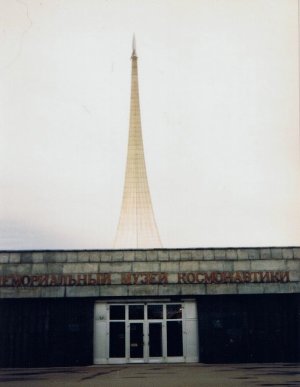
Last year, we told you about the booklet ’50 years of human space flight’ written in English by Steve Korver, with photos by film director René Nuijens who had gone to Russia to gather information on Russia’s Yuri Gagarin, the first man in space. This year marks the 51st anniversary of his famous feat, and the guys put together this film about a man from Belgrade who dreamt of becoming a cosmonaut ever since he was a boy.

And if you like your space fix more modern, you have to see Dutch astronaut André Kuipers’ Flickr photostream. He’s up there right now taking pics almost every day.

(Link: www.amsterdamadblog.com)

Tags: , ,

April 15, 2012

How Dutch beer created Belgium

Filed under: Food & Drink,History by Branko Collin @ 2:07 pm

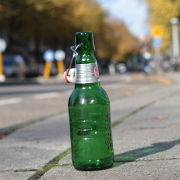
Belgian beers are widely recognised as some of the best in the world, but ironically it was Dutch beer that had a hand in creating the country of Belgium.

The latter at least is something that two Belgian economists argue in their paper War, taxes and border: how beer created Belgium (PDF).

Between 1568 and 1609 the Dutch fought a war of attrition against the Spanish in an ultimately successful attempt to get out from under the rule of the house of Habsburg. At the end, the Seventeen Provinces split into a Northern part (largely coinciding with current-day Netherlands) and a Spanish controlled Southern part (Belgium).

Koen Deconinck and Johan Swinnen from the Economics faculty of the University of Leuven in Belgium argue that the high costs of the war were covered on the Dutch side by high taxes on beer. Small cities would have dozens of brewers, and the beer they sold would often account for as much as half of the municipal tax receipts, large chunks of which would go straight to the war effort.

The success of the beer excise was in part due to a highly efficient system of tax enforcement (Unger 2001; 2004). During the sixteenth century, most cities in the Netherlands developed a similar system to minimize the possibility of fraud and tax evasion based on a strict separation of beer production, beer transportation and beer selling. In practically every town, only officially licensed and sworn beer porters were allowed to transport beer. No barrel of beer could leave the brewery unless there was a receipt to prove that all necessary excises had been paid. Porters were forbidden from delivering beer unless there was a receipt, and it was their task to hand over the receipt to the buyer. Anyone who sold beer (e.g. in a tavern) needed receipts to prove that all taxes had been paid. […]

Governments were also concerned about other possibilities for tax evasion. Ship builders, for instance, could traditionally buy beer tax free. To avoid evasion, the town of Amsterdam decreed that they would have to pay the taxes first, and then ask a rebate afterwards. Another case concerns home brewing, which was in principle subject to taxation, although this was difficult to enforce in practice. In the 1580s the government of Holland, following an earlier move by the town of Amsterdam, simply outlawed home brewing in the entire province.

Beer was the go-to drink in those days. Wine was expensive, coffee and tea non-existant, water polluted and milk perishable.

(Via: Mick Hartley)

Tags: , , , ,

April 13, 2012

Ancient cannabis found during railway construction

Filed under: General,History by Orangemaster @ 3:29 pm

With an emphasis on most probably, archaeologists have found bits of what looks like Cannabis sativa in a grave from the stone age some 4200 years ago near Hattemerbroek where digging is going on to build the Hanseatic railway line. It would also be the first time that cannabis has been found in a grave in the Netherlands. They also found other medicinal plants, jewels, tools and drinking cups.

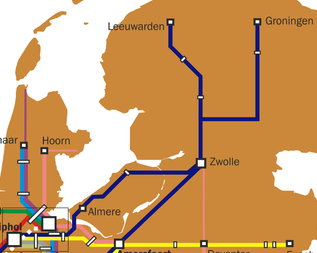
This part of the country has apparently never been really dug up, and so who knows what they’ll find next, as the railway will only be ready in December 2012. The Hanseatic line (Hanzelijn in Dutch) will connect the Randstad conurbation with the Northwest part of the country, namely the cities of Leeuwarden and Groningen (see map).

Currently, the only way to get up there by train is through Amersfoort (cut off on the map, the white square below Zwolle on the blue line more to the right) and then Zwolle, but it involves switching trains at Zwolle because they are no direct trains (intercity trains) like in the rest of the country. It takes a good three hours to get there and people from Leeuwarden and Groningen are a bit fed up of having to switch trains when then commute.

The good news is, wait, it’s bad news. The Hanseatic line will connect Lelystad to Zwolle avoiding Amersfoort , but it will unfortunately take the same amount of time for commuters. Train infrastructure company ProRail has said that commuters will still have to switch at Zwolle without explaining why that is, and so there’s a petition doing the rounds against it. I can imagine they feel like second-class citizens, knowing that if you live in Maastricht or Heerlen you can usually go to Amsterdam Central Station in one go.

(Links: www.waarmaarraar.nl, www.prorailpersberichten.nl, Photos Photo by Eric Caballero, some rights reserved, Photo of Intercitynet NL 2013 by Classical geographer, some rights reserved)

Tags: , ,

February 16, 2012

A warehouse full of works by Karel Appel found in the UK

Filed under: Art,History by Orangemaster @ 2:03 pm

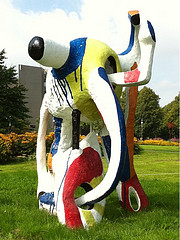
Reported as missing or stolen long ago, more than 400 works by Dutch painter, sculptor and poet Karel Appel were found in a bunch of crates, in a British warehouse.

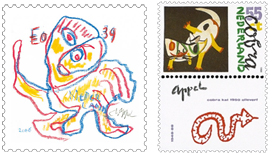
The artist, who died in 2006 at age 85, was one of the founders of the Cobra movement. Just before he died in 2006, he designed a postage stamp for an exhibition on visual artists entitled ‘Kunst’ (‘Art’), the last work of art he ever made.

Now we wait and soon find out what kind of goodies we missed.

We once wrote about a film, The reality of Karel Appel, which also featured some music by Appel.

(Link: www.bbc.co.uk, Photo of Karel Appel, Elephant by Comicbase, some rights reserved)

Tags:

January 2, 2012

The man who sells church interiors

Filed under: Architecture,History,Religion by Branko Collin @ 3:39 pm

Two weeks ago Der Spiegel published an interview in English with Marc de Beyer, a man who sells pews and other items for churches that are closing their doors:

Marc de Beyer is an art historian in Utrecht, located about a half an hour by train from Amsterdam, but one could also call him a liquidator. He’s a man who shuts down churches. When a parish is dissolved, when a church is shuttered, de Beyer is there. And he has a lot to do.

Some 4,400 church buildings remain in the Netherlands. But each week, around two close their doors forever. This mainly affects the Catholics, who will be forced to offload half of their churches in the coming years.

See also:

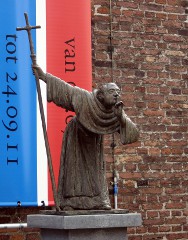
(Photo: the Dominican church in Venlo was turned into a ‘cultural podium […] when the priests left the city in 2005‘. This statue of a blackfriar still reminds passers-by of the building’s original purpose.)

Tags: ,

November 11, 2011

The King of Indo-Rock is no longer

Filed under: History,Music by Orangemaster @ 11:57 am

Rock and roll guitarist Andy Tielman, the figurehead of the Indo-Rock scene and frontman of the Tielman Brothers band has died in Indonesia at age 75.

Before immigrating to the Netherlands, the Tielman played for the Dutch military in Indonesia in the early 1950s. They quickly became famous, having been invited to play the World Expo in Brussels in 1958, just one year after landing in the Netherlands.

Later in their career, they also toured much of Germany. “At that time, bands could only play on weekends for little or no money at all, but in Germany they could get a contract for a month or at least a couple of weeks and make scandalous much money.”

Tielman fans also call him an innovator. He took a six string electric guitar, added four extra strings and tuned them in a way nobody had done before, in search of the big sound he wanted, which became the band’s tight signature sound. The bass players also had two different sounds that complimented each other through the use of different strings and specific amplifier setting, making the Tielman sound very wide on stage.

However, it’s the way Tielman brothers played their instruments live that people wanted to see and here is a video of them rockin’ out.

(Link: nos.nl)

Tags: , ,

November 8, 2011

My name is Cohen at Jewish Historical Museum

Filed under: History,Photography by Orangemaster @ 12:46 pm
annefrankstatue1.jpg

Starting on 25 November 2011, Amsterdam’s Jewish Historical Museum will feature the exhibition ‘Mijn naam is Cohen’ (‘My name is Cohen’), a series of portraits made by Amsterdam photographer Daniel Cohen with texts by unrelated Editor-in-Chief of magazine Vrij Nederland, Mischa Cohen.

They got together and found 25 people with the same last name, but of different generations, backgrounds, gender, views, Jewish and non-Jewish. Former mayor and politician Job Cohen is mentioned as is journalist Jisca Cohen thanks in part to whom I got to meet Daniel Cohen (unrelated to each other) and found out about his project first hand. I also know he plays a good game of football.

The quick and dirty version is that Amsterdam (aka Mokum, its Jewish name still very much in use by everyone) had lots of Jews and today for Holocaust reasons has very few.

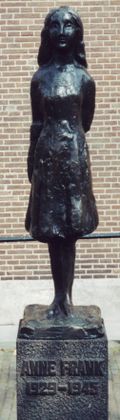
(The picture of Anne Frank, the most ‘popular’ Jewish figure of Amsterdam who was German and not Dutch.)

(Link: www.jhm.nl)

Tags: , , ,