April 6, 2011

Dutch sign language jokes, not very politically correct

Filed under: General,History by Orangemaster @ 11:55 pm

Watch this video here, we can’t embed it. It is subtitled in English.

They say it is a prejudice to sign a headscarf as a symbol for the cheap German supermarket chain Aldi where Muslims shop and to sign a pointy helmet for Germans referring to the WWII. It’s nice to know that the Dutch speaking world is not alone in its prejudices.

And the Dutch have five sign language dialects because they had five different schools that did their own thing.

The sign for Facebook does remind me of a fish.

Tags: , , ,

March 22, 2011

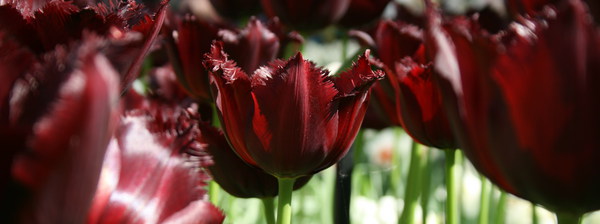
New tulip named after Vincent van Gogh

Filed under: Art,History,Nature by Orangemaster @ 11:33 am

Spring and the Keukenhof, the world’s largest flower garden that attracts visitors from around the world has a new red-brown tulip named after Vincent van Gogh.

Omroep Brabant got an explanation from Amsterdam’ Van Gogh Museum that there is no relation whatsoever between the flower and Van Gogh. He’s never even painted tulips, but he did like flowers.

(Link: vangoghmuseum, omroepbrabant.nl, Photo of Van Gogh tulip by vangoghmuseum)

Tags: , ,

March 21, 2011

Oldest graves of the Netherlands discovered in Rotterdam

Filed under: History by Branko Collin @ 8:31 am

BOOR wrote earlier this month:

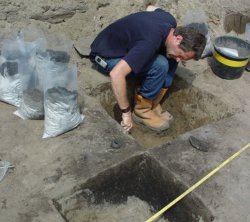
During a dig in 2008 in the Rotterdam neighbourhood Beverwaard three pits with cremated human remains have been found. Carbon dating has revealed the remains to be 9,000 years old. That makes these the oldest graves in the Netherlands.

BOOR archaeologists studied the top of a river dune where a tram garage was to be built. The graves, dating from the middle stone age (8000 – 3500 BC), also contained burial gifts such as flint tools, a hammer and a wetting stone.

BOOR is the municipal bureau for archaeology of Rotterdam.

(Photo: BOOR. Link: Telegraaf)

Tags: , , , ,

March 7, 2011

Carnival parade in Sittard, the Prince throws oranges

Filed under: Food & Drink,General,History,Music by Orangemaster @ 2:36 pm

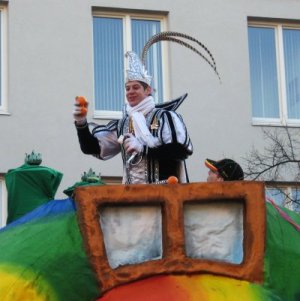
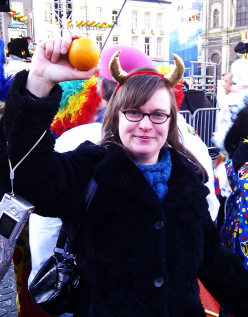
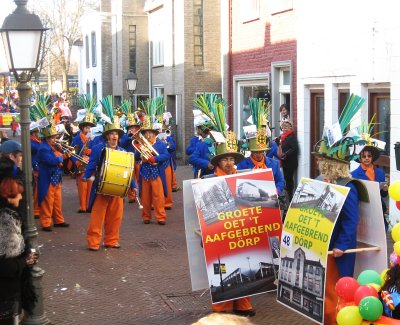
I had heard rumors that in Sittard, Limburg, the carnival Prince throws oranges and I had to go and find out if that was true. Once his float arrived on the Market Square I snapped a picture of him (Tom 1) and I also caught an orange. I’m grateful he didn’t try to hit people with them.

A lot of the people parading also gave their social commentary about Sittard, a city falling apart and watching the number of inhabitants dwindle like many other places in Limburg. In local dialect, these signs read ‘Greetings from the torn down city’, referring to the many broken down and empty buildings in Sittard.

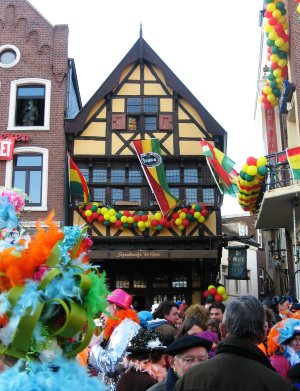
In sharp contrast to the ugly parts of town, the lovely Sjtadscafe de Gats dating back from 1535 on the Market Square makes for a lovely background. I saw a few more similar buildings from that era, as the town didn’t really suffer serious architectural damage from WWII.

Tags: , ,

March 6, 2011

Children’s carnival parade in Heerlen

Filed under: Food & Drink,General,History,Music by Orangemaster @ 11:26 am

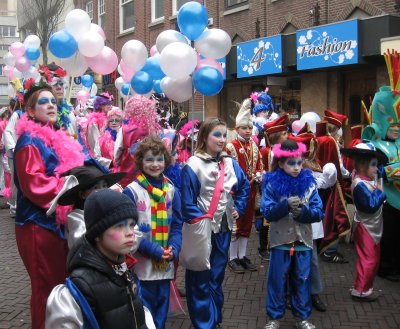
It’s carnival time again in the South provinces of the Netherlands and yesterday in Heerlen, Limburg they had their children’s parade with parents, prams and princes. The red-green-yellow scarf that doesn’t match the rest adorns the carnival colours, a must have for many.

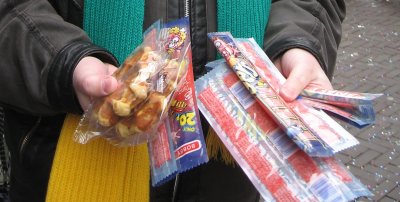
Besides a good story I wanted to know if the kids on the floats threw sweets like they did in when attended carnival in Cologne, Germany a few years back. Just as I reached into my purse to get my camera, I got beaned by a waffle! And I collected enough for breakfast before writing this.

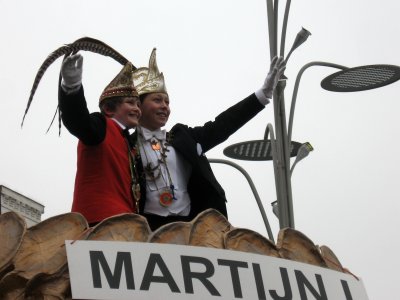
Eventually the children’s carnival Prince, ‘Martijn 1’, showed up in full dress, waving to the crowd. From what I’ve learned, picking the carnival Prince is done by a serious carnival association and is chosen from different schools alternately. They also have princesses, it is done months in advance and is kept secret until the very last minute, a very dear tradition in these parts.

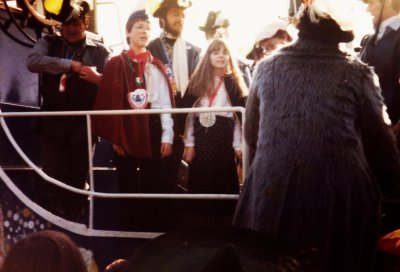
Has the tradition changed over the years? Well, I’m sure some things have, but a few things have definitely remained the same according to a former junior carnival Prince, vintage 1981.

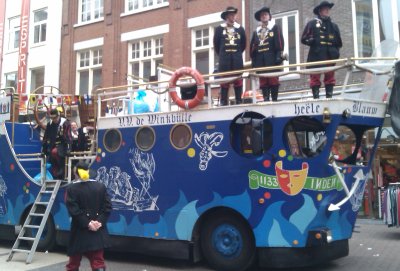
Notice the ship-like float the junior carnival Prince and Princess were standing on here back in 1981? Well, they still use it today, the Blauw Sjuut in local dialect.

Tags: , , , ,

February 23, 2011

Thirty years after the Pierson Street riots in Nijmegen

Filed under: History by Orangemaster @ 2:14 pm

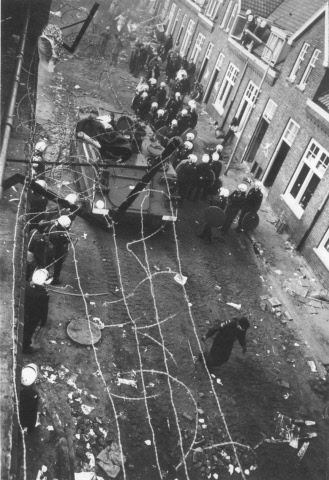
Today exactly 30 years ago, the Dutch government used 5 tanks, armored vehicles, a helicopter, nearly 3,000 soldiers (MP and special army units) and police, and two types of teargas (illegal use), to end a protest in my hometown of Nijmegen against the demolition of a centuries old residential area for a parking garage.

The major point was that there was (and still is) a lack of housing in Nijmegen and throwing people out of their homes to make way for a parking garage seemed like a good reason to fight.

The Mayor signed posters that read in capitals:

1. DON’T USE VIOLENCE.
2. DON’T THROW MOLOTOV COCKTAILS, FIRE BOMBS AND THE LIKES.
3 REMOVE YOURSELF.

UPDATE: Free and legal download of the punk track in the background and more by Nijmegen’s The Squats (Thanks Marco!)

(Tip: Thanks Rob!, Photo: studiezaal.nijmegen.nl)

Tags: ,

December 1, 2010

Please remove the jet fighter from your garden

Filed under: Art,Aviation,Comics,History,Weird by Orangemaster @ 3:09 pm

Artist Marte Röling (often misspelled Martha) has a Lockheed F-104 starfighter in her garden in Uithuizen, Groningen that apparently has to be removed if she hasn’t removed it already. Although it has been sitting there since 1989, some boffins at the Ministry of Defense now think it could be slightly radioactive. Röling received the starfighter as a long-term loan art project. This reminds me of some Peter Tooms in Schoonloo, Drenthe who has a Russian MiG in his yard, although maybe it has been removed as well.

Back in 1976 Prince Bernhard (husband of Queen Juliana) cashed a US$1.1 million bribe from American aviation company Lockheed to ensure that the Lockheed F-104 would win out over France’s Mirage 5 made by Dassault for the purchase contract. Long story short, Bernhard refused to admit it, but after his death in 2004, it turned out to be ‘highly plausible’, but I don’t know if proven is the right word. Lockheed deposited large sums of cash into an account of some guy called Victor Baarn, a person that could never be traced. Co-blogger Branko tells me that Dutch comic strip artist Martin Lodewijk has been milking that story for ages, as in almost every Agent 327 comic book (a character loosely based on James Bond) the secret identity of Victor Baarn threatens to come out.

UPDATE: This was our 1,500th posting, hurrah!)

(Link: rtvnoord)

Tags: , ,

November 29, 2010

Surinam’s deed of independence has been lost

Filed under: History by Branko Collin @ 2:13 pm

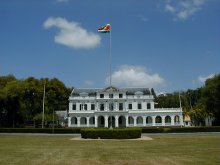
A reporter from Surinam daily De Ware Tijd has discovered that the document in which former Queen Juliana recognised the independence of Surinam in 1975 has been lost.

Home Affairs Minister Soewarto Moestadja, has started a search and is focussing on three leads. The document that signifies the birth of a nation may be in the vault of the national bank, it may be in the national archive, or it may have been lost to the flames of the fire that destroyed the Ministry of General Affairs during the 1980s.

The Netherlands still has its own copy of the deed of recognition, somewhere.

In 1667 the Netherlands ‘traded’ New York (then New Amsterdam) for Surinam in a treaty that concluded the Second Anglo-Dutch War. In reality both colonies had already been conquered by respectively the English and the Dutch, and the treaty merely cemented the status quo. The independence 318 years later was accompanied by the same lack of dramatics, as Surinam asked for independence in 1973 and received it two years later.

(Link: Waterkant.net, Photo by Ian Mackenzie, some rights reserved)

Tags: , , ,

November 21, 2010

Mash-up of war-time and modern photos

Filed under: History,Photography by Branko Collin @ 8:42 am

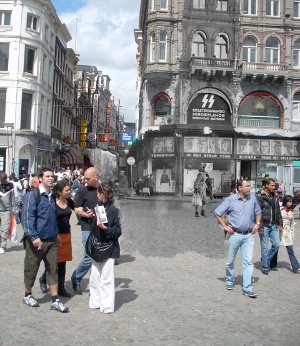
The Schutzstaffel did in fact once have an office in the middle of Amsterdam, on the Dam square to be precise, and historian Jo Teeuwisse has created a great set of photo mash-ups that bring home how the world fitted back then.

Her ‘photoshops’ consist of modern photos overlayed with war-time pictures she found at a flea market. This works particularly well because from an architectural point of view the city of Amsterdam doesn’t seem to have changed much in the past 50 years, if Teeuwisse’s photos are anything to go by. And so you see tourists wandering around areas where once the cobblestones were red with blood, oblivious of that fact:

The final two pictures are of Dam square on Monday, 7 May 1945, two days after the German surrender. Thousands of Dutch people were waiting for the liberators to arrive in the square. They had lived through five years of war and months of fear and hunger. In the “Big” Club, members of the Kriegsmarine watched as the crowd below their balcony grew and grew, people danced and cheered.

Then, for some reason, the Germans placed a machine gun on the balcony and started shooting into the crowds. It has always remained uncertain why it happened but the tragic outcome was that, at the brink of peace, 120 people were badly injured and 22 people died.

See also:

Tags: , ,

November 9, 2010

Visiting a neighbourhood built by Hitler

Filed under: Architecture,History by Orangemaster @ 7:00 am

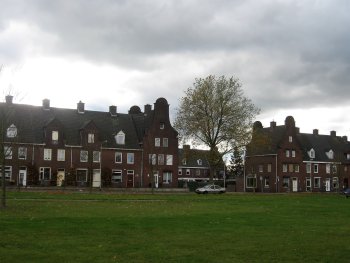
Built in 1941, but only completed after WWII in 1947, the Maria Christina neighbourhood in Heerlen, Limburg, was designed by German architects Karl Gonser and Hans-Georg Oechler by order of Hitler and has been protected heritage since 2008. The locals have long referred to this neighbourhood as the ‘Hermann Göring’ neighbourhood, as the story goes that he actually visited the area before construction started. Although thousands of houses were originally planned, the neighbourhood ended up with 240 homes of different sizes, clearly meant for families with many children (many small rooms upstairs and big gardens by local standards), in this case German mine workers that were to take over the mines from the Dutch.
A plaque I read while visiting the neighbourhood explains that the houses with big attics had saddle roofs masoned with rare bricks called ‘vechtsteen’, bricks made of clay that came from the region along the river Vecht. There is also a rumour that houses were broken down in the province of Zeeland, all the way across the country just to building these houses, which is plausible considering that there was ‘vechtsteen’ to be had in Zeeland.

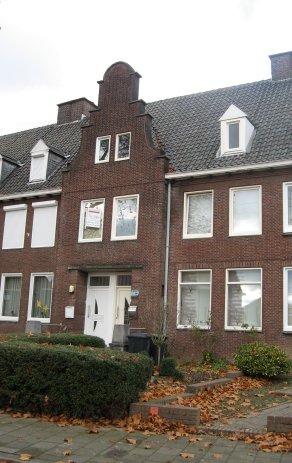
As you can see in both pictures, some houses have a 17th century Dutch bell gable. The first picture shows a row of houses with prominent bell gable houses, while on other streets, the bell gable house is in the middle of the row. My personal impression was that I was looking at row houses in Ireland, and that I was not in the Netherlands.

Many houses on either side of the bell gable house in the second picture are for sale and surprising inexpensive: 135,000 euro on average for 125m2 of living space. To give you an idea of how affordable that is, neigbours of mine in Amsterdam, the country’s most expensive city only rivalled by Utrecht, are trying to sell their 110m2 house for 335,000 euro, down from 349,000.

(Links: rijckheyt and nrcnext)

Tags: , , ,