December 12, 2009

Lost Leyster discovered

Filed under: Art,History by Branko Collin @ 8:31 am

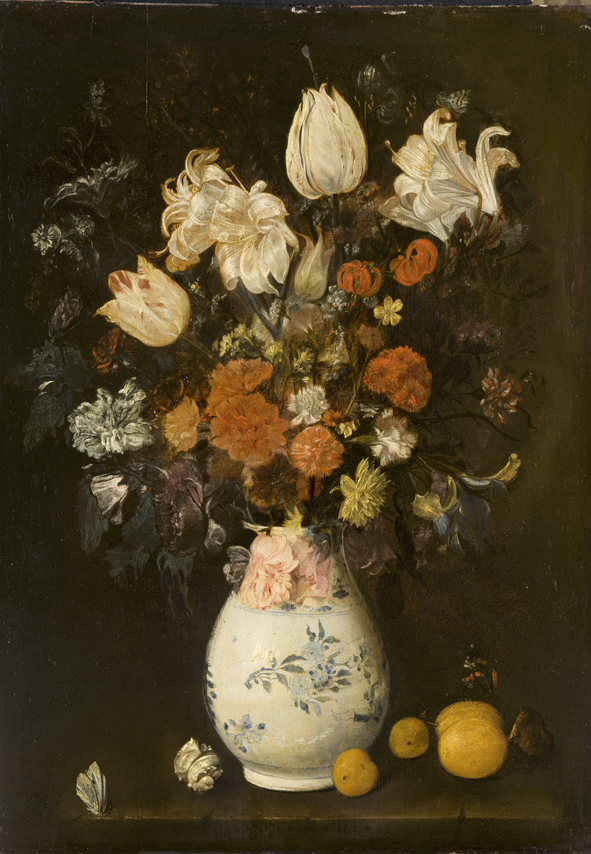
The Frans Hals Museum recently discovered this lost painting by Judith Leyster (1609-1660), the first female Dutch master painter.

The painting depicts a still life of a Chinese vase with flowers. Its Belgian owner, Mrs Luc from Ostend, alerted the museum in August of its existence. Although she was aware art collectors knew about the painting (it is listed in an inventory in Leyster’s husband’s possessions), she was waiting for the right moment to reveal the work, which she originally bought for about 500 euro in the 1970s.

Leyster became a master painter in 1633, the first woman in the West to do so. Her paintings seem inspired by Frans Hals, showing jolly drinkers, musicians and playing children. Both Leyster and Hals had their studios in Haarlem. After Leyster married fellow painter Jan Miense Molenaer in 1636, her output dwindled to a trickle, her last known painting being from 1643 until a few months ago.

The Frans Hals Museum quotes Leyster expert Frima Fox Hofrichter:

Many art historians have often assumed that Judith Leyster gave up painting upon her marriage. With the discovery of the flower still life and its date of 1654, we now have documentation that she continued her career as a painter. It is likely that Leyster moved to still-lives and botanical studies after her marriage, perhaps to split the market with her husband.

The Frans Hals Museum will host a Leyster exhibition from 19 December 2009 till May 9, 2010.

(Link: Parool. Source image: Frans Hals Museum.)

Tags: , , ,

November 8, 2009

Children’s books from the Roaring Twenties

Filed under: Art,History,Literature by Branko Collin @ 1:28 pm

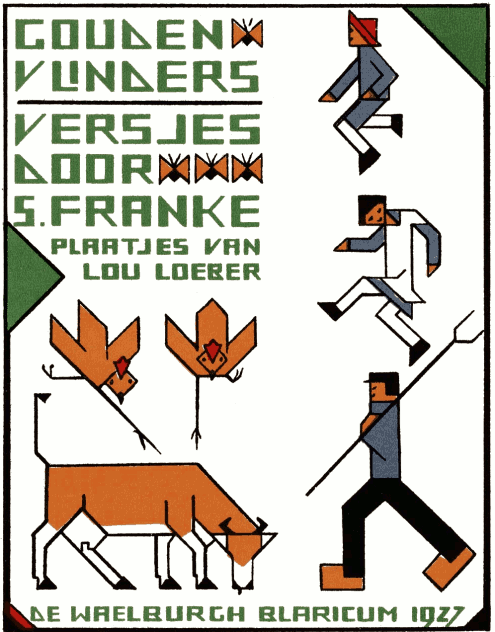
Oh, to have been a child in the 1920s, when you had children’s books illustrated in the De Stijl style. Gouden Vlinders, the cover of which pictured above, contained verse written by S. Franke and illustrations by Lou Loebe.

Pointed out to us by Daddytypes.com who also discusses and links to a number of other illustrated Dutch children’s books he likes. All are hosted at Geheugenvannederland.nl, a website of the Royal Library.

Tags: , , ,

November 1, 2009

Venlo made up foundation legend to fool the church

Filed under: History,Religion by Branko Collin @ 3:48 pm

In elementary school I was taught about the founding legend of my city of birth, Venlo. The story went that the leader of a local tribe, the Bructeri, fled a lost battle with the rival Chamavi tribe towards the fertile ground on the Meuse river in 96 AD.

In remembrance of this chief, called Valuas, giant dolls of him and his wife had been carried around the city for ages, and all kinds of companies, schools and clubs had been named after him. Valuas was Venlo.

Recently though I learned it’s all a crock, and all it took was a visit to Wikipedia. There is no such legend. Instead, the story was made up in its entirety in the 18th century, because the bishop of Roermond wanted to outlaw the use of dolls depicting Goliath and his wife in processions.

With Goliath given a new, non-religious identity, the bishop could no longer object to what was basically idolatry. Today, the local ceremonial shooting club, Akkermansgilde, still carries giant dolls of Valuas and his wife Guntrud around in processions and during carnival.

(Photo of Venlo city hall by Wikimedia user Michiel1972, some rights reserved.)

Tags: , , , , ,

October 18, 2009

Van Gogh’s letters and Max Havelaar in English

Filed under: Art,History,Literature by Branko Collin @ 11:34 am

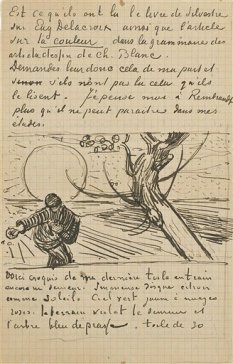
English translations of Vincent van Gogh’s letters to his brother Theo have been released in a 6 volume boxed set by the Van Gogh Museum in a 15-year-long cooperation with the Huygens Instituut. The original letters in French and Dutch have also been reproduced.

The entire set contains all the pictures referenced in the letters, that is, all 4,300 of them, The Guardian reports.

If you don’t feel like shelling out the 325 UKP that the set is undoubtedly worth, you can also read the letters and their translations at vangoghletters.org. The Huygens Instituut is part of the Dutch academy for sciences.

Story via Eamelje.net (Dutch), who in a totally unrelated story also points out that another Dutch giant of the 19th century, writer Multatuli, published his masterpiece Max Havelaar 150 years ago last Tuesday. The Havelaar has been in translation for a long time, and a public domain English version can be found at Google Books.

If you do not like PDF or EPUB, you might be able to extract the HTML version from the EPUB file (which is just a ZIP archive under a different name).

(more…)

Tags: , , , , ,

October 5, 2009

Anne Frank film, Miep Gies asteroid

Filed under: Film,General,History,Literature by Orangemaster @ 12:47 pm

“Here you can see Anne Frank leaning out of the window of her house in Amsterdam to get a good look at the bride and groom. It’s the only time Anne Frank has ever been captured on film, according to the Anne Frank House.”

Remember that if the people over at Dutch copyright collection agency Buma Stemra have their way, we won’t be able to show you fun vids anymore because it would cost us thousands of euro a year. Feel free to sign the petition: petitiononline.

Also in Anne Frank news, an asteroid between the Mars and Jupiter has been named Miep Gies last Sunday in honour of the Dutch woman who preserved the diary of Anne Frank. “The International Astronomical Union (IAU) said it wanted to draw attention to the steadfast courage of the now 100-year-old last surviving helper of the Frank family who hid in a building behind a house in Amsterdam during World War II.”

(Link: Presurfer, earthtimes.org)

Tags: , ,

September 11, 2009

New York birthday celebrations suffer heavy inflation

Filed under: General,History by Branko Collin @ 4:51 pm

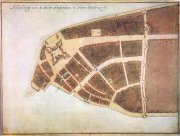
new_amsterdamWrites the Washington Post:

Four hundred years ago this month, Henry Hudson sailed on a Dutch ship into what became New York Harbor, a journey that inspired traders from the Netherlands to become the first immigrants to New York and establish a tolerant, motley Dutch settlement called New Amsterdam.

[…] While many New Yorkers are unaware of the festivities […].

Times have changed since previous anniversary celebrations. In 1909, there were two weeks of events, forming what was then the biggest citywide celebration New York had seen with millions of participants.

In 1959, the current queen of the Netherlands, then Princess Beatrix, came to New York for the 350th anniversary of Hudson’s arrival, and celebrated with a ticker tape parade.

“The world then was a different world,” Dutch Ambassador Renée Jones-Bos said. “Now there are far more countries. You have to work harder as a country to show what you can do and raise your profile.”

(Image: Castello Plan of the tip of Manhattan)

Tags: , , ,

July 31, 2009

Anne Frank diary added to Unesco world register

Filed under: General,History,Literature by Orangemaster @ 9:41 am
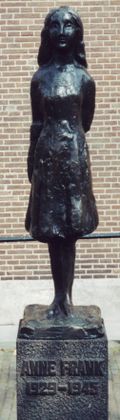
annefrankstatue1.jpg

Anne Frank’s diary has been added to the Memory of the World Register by UNESCO. UNESCO launched the Memory of the World Register to protect documentary heritage reflecting the diversity of the world’s peoples, languages, and cultures from ‘collective amnesia’.

Although often mistaken as a Dutch girl by many probably because she wrote her diary in Dutch, Anne Frank was a Jewish Germany girl who wrote about the two years she and her family spent in hiding in the Netherlands during WWII.

I still find it fascinating that Anne Frank is seen a source of Dutch pride — with good reason of course — while the growing amount of populists in the Netherlands do not think any Dutch person with a second passport qualifies as ‘part of the club’.

(Link: unmultimedia.org)

Tags:

July 23, 2009

The day the grown men cried

Filed under: Bicycles,History,Sports by Branko Collin @ 8:50 am

The Tour de France is drawing to a close, and Dutch cyclists and teams have so far failed to put their mark on the great race. Local sports writers have started to look elsewhere for heroic stories, and one of those places is the past. And the one story inevitably to be rediscovered is … dun! dun! … The Day the Grown Men Cried.

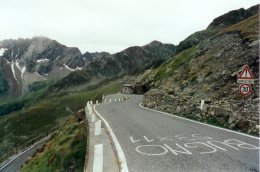
A story “from the old box”, as we say. On 5 June 1988, the Giro d’Italia was to climb the Passo di Gavia in the Italian Alps. A somewhat ordinary looking stage on paper, but when the cyclists woke that morning, they heard snow had covered the road at the top.

Dutch cyclist Johan van der Velde broke away from the pack at the start of the climb and was the first to cross the pass. But he paid a price! Just before his breakaway he had given his raincoat and sleaves to a surprised team-mate. Rain had already plagued the cyclists, but now, a few kilometres before the top, a blizzard hit the mountain.

Van der Velde managed to get over the top, but two kilometres into the descent his cold body started shaking uncontrollably and he had to stop for fear of falling off his bike. He never finished the descent on his bike, instead he drove in his team manager’s car to a point three kilometres off the finish, where he got back on and cycled the last bit. Van der Velde eventually lost 47 minutes to the winner, but wasn’t disqualified—the jury understood.

The conditions were so harsh that many cyclists had to stop for cognac, hot tea and massages. It was so cold that two of the former Giro winners cried in pain. The snow froze the cyclists’ hands and clogged up their brakes, turning the descent into a dangerous undertaking.

Only two of the cyclists in front finished the descent without stopping and without help. Andy Hampsten of the USA and Erik Breukink of the Netherlands raced off the mountain as fast as they could towards the finish line in Bormio. A couple of kilometres before the end, Breukink sped past Hampsten (PDF) and won the race by 15 seconds. Hampsten however won the pink jersey, the mark of the race leader, and he wouldn’t let go of it until the end, competing a fierce battle with second place Breukink in the remaining stages. Hampsten became the first American to win the second most prestigious bicycle race in the world.

Breukink admitted that it was only the thought of being in contention (Dutch, Real Media) that kept him on his bike during that brutal descent. Until then, he had had the reputation of being a bit of a softy, but the Gavia Pass win rid him of that moniker forever.

Through some miraculous stroke of luck, none of the cyclists died that day, although Hampsten’s team-mate and countryman Bob Roll suffered from hypothermia and an extremely low heart rate of 27 bpm.

There are very few TV images I can show you of this stage. Like today, the major bicycle races then had extensive TV coverage, shot by cameramen on motorcycles often taking even more risks in slippery descents than the cyclists themselves. The images were supplemented by video shot from helicopters that doubled as flying relay stations. The signal from a motor camera will not travel through mountains, and on that day it was discovered that blizzards have the same effect. The only moving images made of this climb were those of a solitary land-locked camera at the top of the pass.

Watching that video made me realise that in those days you could play another game of Spot the Dutchman. French team La Vie Claire (Bernard Hinault, Greg Lemond) wore jerseys inspired by Piet Mondriaan’s paintings.

(Photo of the Passo di Gavia by Marco Mayer, some rights reserved.)

Tags: , ,

July 11, 2009

Calvin’s 500th birthday luxuries sell briskly

Filed under: History,Religion by Branko Collin @ 11:27 am

The granddaddy of the War on Fun must surely be Jean Cauvin (1509 – 1564), the French protestant priest who is seen around these parts as more influential than Luther himself. The man was a big believer in hard work and no (earthly) reward, so it is perhaps odd that the trinkets that are being sold in honour of his 500th anniversary are selling like hot cakes.

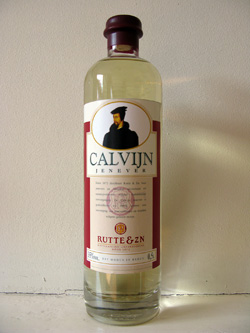
Brabants Dagblad reports (Dutch) that a small lake of Calvijn jenever has already been sold (500+ bottles), and that the 25,000 print run of the Calvijn glossy has completely sold out. The exhibition about his life in Dordrecht has so far attracted more than 60,000 visitors. It is unknown if all these people gorged themselves on nectar and ambrosia right after, but there are ten restaurants in Dordrecht that offer special Calvin meals. Perhaps just a pea on a plate, who knows?

Novelist Maarten ‘t Hart points out delicately in NRC Handelsblad (Dutch) that some of the rules of sobriety of Calvin derive from Roman stoic philosopher Seneca the Younger, who did not like music and dancing (“[there is] a time to dance”, Ecc. 3:4) and other exuberances, such as wearing anything other than dark clothes (“Let thy garments be always white”, Ecc. 9:8).

Meanwhile, in the same paper (Dutch) liberal politician Boris van der Ham points out that the celebration of 500 years sobriety is also the celebration of 400 years resistance against the Calvinist philosophy. The States of Holland had a session in 1608 in which theologian Arminius pleaded for the free will of people: “And so I think that man tries to think well, want well and act well.” But Van der Ham also points out that the Dutch reputation as being straight-shooters to the point of being rude is firmly rooted in Calvinism. “In other countries ‘sins’ were often allowed in a don’t-ask,-don’t-tell way, here the curtains were drawn wide open. […] If other countries sometimes look with bewilderment at our freedoms, it’s not because of the freedoms themselves, but because we are so open and honest about them, in what is essentially a Calvinist way.”

(Photo: Calvijn Dordrecht.)

Tags: , , , , , , , , , , , ,

July 9, 2009

After 195 years, Staatsblad and Staatscourant disappear

Filed under: General,History by Branko Collin @ 11:37 am

No law or decree has ever been valid in this kingdom until after publication in the Staatsblad (laws) or Staatscourant (other government decisions with the force of law). That is, until July 1st of this year, when the paper editions of Staatsblad and Staatscourant were abandoned and a law came into force that allowed electronic publication of laws and decrees.

The Staatscourant was founded by the first Dutch King, Willem I, in 1814. Volkskrant reports that the king wasn’t shy of using this formal publication for political purposes, especially since it could compete cheaply with commercial newspapers.

With the official publications now taken care of by a website, bekendmaking.nl, Staatscourant and Staatsblad publisher SDU will continue with a printed weekly called SC that will focus on commentary on laws.

Tags: , , , ,