


 In Jasper de Beijer‘s work-in-progress The Riveted Kingdom, the photographer pays homage to “the sheer exuberance of the grand engineering projects of the Victorian era”. His method is to create papercraft models, then take beautiful photographs of them.
March 21, 2008
Papercraft models of the industrial age
Tags: papercraft
January 20, 2008
He brought a piece of his toe to the reunion
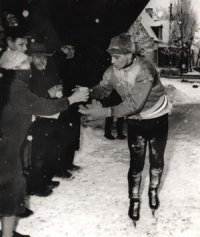
Tinus Udding kept a piece of his big toe that he lost way back in 1963 during the very harsh Elfstedentocht (Eleven-cities Tour speed skating competition in the province of Friesland when it’s cold enough) of 1963. Competition skater and all-round tough guy, Udding brought his left toe bit to the Elfstedentocht reunion held two days ago, commemorating the 45-year anniversary of the 1963 edition. The toe will get its own spot in the Schaatsmuseum (Skating museum) in Hindeloopen. The Elfstedentocht of that year took place in -18 degree weather with ice cold wind. Only 69 people made it to the finish out of the almost 568 competition skaters that took part. Tinus Udding was 31st, minus one toe.
(Link: telegraaf.nl, Photo: tvglorie)
Tags: 1963, Elfstedentocht, Frieland, Schaatsmuseum, toe
January 18, 2008
Anne Frank The Musical in Spanish

It probably remains to be seen and heard, but yes, the Spanish are making a musical out of Anne Frank’s Diary:
A Spanish production company is taking the unusual step of turning The Diary of Anne Frank into a musical. The production at Madrid’s Calderón Theatre does not open until 28th February, but it is already generating a few raised eyebrows.
Not everyone is convinced that the world-famous story of a Jewish teenager who became a victim of the Holocaust should be staged in this way. Tragedy is common fare for opera, but musicals are more often associated with happier subjects.
British theatre critic Michael Billington questioned the need for a musical version of Anne’s diary, in an entry on his blog called Anne Frank – the Musical strikes a false note. It basically asks if we really need this musical. And I have been laughing in my coffee writing this, as one person commented, “won’t the nazis hear her as soon as the tapdancing and singing starts?” Picture the audience participation at a midnight screening of the Rocky Horror Picture Show wtih someone calling out to the Nazis storming in the house “she’s in the attic!”.
The project has the backing of the Anne Frank Foundation, who own the house in Amsterdam where Anne and her family hid during the early 1940s. However, according to reports in the Australian media, the family of Anne Frank object to productions of this kind which treat her story as ‘entertainment’.
While the production has attracted media interest, it is not the first time that The Diary of Anne Frank has been turned into a musical. An English language musical under the name ‘Yours, Anne’ was produced Off Broadway in 1985.
I can’t help but add that although the Dutch know that Anne Frank was Jewish, she was in fact German – not Dutch. I say this because she was put on a list of the 10 most important Dutch figures of all time by the general public. Influential people are conveniently Dutch when it suits the Dutch media.
(Link: radionetherlands.nl)
Tags: Anne Frank, musicals, Spanish version
January 17, 2008
Golden age collections showcased in Wonder Stage of Nature
No Dutch Golden Age (17th century) collection of obscure and exotic trinkets and specimens appears to have survived, as heirs tended to sell off these collections to foreign collectors. However, we still have books that illustrate them at least. As Bibliodyssey writes:
The collection obsession of Early Modern Europe, that saw people stocking cabinets of curiosities […] with obscure and exotic trinkets and specimens from the worlds of ‘artificialia’ and ‘naturalia’, emerged in Holland under a local profile of influences.
Unlike most of their European counterparts, the Dutch republic lacked both a royal court or any sizeable aristocracy, so collecting was a hobby cultivated by regular citizens. […]
[There were numerous collections] built up by Dutch carpenters, merchants, tradesmen and artisans. The enthusiasm for collecting, in Holland at least, could be seen at all levels of society, but with the most notable collections owned by burghers and regents, in contrast to the kings, nobles and prelates of other European countries. And there is the rub. It was customary for families to sell off these ‘rariteitenkabinets’ and divide the spoils following the death of the collector. Accordingly, most Dutch collections of significance left the country, purchased by foreign nobility and no intact collections have survived; adding an interesting element of documentary detective work to scholarly assessments.
But at least a documentation of these collections has survived. The wonderful Bibliodyssey for instance liberally quotes a picture book by Levinus Vincent (1658-1727) called “Wondertooneel der Nature” (Wonder Stage of Nature).
Tags: collectors, Golden Age, museums
November 20, 2007
Anne Frank tree saved by the judge

The fate of the Anne Frank tree has been decided, after a judge had a good look at the tree just before making his decision: it may not be chopped down. Remember, it was really sick and hundreds of thousands of euro were spent to try and save it. At 7 pm Dutch time, a judge decided that the tree needs to be healed or fixed and that there are still things that they can do to keep it alive properly. He added that if the tree causes damages to houses nearby, owners will be compensated.
To anticipate the possible cutting of the tree, grafts have been made. And then there’s our earlier posting about the chestnuts of the Anne Frank tree sold on eBay. Apparently, they currently have a bid of $USD 10,340, which is pretty useless at this point in time.
The 150-year-old tree (a white horse chestnut tree – Aesculus hippocastanum) stands in the inner garden of the house at Keizersgracht 188, one street over from the Anne Frank House, which is on the Prinsengracht.
Anne Frank wrote the following entries about the chestnut tree in her diary:
23 February 1944
The two of us looked out at the blue sky, the bare chestnut tree glistening with dew, the seagulls and other birds glinting with silver as they swooped through the air, and we were so moved and entranced that we couldn’t speak.18 April 1944
April is glorious, not too hot and not too cold, with occasional light showers. Our chestnut tree is in leaf, and here and there you can already see a few small blossoms.13 May 1944
Our chestnut tree is in full blossom. It is covered with leaves and is even more beautiful than last year.
(Info: Live RTL 4 television, Photo: annefranktree.com, link: annefrank.org)
Tags: Amsterdam, Anne Frank, chesnuts, tree
October 23, 2007
25th birthday compact disc

Photo: Joop Sinjou reveals a new form of storing audio to the world in 1979, three years before the cd would go into mass production. Source: Philips.
On August 17, 1982, Dutch electronics giant Philips manufactured the first commercially available compact disc, a copy of The Visitors by ABBA, reports company glossy Password. An interesting choice because it would prove to be the last album of the dying Swedish megaband. By November that year Phiilips own record company Polygram would be selling from a catalog of 150 discs, mainly classical music.
I seem to remember that the CD never really caught on in the Netherlands until the late 1980s, when suddenly everybody wanted a player. According to collage band Negativland, the same revolution happened at the same time in the US, and wasn’t an accident:
[…] a flexible return policy had always existed between record stores and the seven major distributors, i.e. stores could “buy” something from a distributor, and if it didn’t sell, they could return it. This allowed stores to take more chances on new releases or on things they were not so familiar with, because if it didn’t sell, they could always send it back. Well, in the spring of 1989 all seven major label distributors announced that they would no longer accept “returns” on vinyl and they also began deleting much of the vinyl versions of their back catalog. These actions literally forced record stores to stop carrying vinyl. They could not afford the financial risk of carrying those releases that were on vinyl because if they didn’t sell they would be stuck with them. Very quickly almost all record stores had to convert to CDs. The net effect of this was that the consumer no longer had a choice because the choice had been made for us. High priced compact discs were being shoved down our throats, whether we knew it or liked it or not.
I don’t know if this policy was enforced world wide, but I do know that the price difference between the CD and the LP in the Netherlands—40 versus 25 guilders—never went away, even though the production costs of CDs would soon be lower than the original production costs of LPs.
Where were you when the digital audio revolution took place?
Tags: CD player, electronics, Philips
September 11, 2007
“Skiete” Willy, striker of untold legend
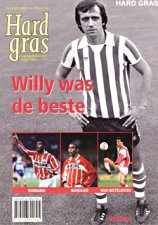 Literary football magazine Hard Gras has dedicated issue 55 (Dutch) to Willy van der Kuijlen, nicknamed Skiete (Shoot) Willy, the legendary PSV forward who only lacked ego. Part of the Cruijff generation that treated the world to its Total Football, Van der Kuijlen was little known across the border because he stayed at PSV for all of his career, and was never called up for the 1974 WC.
Author Rob van der Zanden publishes an excerpt (Dutch) of the issue in today’s Algemeen Dagblad. He discusses the innocent days when PSV hadn’t won any major trophies yet, and when the fans perhaps were unaware how good the unassuming Van der Kuijlen actually was. Van der Zanden recalls a notable moment in 1976, when Van der Kuijlen pannaed an Ajax player, turned around, and did it again.
Van der Kuijlen did not finish his career at PSV with a bang, but sort of petered out. Van der Zanden lays some of the blame of Van der Kuijlen’s anonymity at the player’s feet; being an all-rounder, Skiete Willy would frequently drop back to midfield to help control the game from there, and he never managed to join the Club of Thirty, the elite group of players that scored thirty goals or more in one season. And yet, with his total tally of 311 (20-23-21-21-11-26-14-6-13-27-28-27-24-13-14-12-8-3) Van der Kuijlen is still all-time top-scorer of the Eredivisie.
Even though as leader of the team he had to control the game from mid-field, he never denied himself the chance to steal a goal. Van der Zanden compares his peckishness to that of writer Simon Vinkenoog, who once said: “Even if they invent something that is better than sex, I will continue having it on the side.”
August 20, 2007
“2000× dick” for Bruna’s birthday
Dutch designer and artist Dick Bruna will turn 80 this week, and in his honour the main office of the public library of Rotterdam is hosting an exhibition of his book covers called 2000× dick. Admission is free, and the exhibition runs from August 16 till September 16.
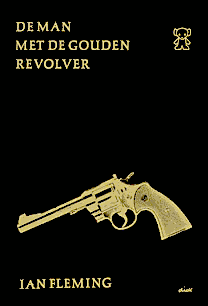
Illustration: cover of the Dutch translation of the James Bond story The Man with the Golden Gun, illustration and cover design by Dick Bruna.
Outside the Netherlands, Dick Bruna is probably best known for his series of books for very young children, revolving around young bunny rabbit Miffy, but within the country, his book covers for series such as Maigret, James Bond and The Saint are probably as famous. Bruna was born to a long line of publishers, and his father wanted him to follow in those footsteps. However, Bruna had other plans, and went for a career in design and illustration.
His father had started a line of book shops at railway stations, where the publisher sold its own range of Zwarte Beertjes (black bears) books. They were pocket novels that went over well with travellers who wanted something easy to read while in the train. Bruna translated a number of these books, and typeset and illustrated thousands of them. Being a great fan of the minimalist De Stijl, both his children’s books and book covers are remarkable for their clean and simple look.
There are several anthologies of Bruna’s book covers, both printed and electronic. On the web you can find pictures of book covers at Retrobook.com as tiny thumbnails, and at De Boekenplank as bigger scans, but unfortunately not sorted by cover designer (google the site for “omslag Dick Bruna” or “omslagillustratie Dick Bruna”).
Tags: book covers, Dick Bruna, James Bond, Miffy, Nijntje
June 11, 2007
Three unknown Mondriaan paintings discovered
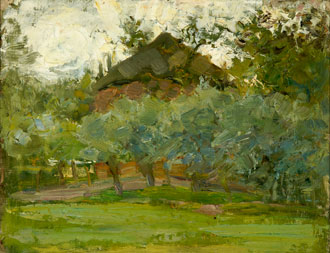
Three unknown works by Dutch painter Piet Mondriaan were recently discovered at an appraisal in France. The oil paintings are not listed in the 1998 works catalogue.
The three paintings are ‘Hooimijt achter een rij bomen’ (‘Hay stack behind a row of trees’, seen here), ‘Irissen tegen een rode achtergrond’ (‘Irisses against a red background’) and ‘Boerenhoeve door bomen omringd’ (‘Farm house surrounded by trees’). The discovery was made by Amsterdam art dealer Dolf van Omme, who obtained the paintings through the heritage of a collector.
The authenticity of the works was confirmed by specialists. They are not signed, but then Mondriaan did not sign his paintings very often. Van Omme is selling one of the paintings for EUR 100,000, while the other two will be given back to the owner.
(Link: RTL, Photo: Dolf van Omme)
Tags: paintings, Piet Mondriaan
May 28, 2007
Tulipmania myth debunked

For the casual observer looking at the Netherlands, the Tulipmania story has it all: tulips, the Golden Age, the start of modern capitalism, windmills, clogs… OK, so everything but the last two. For the puritans among you, this tale has even got a moral. Here’s a quick recap of how the story goes:
In the 17th century, the Dutch were at the top of their wealth, both financially and culturally. The Dutch trading ships controlled the seas, and brought the treasures of foreign countries to these shores. This wealth ignited the local Renaissance, giving artists like Rembrandt and Vermeer, and scientists like Van Leeuwenhoek and Grotius a chance to plie their trade. A story from that time goes that the first economic bubble was also created by the Dutch. Among the many things they imported were tulip bulbs, which started to fetch higher and higher prices. At one point, a box of bulbs would cost as much as a house. But in the spring of 1637 the bubble was burst; Dutch pride was punished, and thousands of traders went bankrupt.
At least, that’s the popular version of the story. According to a recent book written by Anne Goldgar, most of what we know about the bubble stems from propaganda from the period. An interesting review from the Financial Times tells more:
Some contemporary pamphleteers attacked the trade, baffled by what one Englishman called the ”incredible prices for tulip rootes”, and disquieted by the godless materialism of it all. […] Most tulip tales we know, scolds Goldgar, ”are based on one or two contemporary pieces of propaganda and a prodigious amount of plagiarism”.
In fact, during her research Goldgar could not find the name of a single person who had been bankrupted by the burst of the bulb bubble.
Tags: capitalism, Golden Age, stock market, tulips