


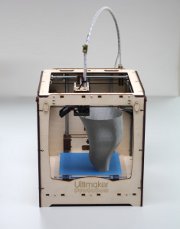
The concept of SkinPrint, thought up by a group of students at Leiden University, uses a 3D printer to print pieces of human skin for skin grafting. SkinPrint has won the Digital Award, the country’s most sought-after student award.
“SkinPrint could mean a revolution in medicine”, explains team leader Ingmar van Hengel in the press. A healthy piece of skin is removed from a burn victim and then printed, ready to be used for medical procedures. SkinPrint must undergo a lot more scrutiny and certification before it can be used, say about five years.
There are many scientists around the world working on printing human body parts such as skin, ears, livers and what not. Have a look at 7 Cool Uses of 3D Printing in Medicine.
(Link: www.parool.nl, Photo of an Ultimaker)


 People who speak Dutch with a foreign accent are just as easy to understand as native speakers. Listeners may need a while to adapt to the accent, anywhere from a few sentences to a few minutes.
 Astronomers of Leiden University have discovered a method of detecting life on planets outside our solar system.
 Researchers at the University of Twente have developed a way of trapping cells in microscopic pyramids.

 During one of his last days in office former Education Minister Halbe Zijlstra has saved the bachelor programme Minorities and Multilingualism: Into the Frisian Laboratory at the University of Groningen (RUG).