February 25, 2013

Printing error in law could mean more money for record companies

Filed under: IT,Technology by Branko Collin @ 1:20 pm

Here is some free advice for our government. If you want the difference between gigabit and gigabyte to be clear, do not abbreviate those words!
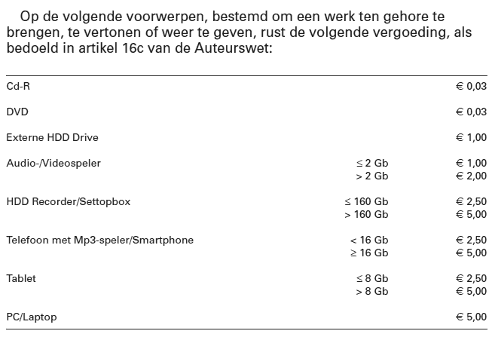
A small printing error has made it so that multinational record companies can pump even more of our tax money out of the country, at least in theory. In October last year the Ministry of Justice published a table of copyright levies in Staatsblad, the official government newspaper in which laws and decisions must be printed to become legal. Where the ministry wanted to write ‘gigabyte’, it wrote ‘Gb’, an abbreviation meaning gigabit. When talking about storage a byte typically contains 8 bits.

This means that legally speaking people who for example buy a smartphone with 2 gigabytes of storage would have to pay a higher price.

In practice this will likely not occur. Jochem Donker, a legal consultant working for Stichting Thuiskopie, the organisation that will collect the levies, told Webwereld: “We agreed upon gigabytes, so I find it hard to imagine that parliament suddenly changed its mind. This is probably a capslock error. I expect we will not abuse this.” Several lawyers called the use of ‘gigabit’ “an apparent mistake” (kennelijke verschrijving).

The ministry has decided that it will not correct the text until the levies are up for revision in 2014. “If we had meant gigabit, we would have written Gbps.” Fail! Gbps means ‘gigabit per second’. Later the spokesperson admitted that the ministry had made a mistake. “But it is evident that we meant ‘gigabyte’. The reports of the lower house also say ‘gigabyte’.”

Here is more free advice. If you desperately do want to use abbreviations, for instance because you are printing a table and the columns aren’t very wide, explain your abbreviations in a legend.

(Image: Staatsblad)
Tags: , , , , , ,

February 24, 2013

Art students hack Google Images to become advertising platform

Filed under: Art by Branko Collin @ 2:03 pm

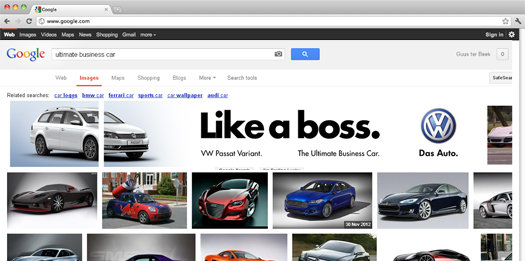
Students of the Willem de Kooning art academy in Rotterdam have managed to take a search string, ‘ultimate business car’, and have this produce five pictures in Google’s search engine for images that, once put next to each other, form an advertisement.

Search engines are in a continuous battle with Search Engine Optimizers, companies with the morals of an arsonist who try to replace relevant search results with links to the sites of their paymasters.

Students Pim van Bommel, Guus ter Beek and Alwin Lanting used the help of ‘hardcore SEO-ers’ to get the ad to show up in Google’s search results. The ad is no longer visible in its original form. When 24 Oranges searched for ‘ultimate business car’, the first panel had disappeared entirely and the text panels were in a different order. Van Bommel told Bright: “As soon as users start clicking on images Google’s algorithm changes the display order based on popularity. Unfortunately that is an aspect we do not yet control. Ads in which the order of the images is of less importance would be a good solution.”

The students call this concept Search Engine Advertising.

(Image: guusterbeek.nl)

Tags: , , , , , , ,

February 23, 2013

Dutch with an accent just as easy to understand

Filed under: Science by Branko Collin @ 3:13 pm

People who speak Dutch with a foreign accent are just as easy to understand as native speakers. Listeners may need a while to adapt to the accent, anywhere from a few sentences to a few minutes.

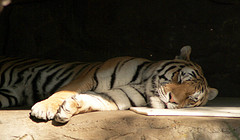
Yesterday Marijt Witteman received her PhD for researching how fast listeners adapt to foreign accents. One perhaps surprising finding was that native speakers who were used to the accent, for instance, Dutch people living near the German border listening to Dutch spoken by Germans, understood words pronounced by language learners just as fast as they understood words pronounced by native speakers.

Even listeners who were not regularly exposed to the foreign accent only needed a few minutes of ‘priming’ to get up to speed. Witteman used reaction time tests in which subjects first heard a word, then saw the word written out on a screen, after which the subjects had to state if a word existed or not. Previous experiments had shown that people respond faster if they hear the word before they see it on the screen. The response times for words pronounced with an accent were just as fast as for words pronounced without an accent.

Witteman’s results could be useful in designing language courses. Course materials could be less about perfecting pronunciation and more about understanding a language. My personal take-away lesson is that Hollanders can stop pretending they don’t understand what the rest of the Dutch are saying. The game is up!

(Photo by Leo Viƫtor, some rights reserved)

Tags: , , , , , , , , , ,

February 22, 2013

Nonsensical road signs in Noord Brabant

Filed under: Automobiles,Bicycles by Orangemaster @ 7:29 pm

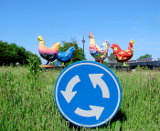
In a country with so many traffic rules and regulations, many of which involve bikes, some set of road signs are so weird you won’t find them in theory books on learning how to drive.

Some of the ones in and around Eindhoven are easy to understand even if you don’t read Dutch, but for the rest:

No. 12: A bike path where bikes are allowed.
No. 20: A bus lane where bikes are allowed, a dangerous place to cycle.
No. 23: Probably the shortest bike path in the country.
No. 24: Neighbourhood being built, forbidden for construction vehicles.

(Link: www.ed.nl, Photo by Photocapy, some rights reserved)

Tags: , ,

February 21, 2013

Apple Macintosh pen holder as a 3D print

Filed under: Design by Orangemaster @ 5:00 am

Here is an old school Apple Macintosh computer as a 3D pixel art style pen holder for your desk, created by the Sevensheaven design studio. The back of it is the same as the front, with the iconic Mac features.

Some of us remember actually owning one of these computers or using them at school or at work.

(Link: www.shapeways.com, Photo by Sevensheaven)

Tags: ,

February 20, 2013

Dutchman wins BAFTA for visual effects, Oscar could be next

Filed under: Film,Literature by Orangemaster @ 10:51 am

On February 10, Dutch animation director Erik-Jan de Boer won a BAFTA award (British Academy of Film and Television Arts, the British version of the Oscars) for the visual effects he co-created for the film Life of Pi, directed by Taiwanese-born American film director Ang Lee.

De Boer is also co-nominated for an Oscar award for his work on Life of Pi, a film based on the novel by French Canadian author Yann Martel. The Oscars will be presented on 24 February, 2013.

Watch the international trailer:

(Link: www.dutchdailynews.com, Photo of Tiger by ArranET, some rights reserved)

Tags: ,

February 19, 2013

Feline aids, a growing problem in Amsterdam

Filed under: Animals by Orangemaster @ 11:58 am

Feline immunodeficiency virus, or commonly called ‘feline aids’, is being diagnosed more and more in Amsterdam’s cats, according to local cat catchers. Almost 10% of the cats caught just this year have contracted the disease, mostly found in male cats that are not castrated.

Once diagnosed, sick cats have to be put to sleep because there is no cure for the disease and they could easily infect other cats, although not humans, by the way. The story goes that cats on ships carried the disease over from far away, but then that’s been said about every modern disease.

If more cats are castrated, the problem would more manageable, cat catchers say. The other classic theory is that in times of crisis, people don’t spend money on things like castrating their cats.

(Link: binnenland.nieuws.nl, Photo of Dead cat by ndanger, some rights reserved)

Tags: ,

February 18, 2013

How to build bigger floodplains

Filed under: Nature,Sustainability by Branko Collin @ 1:08 pm

‘Room for the River’ is a Dutch state project that intends to widen the floodplains of the major rivers.
The project does something that is quite rare for the Dutch, it gives land back to the water. In 1993 and 1995 we had major river floods, the latter even leading to the evacuation of 250,000 people. Geographically, the Netherlands is a river delta, and the Dutch have always had to live with river floods. However, today the population pressure has made the consequences of floods much more expensive.

As the project website says: “The rivers are wedged between increasingly higher dikes behind which more and more people live. At the same time, the land behind the dikes has sunk. It is also raining more often and harder, causing rivers to swell. Water levels are rising and so is the chance of floods with a large impact on people, animals, infrastructure and the economy.”

The New York Times has visited one of those projects and uses it for an opinion piece on how big government is good.

Short read: The Ruimte voor de Rivier site has Nine easy infographics on how to give the river room.

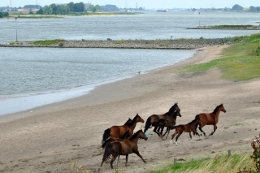
(Photo: Waal beach by Rijkswaterstaat / Ruimte voor de Rivier / Martin van Lokven)

Tags: , , , , , , , , , , ,

February 17, 2013

Infrared sensors detect train composition for travel app

Filed under: General by Branko Collin @ 12:04 pm

Dutch Rail has started an experiment that lets its customers see which train compartments are relatively empty and therefore likely to have seats available.

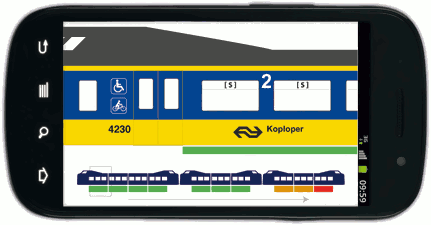
To this end, the company has equipped 11 trains on the Zwolle-Amersfoort line with 280 infrared sensors. The data of these sensors is sent to an app that shows where there is room in the train (see illustration). Two minutes after the train has left a station, the app will be updated.

The app called Reisplanner Xtra also provides information about whether the train has wifi, where the quiet compartments are, where the first and second compartments are, and so on. It is unclear how long this test will run.

(Link and image: Dutch Rail. Via Springwise)

Tags: , , , ,

February 16, 2013

Nickname ‘mosquito’ for journalists more popular than ‘rat’

Filed under: Animals by Branko Collin @ 10:23 am

OK, so this is completely unscientific, but I decided to have a little fun.

If the Dutch want to use a derogatory term for a journalist, they have a couple of options. Persrat (press rat) is one of them, persmuskiet (press mosquito) is another.

According to Google, persrat appears on 10,600 web pages, while persmuskiet appears 12,700 times. There is not much between them and Google is hardly the place to do reliable linguistic research, but since we had already decided this wasn’t going to be scientific I declare ‘press mosquito’ the winner.

A derogatory term for the entire profession is journaille, borrowed from the German language in which the word is a portmanteau consisting of the word ‘journalistic’ and the French word ‘canaille’, meaning ‘rabble’.

Dutch comics godfather Marten Toonder used to have a rat in his fabled stable called Argus, who was of course a reporter (working for a publisher called E. Phant).

To me the word persrat feels different from persmuskiet. Rat seems to suggest a low character, whereas mosquito implies tenacity.

Are you wondering if there is perhaps a reason to this whim of mine? There is. I was getting a bit tired with the news cycle, with the whole idea that there is always news and it is always important. Trying to find a Dutch angle to the British horsemeat scandal (British supermarkets selling horsemeat as beef), reporters of the Parool newspaper had tracked down a restaurant owner who had kept quiet about having used horsemeat instead of beef for his famous steaks for 60 years—even in the Netherlands there is a bit of a stigma attached to eating horsemeat. “Why did you lie,” the reporters asked and that irked me. Sure, the restaurant owner had lied by omission, but every word a journalist ever prints is a lie of omission, because journalists decide what is important enough to print and what not.

And that is when I got a little bit irritated and started thinking in terms of ‘press rats’.

(Image by A.E. Goeldi, in the public domain)

Tags: , , , ,