April 24, 2008

Paul Verhoeven gives Jesus a stab

Filed under: Literature,Religion by Orangemaster @ 8:53 am
jesus1.jpg

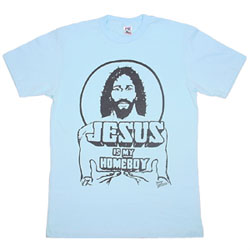
According to Dutch filmmaker Paul Verhoeven, known for ‘epic’ films such as Basic Instinct and Robocop, Jesus Christ was probably the son of Mary and a Roman soldier who raped her during the Jewish uprising in Galilee. Oh and Judas didn’t betray Jesus.

This September, watch out for a book called “Jesus of Nazareth: A Realistic Portrait” (in Dutch), which will eventually be translated into English by 2009. Lucky translator.

It apparently took him 20 years to reach these conclusions, which nobody is ready to believe.

But let’s be fair. I cannot wrap my brain around the ‘fact’ that Joseph was not Jesus’ biological father and started freaking out when someone explained to me that the immaculate conception was Anne (Mary’s mother) giving birth to Mary and not Mary giving birth to Jesus. And that that fish on Friday nonsense was made up by some pope no more than 100 years ago to put their stamp on history. And that Christians were against marriage because it was all Pagan and stuff way back when.

And the source got his degree wrong: they gave him a Ph.D. instead of the Master’s degree he has. So much for checking the facts.

(Link: foxnews.com)

Tags: , , , ,

April 23, 2008

Rem Koolhaas to design Prada museum

Filed under: Architecture,Design by Orangemaster @ 8:37 am
prada1.jpg

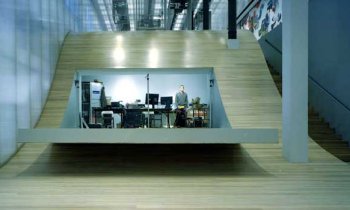
Dutch architect Rem Koolhaas has been asked to design a museum for Prada’s art collection, according to the website of Office for Metropolitan Architecture (OMA), Koolhaas’ architectural firm.

Designer Miuccia Prada and her spouse Patrizio Bertelli have bought hundreds of modern art pieces over the years and need a place to display them. They have found a place in Milan where Koolhaas is going to design three new buildings, including a tower with exhibition halls. Koolhaas has already designed the Prada flagship store in New York City (see photo).

(Link: gelderlander.nl)

Tags: , , ,

April 22, 2008

Mumps epidemic aggravated by religious beliefs

Filed under: General,Religion,Science by Orangemaster @ 9:15 am
mumps1.jpg

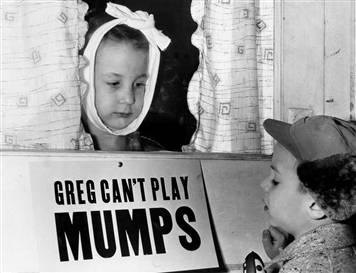
Monday, various media reported a mumps epidemic in the Netherlands for the first time in 20 years. The epidemic is concentrated in the stretch of land between Zeeland in the southwest and the Veluwe heathlands in central Netherlands, the so-called “Bible belt” (that’s what they call it in Dutch as well) where many orthodox Protestants live.

Many people in the area refuse to have their children vaccinated against mumps and other diseases on religious grounds.

Mumps have been diagnosed in more than 60 blood samples over the past few months but the public health institute (RIVM) said the real number could be much higher because doctors are not legally obliged to report cases to the authorities.

The “Bible belt” was also hit by polio and measles epidemics in the 1990s.

Other sources claim that these religious communities’ children have been vaccinated but that it didn’t really help, which is plausible. As well, some 75% of people according to an online poll think it should be forbidden to refuse to vaccinate children on religious grounds. One good point is that their sicknesses bring other people in danger, which is considered asocial at best in such a densely populated country.

(Link: eviewweek.com)

Tags: ,

April 21, 2008

Webcam handles age check in supermarkets

Filed under: General,Technology by Orangemaster @ 4:56 pm
machine1.gif

Why have unmotivated personnel slow the cue down to ask for ID in order to sell alcohol and cigarettes when technology can do it for you?

Dutch super market chain C1000 lets ‘experts’ check the age of ‘spotted teenagers’ faces’ by looking at those faces through a webcam. Now that must be a real motivating job as ‘professional verification employee’. I can picture all the cheap jokes they make during the day. I know I would.

The system, called Plaaaza (yes, three a’s, no idea why) offers a fully automated outsourced solution for the age check that the government requires when selling alcohol and cigarettes.

When someone clearly has wrinkles, the transaction is not a problem, but when spots are spotted (pardon the pun), the second webcam installed at the cash is activated, so that the young person can show their ID card up to it.

For those who do not know, the Dutch require a person to be 16 to buy cigarettes and alcohol (albeit only beer and wine).

(Link: webwereld.nl)

Tags: , ,

April 20, 2008

“Thou shalt not” in Amsterdam

Filed under: Weird by Branko Collin @ 9:00 am

The past few weeks I came across these prohibitory signs in Amsterdam.
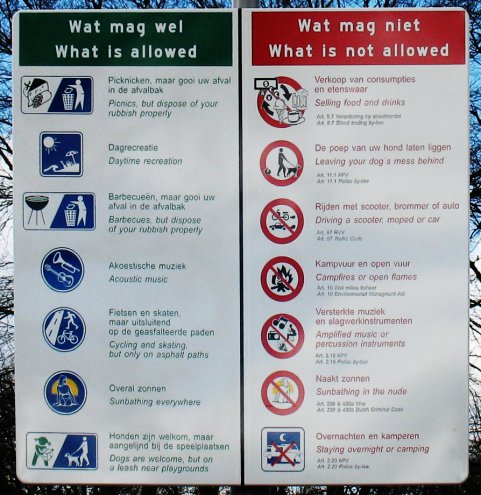
More and more people seem to think that anything that is not explicitly allowed (by whatever nebulous authority) must therefore be forbidden. This sign posted at the entrance of the Vondelpark in Amsterdam seems to pander to that strange sentiment. It starts with a list of things you are allowed to do. Now I can imagine that people wonder about barbecuing—open fires can be dangerous, and assuming that they are forbidden is not much of a stretch. But “acoustic music” and “daytime recreation”? Why, thank you mysterious authority!

That’s not the whole story though. The rules and regulations of this particular park became international news a month or so ago when they were reviewed by the local council. Patrons were interviewed to find out what kind of behaviours they liked and disliked, and it turned out that people hate free-roaming dogs, but don’t mind gays cruising the Rosarium and consuming their short-lived relationships in situ. The latter had of course always been tolerated in grand Dutch tradition. A little task for our readers: add a line to the sign displayed above that allows for steaming hot gay sex, but forbids tepid mushy straight sex. The winner will receive my heart-felt compliments.
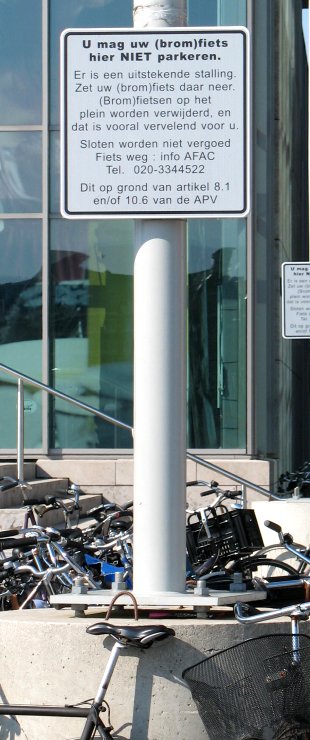
Asking patrons what they like and grand Dutch traditions are almost certainly not what was on the minds of the architects behind the new central public library of Amsterdam. An imposing building at a grand square with steps leading up to the majestic entrance, the obligatory ramp for the wheelchair-bound worked away behind a broad pillar. You cannot have people use such a space any way they like. Somehow, the architects managed to realize that the Dutch won’t give up their bikes though, and designed an underground parking garage for bicycles. They originally limited signage to a parking sign for cars with a drawing of a bike beneath it, neatly out of the way from the square itself.

And then they had to plaster the entire square with these huge signs that point out that there is an underground parking somewhere. Amsterdammers like to bike right up to the entrance, and park within only a few meters distance of the building where they need to be. “There is an excellent parking,” the sign starts. Why not go the whole hog and begin the sign with “there is an excellent sign somewhere near here that points to the excellent parking”? Oh, the snarkiness of these signs: “Bikes will be removed from the square, and that’s an annoyance mostly for you.”

None of these problems would occur with the old library, which had no delusions of grandeur, was cramped or cosy depending on your point of view, and had bike racks no more than a few feet away from its tiny front door.
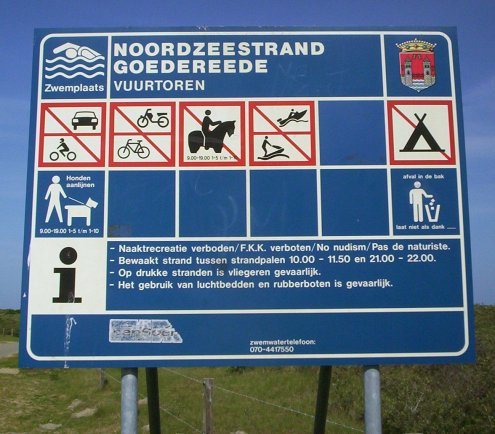
This final sign comes from the town of Goedereede on the island of Goeree-Overflakkee near Rotterdam. Not really mine, and not really “in Amsterdam,” but I felt it deserved a mention nevertheless. The good people of “Good Harbour” had the foresight to leave room for at least five more prohibitions. Last photo by David van der Mark, distributed under a Creative Commons Attribution-Share Alike 2.0 Generic license.

Tags: , , ,

April 19, 2008

Reverse graffiti embraced by advertisers

Filed under: Art,Fashion by Branko Collin @ 11:04 am

Reverse graffiti is a delightfully provocative art form that works by selectively cleaning the grime off a city’s walls and streets (and by writing “clean me” on the back of vans). It has city governments the world over racking their brains over how to prosecute the perpetrators—how are you going to punish the people that clean your city for you? But officials need not worry much longer because they’re getting help from an unlikely source: the business world. The Dutch version of women’s magazine Elle has started a reverse graffiti campaign to advertise its wares. Surely no self-respecting artist will touch reverse graffiti now that it has been tainted by commercialism?

Elle’s “artists”—in a presumed rush to get as much work done as possible—are using stencils and pressure washers to clean parts of the pavement.

Photos: stills from Elle’s promotional video. See also: reverse graffiti by Moose (UK) and by Alexandre Orion (Brasil). Via Dagelinks (Dutch).

Tags: , ,

Hitchcock’s The Birds without birds

Filed under: Art by Branko Collin @ 8:30 am

Video-artist Martijn Hendriks is removing the birds from scenes of Alfred Hitchcock’s 1963 classic thriller The Birds for his current project Give Us Today Our Daily Terror, and presents the curious visitor with stills and a number of clips in the meantime. Very eerie in its own right.

Via Poste Restante (Dutch).

Tags: , ,

April 18, 2008

Poor people give more (as do the connected and the religious)

Filed under: General,Religion by Branko Collin @ 9:03 pm

Poor people give more to charity than rich people … relatively speaking. According to a story in Z24 (Dutch), this is one of the outcomes of a study for a PhD thesis that Pamela Wiepking will present next Monday at VU University in Amsterdam. Wiepking claims the poor tend to give about the same as the rich because both groups have the same idea of what makes a fair donation; and since the poor earn less, what they give is a bigger percentage of their income.
Two other groups that give more according to Wiepking’s research are the well-networked people (they tend to trust others more) and the religious.

See also Wiepking’s 2007 paper “The Philanthropic Poor: In Search of Explanations for the Relative Generosity of Lower Income Households”.

Tags: , , , , ,

Royal Library wants copyright law changed

Filed under: Literature by Branko Collin @ 11:21 am

Copyright is not fit for this digital age, and needs to be changed, so say two representatives of the Dutch national library in a letter to daily NRC yesterday. In their epistle (Dutch) Martin Bossenbroek and Hans Jansen, managers Collections & Service and E-strategy respectively of the Koninklijke Bibliotheek (Royal Library), the Dutch national library, explain how difficult it can be to run large-scale digitization programs when for a large number of books it simply is not clear whether they have returned to the public domain or not:
Copyright is a good thing, but the code that enshrines this right is too much of a good thing in its current form. In the digital age, it misses its targets. For hundreds of thousands of 20th century rights holders, it offers no protection, recognition and reward, but only the prospect of oblivion. An adaption of copyright law to the demands of the 21st century is needed urgently, otherwise the building of a digital library of any serious proportion will remain an illusion.

[Because of the difficulty of locating the heirs of long-dead authors, you cannot safely re-publish works that came out a 100 years ago.]

Both institutions and companies are keeping a safe distance from this copyright danger zone, and this will result in unbalanced digital collections. The digital library of the 21st century will have a gaping hole where works of that age should be. Hundreds of thousands of authors will never be found again. For them the chance of an epiphanous find followed by a second, digital life will definitely be gone.

This scenario can hardly be the meaning of a law that should protect an author’s rights. Before anything else, an author has the right to be read. That is why it is high time for an Internet exception for non-commercial use in the Dutch copyright law, one better thought through than the changes of 2004. Since then, heritage institutions are allowed to offer their collections electronically to the general public, but only from within their own building, using an intranet. That’s just not how the Internet works.

The authors go on about orphaned works, and how a mixture of Scandivian and Anglo-Saxon orphan works law could produce a best of both worlds: mixing extended collective licenses with the opt-out principle. Collective licenses, also known as levies, are funds paid by the public into one big pot, and redistributed to the copyright holders. In a lot of jurisdictions radio is paid for this way. This makes radio possible: if there were no collective licenses, a radio broadcaster would have to negotiate separate contracts with artists for each track they play. At least, so the theory goes. Opt-out means the author or their heirs has to state explicitly not to want to participate. Copyright law is opt-in by default, but stops functioning in areas where the rights holders cannot be traced, or only with immense difficulty. It is something authors have brought upon themselves with their support of the Berne Convention, which outlaws any sensible scheme for tracking authors and their works.

I published an essay on the same topic last week at the Teleread blog. Next week the Amsterdam public library will organise a conference on the meaning of copyright for libraries, where Ernst Hirsch Ballin, the Dutch Minister of Justice, will be one of the speakers.

Tags: , ,

April 17, 2008

Stairs made from a castle’s floorwood

Filed under: Design by Branko Collin @ 10:41 am

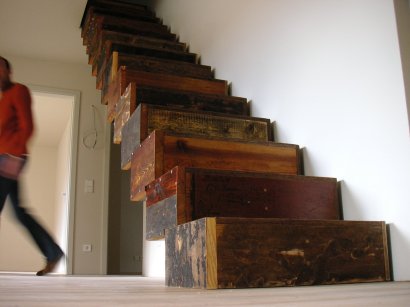
Recycled furniture – furniture clearly made from recycled materials – got very popular in the Netherlands sometime in the 1990s when an artist found out that a regular cupboard made from new materials would easily net multiple times the price if made from recycled wood. Despite the over-saturation of this market I like this staircase made by Jan Korbes from the Hague by turning old floorboards of Schloss Wiesenburg (Wiesenburg Castle) in Germany into boxes.

Via BoingBoing.

Tags: , , , ,