Delft University of Technology related designer Heike Vallery together with Dutch startup WOLK have designed an airbag for falling elderly. As they fall a cushion fastened to their hips pops upon and softens the blow, reducing the chance of hip injuries.
Vallery and WOLK studied the fall algorithm that anticipates instability so that their airbag deploys on time. They claim that the airbag is comfortable to wear under most clothing and the cushions can deploy from the left, the right and the rear, as seen in this very short video. They are still at the prototype stage, but by 2017 they’ll have a working model.
When fine art painter Willem van der Made saw a print he liked at a car boot sale in Oosterhout last Sunday and found out it was only 5 euro, he didn’t hesitate and bought the work.
When he got home and removed the cardboard back, he found another print hidden underneath. And another and another. The frame turned out to contain 63 lithographic prints in total.
Van der Made told BN De Stem that something did not feel right when he first lifted the frame. It was heavy and thick. “I immediately asked the salesman where he got the print. He told me that an old lady had asked him to clear out her attic which was full of stuff dating back to World War II.”
Van der Made believes that the frame was purpose-built to hide so many prints. “It was hand-made and reasonably deep. The prints all fit in.” The prints all depict biblical scenes. Van der Made wants to sell them as a collection.
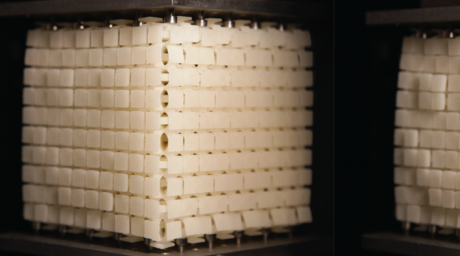
Physicists from Dutch FOM Institute AMOLF in Amsterdam and Leiden University together with colleagues from Tel Aviv University have developed a method to design patterns that can appear on any cube’s surface.
AMOLF group leader professor Martin Van Hecke explains that if pressure is applied to, for example, a 10x10x10 cube, some of the sides cave in, while others bulge out. By stacking several of these blocks researchers could make three-dimensional structures. Their research is said to pave the way for the use of ‘machine materials’ in, for example, prostheses and wearable technology, as published in ‘Nature’ today.
“Although Van Hecke’s research is fundamental in nature there are applications on the horizon. This type of programmable ‘machine materials’ could be ideal for prostheses or wearable technology in which a close fit with the body is important,” says Van Hecke. “If we can make the building blocks more complex or produce these from other materials then the possibilities are endless.”
Filed under: Food & Drink by Orangemaster @ 5:28 pm
Last year we told you about an ice cream man from Maarssenbroek, Utrecht who rings his bell at night, pushes ice cream on children to get their parents to pay for it and does other nasty things. Albeit very different, here’s a contender for most questionable ice cream man: a guy from Uddel, Gelderland who makes calculations that don’t match his list of prices.
The long story is that one flavour of ice cream is counted as two scoops of ice cream, so if you want two flavours, you’ll end up paying for four scoops. If you feel like that’s not what you asked for, then too bad. The scoops are apparently as small as strawberries. Imagine what happens if you order for a family of four. If you need napkins called ‘happy hands’, he’ll hand them over to you and then charge you for them. And there’s no child-size cones, so that’s also quite expensive and wasteful I’m sure in many cases.
Munchies interviewed the man behind this creative accounting scheme who simply said he’s been in the business for years. He blames all his clients for not understanding his concept and if people don’t like it they can go elsewhere. He compares the ‘happy hands’ to paying for mayonnaise with Dutch fries, but then the price of the mayo is clearly indicated, while his napkins are not. Oh, and the amount of bad reviews he has on social media must mean something.
Let’s roll the clip and see what happens. In Dutch.
(Link: munchies.vice.com, Photo of unrelated Dutch rocket ice lolly)
Designed by Dorine Vos, the Parqer glass is a proper wine glass with a sharp-ended aluminium stem instead of a glass stem and a foot you can plant into the ground, be it in a park, a beach or in the forest. This also means you can drink decent wine instead of some Château Migraine in a plastic cup.
A set of two glasses comes in a shockproof casing where the glasses don’t touch the sides, while the aluminium stems come in different colours like silver, gold, black and green. Vos came up with the design after her own experiences sitting in the parks of Amsterdam, which I can tell you means having to drink out of soft plastic cups.
The town of Drimmelen, Noord-Brabant has built a one-kilometre long ‘singing bike path’ (an official traffic sign), encouraging people to sing on their bikes and hopefully continue singing when they see another cyclist rather than stop singing.
The idea came from artist Mapije de Wit, a former columnist for the Fietsersbond cyclists union. The special bike path was officially opened by city council member Jan-Willem Stoop for which local troubadour Rinus Rasenberg wrote a song, saying he got some of his best ideas while cycling. In 10 minutes of cycling you can belt out three hit songs or maybe one or two if you keep forgetting the words.
The bike path is a comfortable three metres in width and is part of a nice 17-kilometre network of paths around the town.
Before Pokémon Go was officially launched in the Netherlands there were already 1.3 million players. Now that it’s been officially released for about a week, that figure is approaching 2 million players, one eight of the population.
Some people have been creating accounts, catching a shit ton of ideally rare Pokémons and then selling their account to people with a lot of money and not too much time or patience. The Dutch tax office is trying to get in on the action by looking into taxing people who are selling these accounts. They’ve already dug their claws into people renting their flats out as Airbnb locations, so why not hit Pokémon Go account sellers?
Selling accounts falls under additional earnings, which means expenses could be deducted as well such as phone costs and travel costs. Sellers could even show how many kilometres they’ve had to travel for their catches by using apps for it. Some level 20 Pokémon Go accounts are going for €500 on online auction sites, according to fhm.nl.
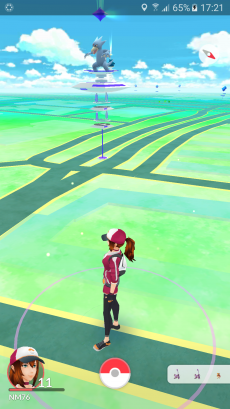
Businesses that are designated Pokéstops, a place where players can obtain free items to use in the game, are apparently earning money by buying ‘lure modules’, which can only be set up at Pokéstops. The idea is that the business turns on a lure module, which lasts 30 minutes, luring all kind of Pokémon for anyone to catch. And this is only the beginning.
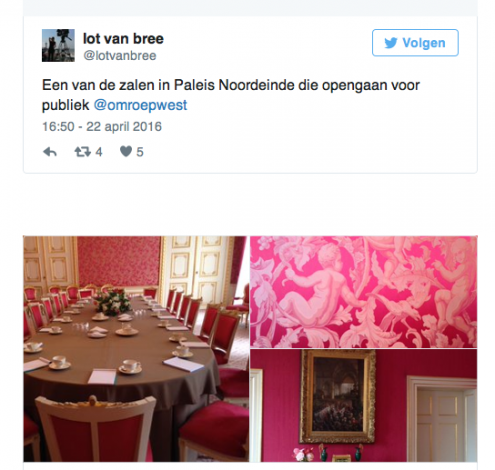
On Saturday 23 July and the next two Saturdays after that, the palace of Noordeinde where the King and his family live, will open its doors to the public for the very first time. The public will be able to see a number of areas, such as the Grand Ballroom, with its gold chandeliers and marble walls. The rooms also feature the royal family’s impressive art collection and antiques.
As of 26 July and for four days in the week, the royal stables will also be included in the tour, where visitors will be able to see the family’s horse-drawn carriages. The visit will costs 6 euro because if they didn’t charge anything people wouldn’t come, according to the reasoning of the Netherlands Government Information Service (AIVD).
Although the palace being open is very special, its Princess’ Garden is accessible daily for free.
Thanks to lots of people including Amsterdam resident Maurice Beljaars who asked for a rainbow emoji flag, Unicode has approved the request for the flag. It won’t be ready for a while or in time for Amsterdam’s Gay Pride, but then people can use hashtags #EuroPride, #AmsterdamPride and #Joinourfreedom for Gay Pride from Saturday 23 July through 7 August.
According to Emojipedia, the gay pride flag features in the top 30 emoji requests collected on Facebook, Twitter, and Instagram.
The Netherlands has debuted self-driving trucks in a convoy, but this week a self-driving bus went from Schiphol Airport to Haarlem, a 20-kilometre ride.
The test was carried out with a self-driving Mercedes-Benz bus from German car company Daimler AG, some of which took place on a public road, but mostly on a closed circuit. The bus was able to communicate with traffic lights, collect data and negotiate junctions. As well, there was a driver on board in case things when wrong.
There is still a lot of testing to be done before self-driving cars become a reality, and it is cool that tests are carried out here. I don’t know about cars dealing with cyclists and pedestrians in the big cities, which still is a major source of accidents.



 When fine art painter Willem van der Made saw a print he liked at a car boot sale in Oosterhout last Sunday and found out it was only 5 euro, he didn’t hesitate and bought the work.