
April 7, 2008

Buran passes through the Netherlands

Filed under: Design,History by Branko Collin @ 12:02 pm


Illustration: the Buran space shuttle on display at the MAKS air show, 1997. Public domain photo by Kobel.

One of the 10 Soviet space shuttles ever built traveled through the Netherlands last weekend on its way to its final destination in Germany. The shuttle, an atmospheric test model code-named OK-GLI or BTS-02, was shipped from Bahrain to Rotterdam, and from there was moved by river barge over the Rhine to the Technik Museum Speyer in Mannheim, German.

The story of the Soviet space shuttle is one of the most interesting of our time. The Soviets saw the Americans build a space shuttle, but could not figure out what it was for. So they built their own, and found out what NASA was desperately trying to hide: that in terms of effectiveness and launch costs, the shuttle is an inferior solution to current non-reusable launch technology (nowadays NASA shuttles costs USD 1 billion per launch). Astronautix even concludes: “The cost of Buran—14.5 billion rubles, a significant part of the effort to maintain strategic and technical parity with the United States—contributed to the collapse of the Soviet system and the demise of the spacecraft.”

The OK-GLI model was never intended to be launch tested. Instead, it was fitted with jet engines so that it could take off and land on its own, and was used to test atmospheric handling of the Buran shuttles. Later it was used as a demonstration model at airshows. It was bought by an Australian company which wanted to use it for the same purpose, but while the OK-GLI was in transit in Bahrain, its owner went bankrupt and the shuttle was stored for four years in parts at a junkyard.

The re-built shuttle drew crowds on its tour through the country, according to Blik op Nieuws (Dutch). Yesterday it passed Nijmegen, its tail clipped to fit under a bridge filled with onlookers.
Tags: , , , , , , ,

April 6, 2008

No need to refresh car’s oil says former oil mogul

Filed under: Automobiles,Sustainability by Branko Collin @ 2:02 pm

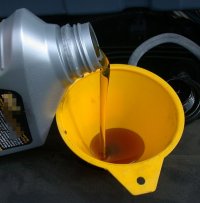
“Refreshing your car’s oil regularly is nonsense, a myth that’s been spread by the oil and car industries for years now,” says Henk de Groot. And he should know, as he is a former CEO of Castrol Nederland. Apparently all you need to do is regularly top up the oil in your car, and check it with a special dipstick that won’t just tell you the level, but also the quality of the oil, and you should be good for hundreds of thousands of miles. Luckily for all of us, Henk de Groot just happens to have invented this magical dipstick.
De Telegraaf (Dutch) helpfully calculates that the costs of excessively refreshing your motor oil are 600 million euro per year to Dutch drivers alone, not to mention the environmental costs. “I am doing this for my grandchildren,” De Groot explains.

“But the industry’s tentacles reach far. That is why they silenced me, the interests are too big.” Nary a word about the faked moonlandings though.

I welcome links to this magic dipstick in the comments.

Via De Telegravin (Dutch). Photo by Dvortygirl, licensed under the Creative Commons Attribution ShareAlike license version 3.0.

Tags: , , ,

April 5, 2008

Rotating house as artwork

Filed under: Architecture,Art by Branko Collin @ 1:43 pm

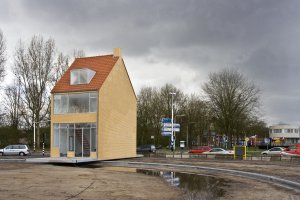
John Körmelings’ house on rails was unveiled yesterday in Tilburg. The artwork is an actual, yet uninhabited house on rails that travels along the inside of a roundabout, the Hasseltrotonde. Originally the speed was planned at one round per hour, and currently it is turning at that speed for testing purposes. However, the city council thought that was too fast and the house will be slowed down to 0.000758 RPM (or 1.09 rounds per day) later on.

Körmeling’s idea behind the house was to reverse roles: at a roundabout the cars tend to run circles while the background remains static.

Via Jong Nieuws (Dutch) and Eindhovens Dagblad (Dutch). Photo: Stinkfinger Producties. More photos here and here.

Tags: , ,

April 4, 2008

Housewives to conquer France?

Filed under: Shows by Branko Collin @ 11:07 am

France rarely looks to the North—or indeed to the East, South or West. But last week, the French massively tuned into TF1, their most popular TV channel, to follow the lives of four Dutch bored and rich housewives, as portrayed in Gooische Vrouwen, a vehicle for Linda de Mol (photo) and a Desperate Housewives clone. The series is broadcast in France as “Jardins Secrets” (Secret Gardens) and is dubbed. According to ANP, 2.3 million people watched the first episode, which translates to a market share of 26.6%. At that time the show had competition from “FBI portés disparus” and “Les nouveaux voisins.” TF1 broadcast the first three episodes back-to-back, and later during the evening the market share rose to 31.6%.
Gooise Vrouwen means “Women of De Gooi,” the latter being the rich neighbourhood of Hilversum where Dutch TV makers used to live. The name literally means The Shire, but is now synonymous with decadence. The saying goes that if you want to make it in Dutch television, you have to sleep “on the Gooi’s matress”, meaning to sleep with somebody influential in TV land (in lieu of talent or skills). It’s the Dutch equivalent of the casting couch, if you like.

Via Z24 (Dutch). Source photo: RTL.

Tags: , , ,

April 2, 2008

The face of Leonardo Da Vinci revealed

Filed under: Art by Branko Collin @ 8:30 am

Siegfried Woldhek is a caricaturist from Giethoorn, Overijssel. Having drawn over a thousand portraits for newspapers in the past thirty years he feels himself eminently placed to try and figure out what Leonardo da Vinci looked like. In a short presentation he held at TED last February he explained his method, and showed the result.

Via BoingBoing.

Tags: , ,

March 30, 2008

Copycats try to trade up red thumbtack for housing

Filed under: General by Branko Collin @ 3:27 pm

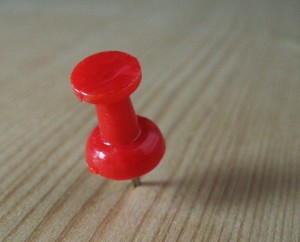
Between 12 July 2005 and 12 July 2006 Canadian Kyle MacDonald traded up a red paperclip for a house in Saskatchewan in 14 separate trades. Two Dutch high school students are now trying to follow in his footsteps by trying to trade up a red thumbtack for a place to stay in Utrecht because next year they will attend business school there. So far they traded a red thumbtack for a lighter, the lighter for an analog photo camera, the camera for a digital photo camera, the second camera for an MP3 player, the MP3 player for two days worth of canoe rental, and the canoe rental for a key chain that doubles as a photo player.

For those of you unfamiliar with the lack of rooms who are thinking what’s the big deal, you have to understand how unbelievably tough it is to get any kind of housing in the Netherlands, let alone as a poor student who needs a place to sleep and shower. Allow me: 1) Many students continue to live in their rooms after their studies because they cannot find housing, so life is rough for new students. The law also says you can’t throw them out to make way for the new arrivals. 2) There are even stories of universities telling foreign students to go study somewhere else because of a lack of rooms. 3) Emergency living space, which is supposed to be temporary but ends up permanent, is made out of shipping containers. During a severe wind storm a few weeks ago, one of the stacks of containers detached itself from the pier to which it was attached and started floating.

Via Sargasso.

Tags: , , , ,

March 27, 2008

Oh nose, more hyperrealistic papercraft

Filed under: Art,IT,Photography by Branko Collin @ 1:07 pm

[photo of three papercraft heads, stuck to a wall]

Heerlen-born, Rotterdam-based artist Bert Simons makes these scarily realistic papercraft models, by first making 3D models of real subjects. Playing with the uncanny valley, eh? Dude uses Free Software, namely the 3D package Blender (originally from Dutch company Not a Number, but released as GPL software after a donation drive); and Ubuntu for his web server.

See also: Papercraft models of the industrial age.

Via Boingboing. Source photo: Bert Simons.

Tags: , , ,

March 25, 2008

Electrowetting displays coming up in 2008

Filed under: Gadgets,IT by Branko Collin @ 8:30 am

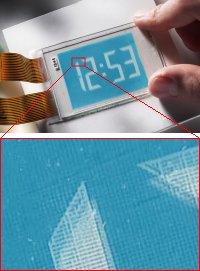
Philips spin-off Liquavista announced last week that it will start production of so-called electrowetting displays this year, having secured 8 million euro in investment money. Electrowetting is a member of a loosely knit family of energy efficient reflective display technologies. It works by manipulating layers of oil and water in a cell (pixel). Liquavista expects to produce small displays for use in mobile devices such as mobile phones and watches first. The Eindhoven-based company claims its ColorMatch FreeStyle platform will have more than twice the brightness of LCD displays.

Via Bright (Dutch). First published at Teleread. Source image: Liquavista.

Tags: , , , ,

March 24, 2008

Farmers to replace cows for worms

Filed under: Animals,Food & Drink by Branko Collin @ 11:47 am

If it is up to Zeeland’s bait producer Topsy Baits, farmers in the North of the country will swap their cows for worms. These worms are necessary according to Topsy Baits CEO Bert Meijering to replace the tons of fishmeal used every year to feed farmed fish. Apparently, for every kilo of farmed salmon, five kilos of wild fish have to be turned into fishmeal, and fishmeal is needed for fish to reach maturity. Meijering claims that using farmed ragworms instead can give the same result.

Meijering’s firm has built a farm in Wales which will raise 50,000 tons of ragworms each year, enough to produce 500,000 tons of fishmeal replacement once mixed with soy, wheat or peas. Currently, the firm is in talks with a farmers’ organisation in Groningen and Friesland to cooperate on his next few farms. According to Meijering, 500,000 tons equals the amount of extra fishmeal needed every year. Building ragworm farms could create between 1,000 and 1,500 jobs in the region.

Via Dagblad van het Noorden (Dutch). Source image: Topsy Baits.

Tags: , ,

March 23, 2008

Snowy Easter in Amsterdam

Filed under: Nature by Branko Collin @ 5:34 pm

Snopes says “the last time Easter fell on so early a date was 1913, and the next time it will do so will be in the year 2160.” It’s barely spring, and some late snow is melting on the petals of this daffodil, or paasbloem as it is also called in Dutch (Easter flower).

This weekend will have been the coldest Easter in the Netherlands sinds 1964, although the holiday then took place a week later, according to the Dutch meteorological institute, KNMI. Including this year, frost was recorded at De Bilt (in the middle of the country) during 14 Easters since 1901.

Tags: , , ,