April 19, 2008

Reverse graffiti embraced by advertisers

Filed under: Art,Fashion by Branko Collin @ 11:04 am

Reverse graffiti is a delightfully provocative art form that works by selectively cleaning the grime off a city’s walls and streets (and by writing “clean me” on the back of vans). It has city governments the world over racking their brains over how to prosecute the perpetrators—how are you going to punish the people that clean your city for you? But officials need not worry much longer because they’re getting help from an unlikely source: the business world. The Dutch version of women’s magazine Elle has started a reverse graffiti campaign to advertise its wares. Surely no self-respecting artist will touch reverse graffiti now that it has been tainted by commercialism?

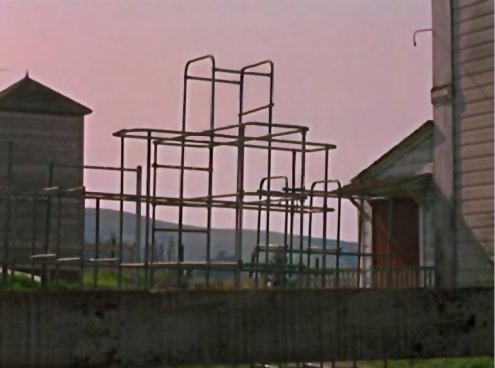
Elle’s “artists”—in a presumed rush to get as much work done as possible—are using stencils and pressure washers to clean parts of the pavement.

Photos: stills from Elle’s promotional video. See also: reverse graffiti by Moose (UK) and by Alexandre Orion (Brasil). Via Dagelinks (Dutch).

Tags: , ,

Hitchcock’s The Birds without birds

Filed under: Art by Branko Collin @ 8:30 am

Video-artist Martijn Hendriks is removing the birds from scenes of Alfred Hitchcock’s 1963 classic thriller The Birds for his current project Give Us Today Our Daily Terror, and presents the curious visitor with stills and a number of clips in the meantime. Very eerie in its own right.

Via Poste Restante (Dutch).

Tags: , ,

April 18, 2008

Poor people give more (as do the connected and the religious)

Filed under: General,Religion by Branko Collin @ 9:03 pm

Poor people give more to charity than rich people … relatively speaking. According to a story in Z24 (Dutch), this is one of the outcomes of a study for a PhD thesis that Pamela Wiepking will present next Monday at VU University in Amsterdam. Wiepking claims the poor tend to give about the same as the rich because both groups have the same idea of what makes a fair donation; and since the poor earn less, what they give is a bigger percentage of their income.

Two other groups that give more according to Wiepking’s research are the well-networked people (they tend to trust others more) and the religious.

See also Wiepking’s 2007 paper “The Philanthropic Poor: In Search of Explanations for the Relative Generosity of Lower Income Households”.

Tags: , , , , ,

Royal Library wants copyright law changed

Filed under: Literature by Branko Collin @ 11:21 am

Copyright is not fit for this digital age, and needs to be changed, so say two representatives of the Dutch national library in a letter to daily NRC yesterday. In their epistle (Dutch) Martin Bossenbroek and Hans Jansen, managers Collections & Service and E-strategy respectively of the Koninklijke Bibliotheek (Royal Library), the Dutch national library, explain how difficult it can be to run large-scale digitization programs when for a large number of books it simply is not clear whether they have returned to the public domain or not:

Copyright is a good thing, but the code that enshrines this right is too much of a good thing in its current form. In the digital age, it misses its targets. For hundreds of thousands of 20th century rights holders, it offers no protection, recognition and reward, but only the prospect of oblivion. An adaption of copyright law to the demands of the 21st century is needed urgently, otherwise the building of a digital library of any serious proportion will remain an illusion.

[Because of the difficulty of locating the heirs of long-dead authors, you cannot safely re-publish works that came out a 100 years ago.]

Both institutions and companies are keeping a safe distance from this copyright danger zone, and this will result in unbalanced digital collections. The digital library of the 21st century will have a gaping hole where works of that age should be. Hundreds of thousands of authors will never be found again. For them the chance of an epiphanous find followed by a second, digital life will definitely be gone.

This scenario can hardly be the meaning of a law that should protect an author’s rights. Before anything else, an author has the right to be read. That is why it is high time for an Internet exception for non-commercial use in the Dutch copyright law, one better thought through than the changes of 2004. Since then, heritage institutions are allowed to offer their collections electronically to the general public, but only from within their own building, using an intranet. That’s just not how the Internet works.

The authors go on about orphaned works, and how a mixture of Scandivian and Anglo-Saxon orphan works law could produce a best of both worlds: mixing extended collective licenses with the opt-out principle. Collective licenses, also known as levies, are funds paid by the public into one big pot, and redistributed to the copyright holders. In a lot of jurisdictions radio is paid for this way. This makes radio possible: if there were no collective licenses, a radio broadcaster would have to negotiate separate contracts with artists for each track they play. At least, so the theory goes. Opt-out means the author or their heirs has to state explicitly not to want to participate. Copyright law is opt-in by default, but stops functioning in areas where the rights holders cannot be traced, or only with immense difficulty. It is something authors have brought upon themselves with their support of the Berne Convention, which outlaws any sensible scheme for tracking authors and their works.

I published an essay on the same topic last week at the Teleread blog. Next week the Amsterdam public library will organise a conference on the meaning of copyright for libraries, where Ernst Hirsch Ballin, the Dutch Minister of Justice, will be one of the speakers.

Tags: , ,

April 17, 2008

Stairs made from a castle’s floorwood

Filed under: Design by Branko Collin @ 10:41 am

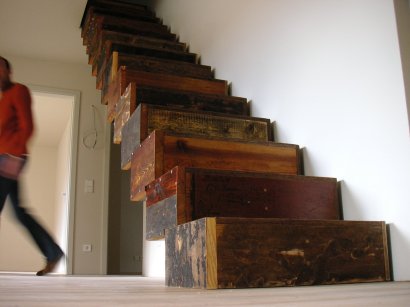
Recycled furniture – furniture clearly made from recycled materials – got very popular in the Netherlands sometime in the 1990s when an artist found out that a regular cupboard made from new materials would easily net multiple times the price if made from recycled wood. Despite the over-saturation of this market I like this staircase made by Jan Korbes from the Hague by turning old floorboards of Schloss Wiesenburg (Wiesenburg Castle) in Germany into boxes.

Via BoingBoing.

Tags: , , , ,

April 16, 2008

Watercity to be built in Zeeland

Filed under: Architecture by Branko Collin @ 11:54 am

[Visualisation of the new city]

Architect Taco Tuinhof proposes this city on piles to be built in the sea near Goes in Zeeland according to Bright (Dutch). The city would be called Westerschelde Water Stad. Tuinhof is currently looking for investors.

Image: Bright/RDH.

Tags: ,

April 14, 2008

Quacks get legal recognition

Filed under: Religion,Science by Branko Collin @ 11:01 am

Last Wednesday a trio of judges held that quacks are responsible for their diagnoses, and can therefore be prosecuted when something goes wrong. The case was brought by the Vereniging tegen de Kwakzalverij (Association against Quackery) and the Stichting Skepsis (Skepsis Foundation) against the public prosecutor, after the latter had decided to drop prosecution against two “alternative” physicians and “faith healer” Jomanda. The alternative healers had been accused of leading comedian Sylvia Millecam to her death in 2001 by steering her away from regular medicine. Millecam had been diagnosed with breast cancer, from which she died.
The court held (Dutch) that the association and the foundation had standing, and that care givers have a care duty, even if they are not accredited. This means that quacks who were able operate in relative safety in the Netherlands will now have to face the criminal consequences of their “healing” practices gone bad, just like regular physicians.

Via Wis(s)e Words.

Tags: , ,

April 12, 2008

Zone 5300, an abundance of bunnies

Filed under: Comics by Branko Collin @ 8:30 am

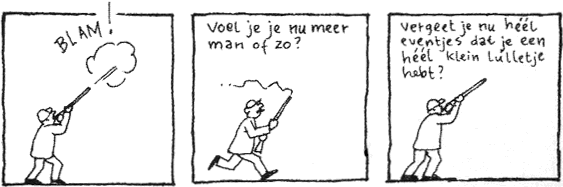
In issue 81 of Zone 5300 one Eric van der Heijden is giving Maaike Hartjes a run for her money with his own brand of tiny comics, although his intellectual absurdities remind me most of online comic XKCD. A hunter walks up to a giant rabbit, wraps his arm around its shoulders, and tells it with a big grin: “There are too many rabbits here. That’s all I am saying. Draw your own conclusions.”

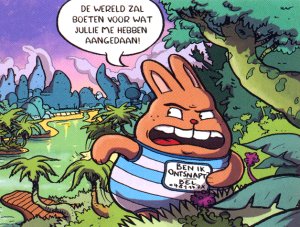
There’s a four pager by Floris de Smedt where Mr. Bunny (see image above) escapes from his prison and exacts a terrible revenge from Brussels. Luckily Mr. Bunny is no match for The Professor, who has a brilliant brain and ready access to dragon eggs. No bunny can resist eggs!


Illustration by Eric van der Heijden: “Does this make you feel more of a man? Does this make you forget for a fleeting moment that your wiener is tiny?”

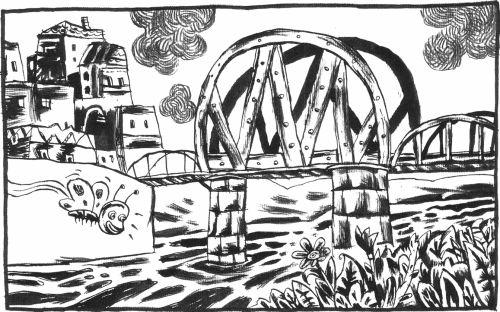
Toen ik klein was (When I was young) is a translation of a comic by Mr. Stocca (Milan Pavlovic) about a boy/bunny who has a crush on his school teacher, and then she dies. I love the atmospheric drawings (see below)!

Also: voyeuristic drawings of young women by Barend van Hoek, a look at artificial creatures, and the regulars (Hibou, Cowboy John, Fool’s Gold, et cetera).

Tags: , , ,

April 11, 2008

I amSterdam, Madrid is mad

Filed under: Design by Branko Collin @ 11:41 am

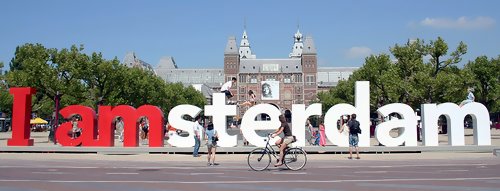
You can say many bad things about Amsterdam’s city marketing campaign I AmSterdam, but at least in some respect it works. A mix of the phrase “I am Amsterdam” and “I heart Amsterdam,” the slogan lets people express their positive feelings towards the city in a tacky but unified manner.

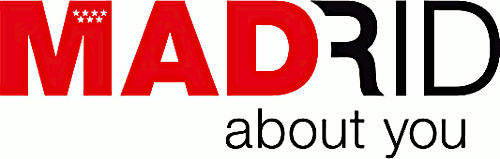
Madrid tries to copy the formula, and copies everything that is wrong about the I AmSterdam campaign. It is tacky. You cannot force a meaningful emotional response with a cold marketing campaign. The formula replaces core values—the reasons why people like Amsterdam or Madrid—with empty slogans. And in doing so, the campaigns are insulting to their audiences’ intelligence.

But Madrid’s copy takes things one step further: it just doesn’t work. “Madrid about you” is a funny pun, but the way the logo is styled makes it say: “Madrid equals mad” (the “about you” is de-emphazised by shoving it to the bottom and printing it in a smaller font.) Critical Spanish designer Rafa Celda says in El Pais that the people who came up with this campaign are trying too hard. “This is like one of those logos that comes with a manual.”

Via Nieuws uit Amsterdam (Dutch). Photo by Matt Rubens, distributed under a Creative Commons Attribution-Share Alike 2.0 license.

Tags: , , , , ,

April 10, 2008

Maaike’s diary in English

Filed under: Comics by Branko Collin @ 12:10 pm

Sample Maaike Hartjes

Maaike Hartjes, who was already the grand old lady of Dutch comics when she was yea high, has started an English language blog in which she documents her next book.

The work title is ‘Enjoy Your Life and Your Socks’, something I saw written on a shop in Japan. I’m going to try to add a new page every day.

I first met Maaike when I was co-publisher of the Iris fanzine in my student days. I believe it was at the Haarlem comics con which takes place every two years, where she showed up with her “folder.” She had wanted to publish her work with another fanzine but they never showed up … and she went on to become a figurehead for our magazine until we quit in the mid-nineties. Maaike is an incredibly versatile artist—though she hates to show this versatility in her comics, focusing instead on what fellow cartoonist and fanzine editor Reinder Dijkhuis once called “her irresistibly funny minuscule drawings,” with which she fills and publishes diaries.

Tags: