July 26, 2013

Cleaning up the ocean, a young Dutchman’s vision

Filed under: Design,Sustainability by Orangemaster @ 7:00 am

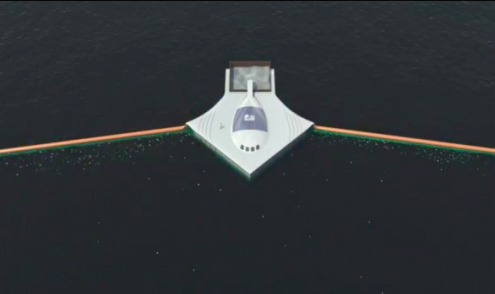
We’ve mentioned wunderkind Boyan Slat a few times and it has always involved water and pushing boundaries. This time, at 19 years of age, he’s been making waves internationally with his Ocean Cleanup Project, which aims at ridding the world’s oceans of plastics. The best thing to do is just watch the video and let him tell you what his plans are.

Problem: The plastic is not static, it moves around.
Solution: Why move through the oceans, if the oceans can move through you?
Fix the sea water processors to the sea bed, and save vast amounts of funds, manpower and emissions.

In his bio, Slat says: “It will be very hard to convince everyone in the world to handle their plastics responsibly, but what we humans are very good in, is inventing technical solutions to our problems. And that’s what we’re doing.”

This fits in with my personal philosophy that using guilt, shame and other negative emotions to force people to do something positive is not the way to go. I am already looking forward to the rest of Slat’s career.

(Link: m.parismatch.com, Photo: screenshot of Tedx presentation)

Tags: , ,

July 25, 2013

Electric charging stations for cars at Dutch filling stations

Filed under: Automobiles by Orangemaster @ 7:11 pm

A court ruled that charging stations may be installed at normal filling stations albeit in the free parking area simply because electricity is not fuel. A collective group of filling stations tried to fight off businesses who wanted to install charging stations, but lost. The law on fuel states that filling stations have a monopoly on selling ‘fuel’ and if electricity isn’t fuel, then they can’t stop the building of charging stations.

This is good news for electric car owners, and particularly for people who rent electric cars but can’t leave the city limits because of the lack of charging stations. Some 250 quick charging station, which claim to be able to charge cars in 20-30 minutes, will soon enough be built to accommodate electric cars on Dutch roads.

Worrying about dropping petrol losses because of hybrid cars is premature, as we told you last year since Dutch Prius drivers use too much petrol.

(Link: www.elsevier.nl, Photo by DaveOnFlickr, some rights reserved)

Tags: , ,

July 24, 2013

Fly your own drone-like favourite objects, DIY style

Filed under: Design by Orangemaster @ 8:49 am

With this kit, you can turn your favourite object into a drone (the popular term) or actually an UAV (Unmanned Aerial Vehicle), as designer Jasper van Loenen explains.

As of 1 June 2013 you no longer need to have a permit to use a drone (thanks big corporations), so it’s time to get your favourite items up and flying. Allowing satellite pictures be made of the entire country, but then fining drones that take pictures for spying was finally considered obsolete.

Many of the parts in the kit can be created with a 3-D printer. Van Loenen made the printer files available, so that people can get into DIY mode with 3-D printing. About the printed parts, he said, “I recommend printing them in ABS or something similarly strong and durable. I printed them in ABS with a fill of around 50 percent and a rectangular mesh, but I think printing them with slightly more fill might be better. It will not increase the weight that much (all the printed parts are pretty light) and might increase the strength quite a bit.”

(Link: phys.org, Photo of Drone by Karen Axelrad, some rights reserved)

Tags: , ,

July 23, 2013

Amsterdam North’s famous crane is being dismantled today

Filed under: Architecture by Orangemaster @ 8:48 am

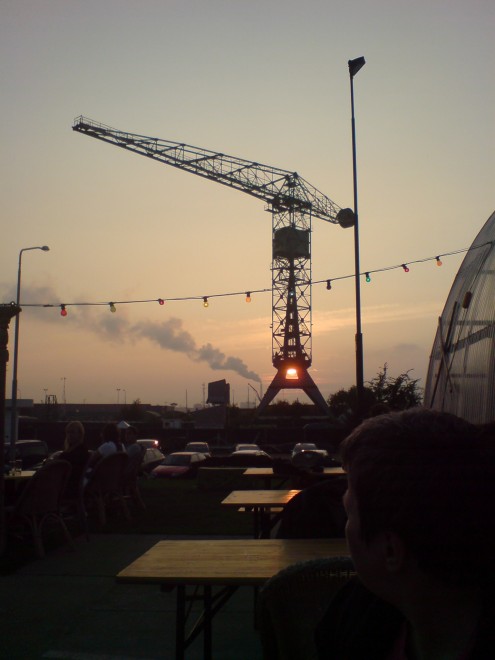
One of the symbols of Amsterdam North’s NDSM dock area is a towering, 50-metre crane (‘Crane 13’) that is said to weigh about 300 metric tons. Today marks the beginning of the crane being dismantled and brought to the province of Friesland to be renovated.

Currently, a design hotel that will be 45 metres high and a small television studio is being built right next to the crane (or where the crane was). The crane will eventually be put back, a good excuse for a party maybe, who knows.

(Link: www.amsterdamfm.nl)

Tags: , ,

July 22, 2013

Ferry wars are threatening to isolate the island of Vlieland

Filed under: General by Branko Collin @ 9:42 am

A price war between two competing ferry companies servicing the Dutch Wadden island of Terschelling is threatening to isolate the island of Vlieland as well.

Rederij Doeksen is the official ferry company that connects both islands with the mainland. In 2008 islanders of Terschelling, dissatisfied with Doeksen’s service, decided to start their own ferry company, Eigen Veerdienst Terschelling (EVT), which literally means Own Ferry Service Terschelling.

The Dutch government granted Doeksen a monopoly in 2011 (which was to enter into force in 2012) provided that Doeksen would guarantee a service throughout the year and not just in the summer, when tourists flock to the islands. EVT brought a case before the Dutch Trade and Industry Appeals Tribunal fighting the concession and in the meantime it charged 5 euro for a ticket to Terschelling whereas Doeksen originally charged 25 euro. Doeksen has lowered its rates to 4 euro, but now threatens to cut trips to Vlieland from three times a day to twice a day.

Vlieland’s inhabitants are not happy. Mayor Else Schadd (Labour) told Volkskrant on 15 July: “This is unacceptable. In the future if you want to go to the dentist, you will need to take the entire day off. Islanders who work on the mainland won’t get to their office before ten in the morning. And day trippers who want to visit us in the off-season will have to return home at five o’ clock.”

EVT’s case hinges around whether the Wadden Sea is a real sea or merely a whole lot of water, Veerbootinfo writes. In case of the former European law apparently gives EVT some breathing space.

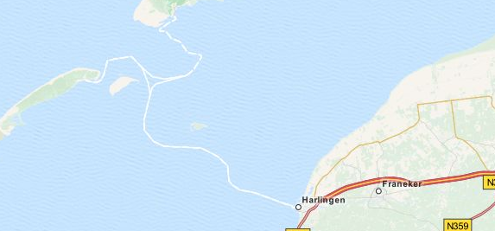
(Map of the Wadden Sea by OpenStreetMap contributors, some rights reserved. Vlieland and Terschelling are in the top left corner, Vlieland is on the left. The white lines show the ferry routes)

Tags: , , , , , , ,

July 21, 2013

Cardboard dividers nets HEMA design award

Filed under: Design,Dutch first by Branko Collin @ 9:25 pm

The 2013 HEMA design award was won by Tessa Eising, a student at the University of Twente, for her laminated rectangular cardboard space dividers.

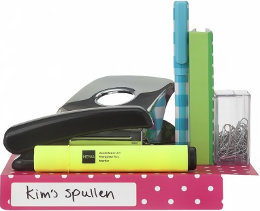
The dividers have one folding edge at both one short and one long side with a label you can write on. The idea is that you put them in a cupboard, fold the edge, write your name on it, and put your stuff on it. As we wrote a couple of days ago, Dutch students often share a flat because of the high rents and they often need to figure out ways to determine who owns what. (In my student days, we shared most of the food and wrote our name on the packaging in the rare cases we needed to reserve something for ourselves.)

Another nominated design that I liked is Kim Monster’s ‘spider’ which you screw onto a standard soda bottle filled with water. Put the bottle ‘feet first’ in a planter and you’ve got a drip for your plants. There is also the travel bottle by Zsolt Hayde with two caps, one for dispensing whatever cream you put into it, the other for cleaning it when it’s empty. Handy for these paranoid times where governments won’t let their electorate onto planes with full bottles.

The HEMA design contest is held every year by the department store of the same name. Winning designs sometimes end up in the store, and it seems that first prize winners are sold through HEMA’s web shop. I have seen 2011’s winner Vrachtpatser, an extension for your bicycle’s luggage rack, in the wild a couple of times. This years prizes were awarded at a ceremony held 11 June at the OBA, the Amsterdam public library.

(Photo: HEMA)

Tags: , , , ,

July 20, 2013

How Heineken branched out into bricks for a short while

Filed under: Design,Food & Drink,Sustainability by Branko Collin @ 11:36 pm

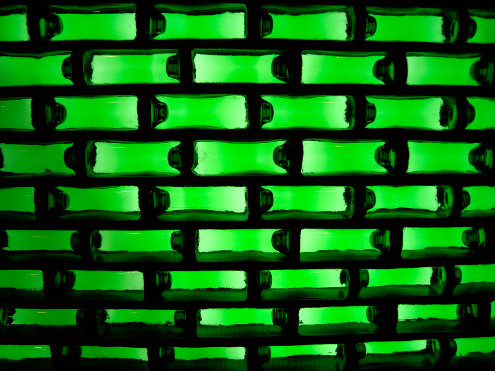
In the 1960 Dutch beer brewer Heineken came up with the idea of using rectangular, stackable beer bottles thinking that they could be re-used as building materials.

Cabinet Magazine writes how Freddy Heineken got the idea when visiting Curaçao in 1960:

[Heineken] noted with dismay the acres of trash underfoot—a good part of it produced by his own company. Heineken Breweries had an efficient bottle-return system in Holland, where the average bottle was used 30 times before being discarded. But without modern distribution, bottles in Curaçao were used once and thrown out. There was no lack of resulting trash: what the island did lack, however, was affordable housing. Heineken had a flash of brilliance: make beer bottles that you can build houses out of.

An initial bottle design by architect John Habraken—a long slender bottle to be stacked vertically—was vetoed by Heineken’s marketing department for being too ‘effeminate’. The second design was the squat bottle you see in the photo. Of this 100,000 bottles were produced and even a prototype shed near Freddy Heineken’s villa in Noordwijk.

(Photo by greezer.ch, some rights reserved)

Tags: , , , , ,

July 19, 2013

No wonder Dutch students live in containers

Filed under: General by Orangemaster @ 12:10 pm

It’s not too much of a surprise that student rooms in Amsterdam are the most expensive in the Netherlands at 100 euro a week, but maybe a little surprising that Dutch student housing is the second most expensive in Europe after the UK at 139 euro a week. Belgian and German neighbours are lucky, paying respectively 66 euro and 57 euro a week.

The typical ‘I’m looking for a room ad’ shows that people are willing to pay just as much and even more than people renting an entire flat to get a room. I also know a lot of Dutch adults who still have roommates, but then the amount of British television shows where adults share flats taught me as a non-European that it’s perfectly normal in Europe.

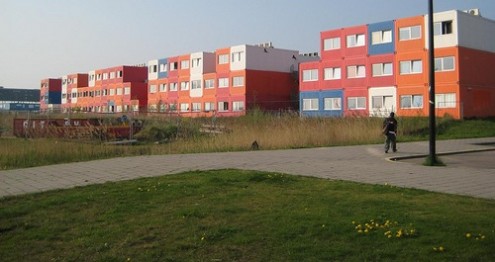
A few weeks ago I was part of a Canadian documentary about Amsterdam North’s NDSM dock area and both cameramen were stunned by the container village (see pic) that students have to live in, first thinking it was some sort of elaborate artwork. When I told them it was student housing, we talked about the differences between Amsterdam and Montréal were the entire crew and myself are from.

Amsterdam style:

– I actually know rich Dutch parents who bought a second house so that their daughter could have a room and share the house with friends.
– There used to be parties in Amsterdam where students could win a room in a house, not rent-free of course.
– Some adults stay in their student room years after graduation because there are very tough laws about throwing people out of their homes.

Montréal style:

– Student housing provided by universities is overpriced and usually full of foreigners who don’t know better. They usually wise up really quickly and get a normal flat.
– Renting a flat is easy, so there is no need for students to live in student housing. They live in flats just like normal people.
– The idea of renting a room in a house is weird. People rent a flat or share a flat, but don’t usually go looking for a room with the assumption that renting a flat is very difficult like it is in Amsterdam.

(Link: www.iamexpat.nl, Photo of Multi-storey container housing by Rory Hyde, some rights reserved)

Tags: , , ,

July 18, 2013

Chinese vase turns family into multimillionaires

Filed under: Art by Orangemaster @ 3:50 pm

In 2003 an anonymous Dutch family inherited a Chinese vase and assessed its worth at 12,500 euro for the tax people. The rare vase of the Han Yuan dynasty then skyrocketed in value between 2003 and 2005 up to 100,000 euro according to the family, due to the many rich Chinese that were interested in buying these vases.

Just 20 months later at an auction at Christie’s in London, the vase went for a whopping 23 million euro. The tax people took the family to court, as they felt cheated and wanted to see a chunk of the megabucks. The family appealed the decision and the court made them settle at 10 million euro.

(Link: www.quotenet.nl, Photo of Chinese vase by epSos.de, some rights reserved)

Tags: , ,

July 17, 2013

Dutch designed 3D printed shoes debut on Paris catwalk

Filed under: Design by Orangemaster @ 12:02 pm

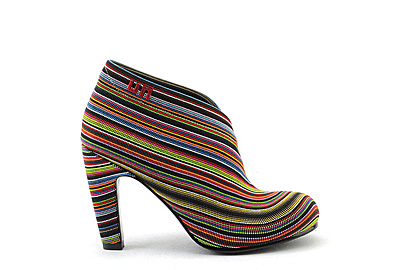
A manufacturer of 3D printers and production systems for prototyping and manufacturing Stratasys has announced the unveiling of 12 pairs of 3D printed shoes during Paris Fashion Week. In collaboration with Dutch designers Iris van Herpen and Creative Director of United Nude (shoe above) Rem D. Koolhaas, Stratasys 3D printed the shoes with a number of intricate geometries designed to mimic elements of nature. Following the success of van Herpen’s recent collaboration with Stratasys for an elaborate 3D printed dress, Van Herpen teamed up with Rem D. Koolhaas to design a tree root inspired shoe.

(Link: www.dutchdailynews.com, Photo United Nude)

Tags: , , ,