
 Rotterdammers spotted this foam lady at a local roundabout last week.
Two days later and she had lost her head, a leg and an arm. The statue was made by Hans Kleinjan.
(Photo by Trendbeheer/Niels Post, some rights reserved)


October 3, 2010
Rotterdammers spotted this foam lady at a local roundabout last week.
Two days later and she had lost her head, a leg and an arm. The statue was made by Hans Kleinjan.
(Photo by Trendbeheer/Niels Post, some rights reserved)
Tags: Rotterdam, roundabouts
October 2, 2010
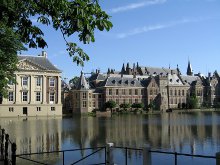 According to the Washington Post, the Netherlands went without a government for 207 days in 1977.
That record was recently broken by Iraq. At least Iraq has an excuse: it is being occupied by a militarist pseudo-theocracy that is after its oil reserves. (Still, you have to wonder why it would take a puppet regime so long to form.)
Following the Washington Post’s definition (the period “between holding a parliamentary election and forming a government”), the Netherlands has now been 115 days without a government, but looking at the current formation talks there is hope yet that we may regain our old record.
Indeed, the caretaker government found out recently that not having any power at all can be a very powerful thing. When they had to get their budget approved, almost nobody protested. Nobody wanted to give up their chances of becoming a government party by alienating the parties in favour of the budget.
I don’t know why 1977 was such a troublesome year, but in more recent times the forming (and then holding on to) of coalitions seems to have been troublesome because of the wide spectrum of political parties that have come to fore in the last decade. Before that (and since time immemorial) there have been three major political blocks, the social-democrats, the liberals and the Christians. Those three could always form a viable coalition with a clear majority in parliament, and now they no longer can.
(Photo of Dutch government buildings in The Hague by Patrick Rasenberg, who released in the public domain)
September 26, 2010
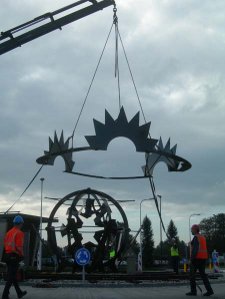 Every roundabout needs its artwork, and here is Yasser Ballemans’ proof.
The photo shows workers putting in the centre piece of the roundabout near Hoogeveen airport.
I especially like the spiky bits that mirror the obligatory ‘shark’s teeth’ painted on the street (to indicate you must yield) and that just make the one in ten million chance that you crash through the front window of your car and impale yourself that much more interesting.
Check out Yasser’s website, he’s done a lot of interesting things lately.
(Link: Trendbeheer. Photo: Yasser Ballemans.)
Tags: roundabouts
September 25, 2010
In the past few days, uploading illustrations has been breaking down regularly. Please bear with us while we try and convince our hosting provider that this is not acceptable.
Tags: 24oranges
As part of the Noord Holland biennial you can spend an hour or more on a life raft on the IJsselmeer (PDF) near Hoorn. Cell phones are not allowed, but there is apparently a way to signal the organisers that you wish to get off prematurely.
The event was set up by artists Marjolijn Dijkman and José Carlos Martinat, who hope you reach enlightenment in that short time. If you wish to reach enlightenment in a rescue vessel equipped with a Martini bar, sheep skin rugs and a DVD player, you should contact a different artist.
September 24, 2010
 Engadget is none too impressed in their hands-on review with Philips’ latest Android PMP, the GoGear Connect:
Overall, we came away feeling like this is an interesting version 1.0 effort in a world of version 2.0 and 3.0 Android devices — and considering that Philips has mostly been a no-show in the smartphone game for the past several years, we can’t say we blame them for the Connect’s shortcomings. […] In the meantime, €250 (about $320) for a rough-around-the-edges 16GB media player — even more for the 32GB model — is a tough sell.
The tech-blog is hopeful though:
Dedicated PMPs aren’t necessarily a hot category at the moment, but add a year or two of refinement and some 3G radios to this bad boy, and there’s no reason to think the Dutch giant couldn’t get back into the phone race in a big way.
(Photo: Philips Communications)
September 21, 2010
 Last Wednesday the Dutch and Australian governments signed an agreement on how to give Australia the Dutch half of the ANCODS collection, which contains the salvage of four Dutch ships that sank near the Australian coast in the 17th and 18th century.
The agreement to give Australia the Dutch portion of the artefacts had already been taken in 2006, Flevocourant writes.
According to a press release (PDF, 2009) by the ministry of foreign affairs the collections of the Batavia (1629), Vergulde Draeck (1656), Zuytdorp (1712) and the Zeewyk (1727) “include bricks, building blocks, lead ingots, elephant tusk, canon, canon balls, amber and pitch as well as rare objects owned by crew and passengers such as navigational instruments and ornaments”.
“Rather than dividing objects between the two countries, they will be kept as close as possible to the shipwrecks where they have been excavated. This is why the Netherlands has agreed to entrust Australia with safeguarding the objects, which are currently in Dutch possession.”
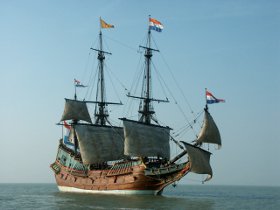
The agreement was signed aboard a replica of the Batavia which is stationed in Lelystad.
(Photo of the Batavia replica by Wikimedia user ADZee who released it to the public domain)
Tags: Australia, Batavia, Golden Age, Lelystad, treasures
September 20, 2010
 A ‘sex sells’ issue (aren’t they all?) of weekly Nieuwe Revu questioned almost 3,000 university students about sex, Blik op Nieuws reports.
Here are some of the numbers:
For the sake of transparency I will list my answers to the magazine’s questions below, but for the sake of privacy I will do it in random order: 314, twice, yes, no, maybe, in Spain, in a hot air balloon, leather, a puppy’s tongue, 19, every other minute, 13, pickled gherkins, beards and moustaches, hanging upside-down, always, velvet, always, always.
(Photo by David Morris, some rights reserved)
Tags: sex, statistics, traits
September 19, 2010
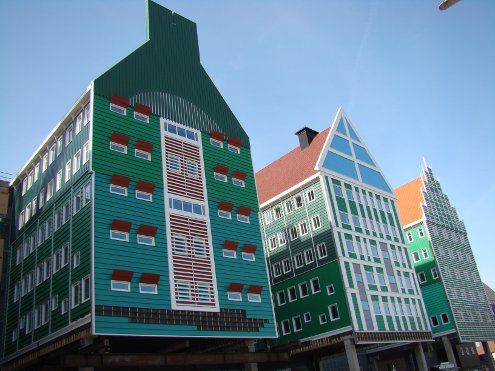
No, the headline is not about environmental technology but about paint. We wrote earlier about the hotel in Zaandam that is made to look like it’s constructed of dozens of the green wooden houses that are typical for the area. It turns out that this was just part of a plan to give a much larger part of the inner city that look, including city hall.
Trendbeheer has more photos of the work in progress.
Alderman Hans Luiten told De Volkskrant in March: “There have been times where I wondered if I could deal with this much identity.” The new city centre is a response to the neglect of the old one. Luiten: “In the past you would not have wanted to be found dead there.”
The man behind the reshaping of the centre of Zaandam into a green Disneyland/nightmare/whatever is architect Sjoerd Soeters who was also responsible for Java Island in Amsterdam. “All his works have been discussed vehemently among architects, but are also appreciated much by their users”, Volkskrant adds. It appears that behind Soeters’ façades lurks a strong vision of livable streets. Which may be why the main street on the aforementioned Java Island is a foot and bike path.
(Photo of the new city hall in Zaandam by Wikimedia user Arch who released it in the public domain)
Tags: green, livable streets, wood, Zaandam
September 18, 2010
 A designer ‘dumbphone’ from the Netherlands: ad agency John Doe from Amsterdam came up with this 80 euro marvel called John’s Phone, and as the price tag suggests they actually put it in production!
Dumbphones, mobile phones that stick to telephony and SMS, are nothing new, but so far have generally been aimed at people who did not need all the features a modern phone has to offer, like the elderly. John’s Phone on the other hand seems aimed at “those who are willing to pay extra to have less” as one BoingBoing commenter puts it.
Publishing an article about a mobile phone brings with it the grave responsibility to produce a spec list, so here goes:
BoingBoing readers (presumably Americans) lamented the lack of compatible service plans, which makes me guess not every country has SIM-only plans, which can be had for as little as 3.50 euro a year. The lack of texting seems a more serious problem: if I see a 06 number (Dutch mobile phone number), I expect to be able to text to it.
(Source photo: John’s Phone. Also check the ad agency’s Flash site for more complete details of the phone.)
Tags: mobile phones, telephony


