October 18, 2011

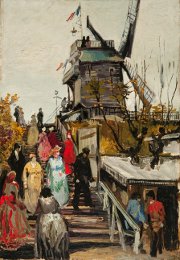
Vincent van Gogh did not shoot himself, biographers claim

Filed under: Art,History by Branko Collin @ 9:31 am

Steven Naifeh and Gregory White Smith just published a new biography of Vincent van Gogh in which they claim that the Dutch 19th century painter did not shoot himself, as is generally believed.

BBC writes:

[The authors] say that, contrary to popular belief, it was more likely he was shot accidentally by two boys he knew who had “a malfunctioning gun”.

The authors came to their conclusion after 10 years of study with more than 20 translators and researchers.

[…] [Stephen Naifeh] said that renowned art historian John Rewald had recorded that version of events when he visited Auvers in the 1930s and other details were found that corroborated the theory.

They include the assertion that the bullet entered Van Gogh’s upper abdomen from an oblique angle – not straight on as might be expected from a suicide.

Last Monday the Van Gogh Museum launched a biographical app on the life of the painter that presumably does not include this fresh light on his life and death. Museum manager Frank van den Eijnden nevertheless sees the book’s publication as a positive development according to De Pers: “Because of the news, the app is more current than ever.”

Earlier today the museum’s conservator, Leo Jansen, called the new theory about Van Gogh’s death insufficiently supported by the evidence: “Many questions remain unanswered.” Nevertheless he feels the authors—for which he reviewed a first draft—did a good job: “They looked at everything that was already known, and came up with many new insights and connections.”

(Illustration: the Van Gogh that was ‘discovered’ last year)

Tags: , ,

October 11, 2011

Reporter nicks 30 kg worth of Khadaffi’s stuff, isn’t sorry

Filed under: General,History by Branko Collin @ 7:00 am

Business news site z24 reports that Harald Doornbos, a Dutch reporter who works for press agency GPD amongst others, has taken 30 kilos worth of goods from former Libyan president Khadaffi’s home.

The alleged loot contains a map, family photos, posters and the passport of the cat of the dictator. Legal experts told the news site that even though it is doubtful that Khadaffi would or could take any legal action, the provisional government could claim ownership of the ex-leader’s possessions.

Doornbos announced this on October 5 on Twitter.

When confronted with the legality of his actions, Doornbos tweeted cryptically: “That is why I haven’t lived in the Netherlands for 18 years.” Later: “If I had not taken these things, they would have been burned half an hour later anyway, good bye history.” Even later: “Discussion closed. You can see stuff in a museum/gallery in the Netherlands soon. Suggestions [for a venue, presumably] still welcome.”

(Photo of a karikature of Gadaffi in Benghazi by Maher27777, who released it into the public domain)

Tags: , ,

October 8, 2011

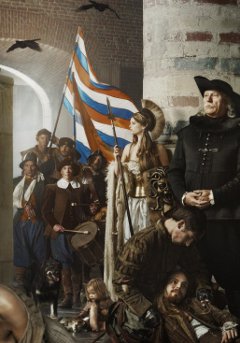
Erwin Olaf’s painting-like photos of the liberation of Leiden (1574)

Filed under: History,Photography by Branko Collin @ 12:22 pm

Look at these great photos Erwin Olaf made in celebration of the liberation of Leiden from an 11 month siege by Spanish forces in 2011.
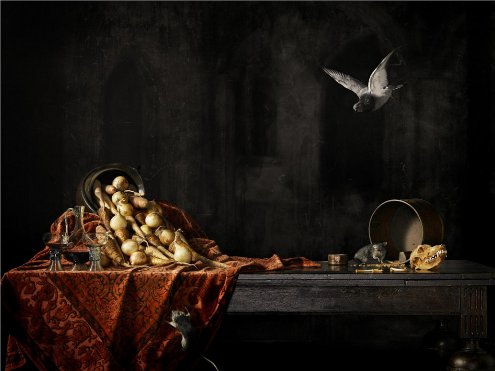
The city still celebrates the liberation each year. Olaf made nine photos on request of Leiden University (the oldest in the Netherlands) and Museum De Lakenhal, some of them portraits, other still lifes. The largest, a historical ‘painting’, is on permanent display in De Lakenhal, the other eight are exhibited until January 8 in the university library. The photos are inspired by paintings of the time.

You can also view the photos at a digital exhibit of the University of Leiden:

The historical piece was shot on July 6, 7 and 8 in Peter’s Church in Leiden. The equipment had been installed on the fifth. On that same day Olaf took a test photo using stand-in models. He had picked the camera angle during an earlier visit to the church. […] The photo was shot in three parts, spread out over the three shooting days. First the right hand side, then the middle, and finally the left hand side.

NRC has a short ‘making of’ picture gallery.

Erwin Olaf is a former journalism student who quickly turned to art and commercial photography. He gained fame and notoriety with his portraits of fat people and midgets in bondage outfits. On October 13 he will receive the Johannes Vermeerprijs, a state award founded in 2008 to “honour and further stimulate remarkable talent”. The award consists of 100,000 euro.

Leiden was liberated in 1574 by the terrorists of Willem van Oranje, the so-called geuzen or gueux. The French word means beggars, a name given to the Dutch nobles that wanted to separate from Charles V’s European empire. The geuzen breached dikes around the city, after which the Spanish army fled. A young orphan called Cornelis Joppenszoon left the city on October 3 and went to a Spanish army camp, which he found deserted. There he also found a kettle containing hutspot (mashed potatoes, carrots and onions). He then alerted the citizens. In the early morning the geuzen entered the city bringing herring and white bread.

Using water as a defense was seen as a viable way to maintain Amsterdam as a national redoubt until the invention of the tank. The floodable area was called Fortress Holland.

Not unrelated: Modern still lifes by Richard Kuiper.

(Photos: Erwin Olaf, 2011, Leidens beleg en ontzet (1574). Link: Historiek.net. Link tip: the Digital Diva.)

Tags: , , ,

September 4, 2011

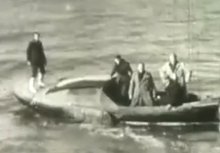
Fleeing from Nazis in a Chevy-powered boat

Filed under: History by Branko Collin @ 12:30 pm

During World War II about 1,900 people fled Dutch territory to unoccupied lands, sometimes to be safe, sometimes to help the allies fight the Nazis. These people were called Engelandvaarders (England-goers), regardless of whether they actually went to England.
The New York Times blog has a story about five of them, students, who fled the country in a DIY motor boat after the Nazis required all students to sign a loyalty oath.

Their engine, commonly known at the time of its manufacture as the cast-iron wonder, was introduced in 1929, giving Chevy customers “a six for the price of a four,” as the advertising slogan said. Displacing 194 cubic inches, it produced 46 horsepower at 2,600 r.p.m. Fuel consumption was 19 m.p.g.

The men bought the engine from a marina operator in western Holland, paying 700 Dutch guilders. Fitting it to their seven-meter launch required numerous modifications, including an underwater exhaust outlet to suppress noise. The driveline and propeller were clandestinely built.

The five made it to England safely—in the end they were picked up by the British navy.

One of the most famous Engelandvaarders was Leiden University student Erik Hazelhoff Roelfzema who was portrayed by Rutger Hauer in the Paul Verhoeven film Soldier of Orange, after Hazelhoff Roelfzema’s autobiography.

(Source photo: a still from a video by Captain A.J. Hardy, now in the public domain)

Tags: , , ,

August 16, 2011

Museum turns into Roman Empire IKEA

Filed under: Design,History by Branko Collin @ 1:21 pm

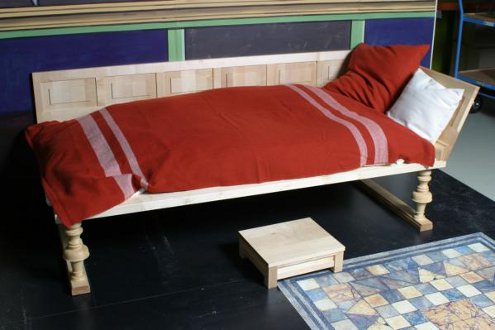
Limburgs Museum in Venlo has an exhibit of Roman Empire household goods with a twist. All the items on display are replicas, and are for sale as part of an exhibit that tries to mimic IKEA down to the smallest detail, including the familiar blue floor map in Latin.

Gadling.com writes:

There’s the blue and yellow logo, the shop-by-room concept, and a cheap Roman meatball lunch in the café. Best of all are the exhibit’s housewares, all of them labelled with Latin names and all available for purchase. You can pick up a “Romulus” toy wooden sword, a “Secundus” wine goblet, or a bust of Emperor Hadrian. Furniture available for online ordering include lounges, tables, and storage cabinets modelled after items found in the ancient Roman city of Herculaneum.

The furniture was built by Drias in Tilburg based on charred remains found in Pompeji and Herculaneum, on frescos from those same cities, and on an illustrated coffin from Simpelveld (Limburg).

The exhibit/store runs until 6 January, 2012. The web shop is in Dutch, but also delivers abroad.

(Photo: Limburgs Museum)

Tags: , , , ,

August 12, 2011

A short guide to Venloish given names, with translations in Dutch, English, German and French

Filed under: History by Branko Collin @ 12:50 pm

Slow news day, so I thought I’d try something different. Here is a list of (short form) given names from my city of birth, Venlo, and their translations into Dutch, English, German and French, where possible.

Dutch Venloish English / German / French
Jan (jAn) Sjeng (sjeN) John / Jan* / Jean
Bert (bErt) Baer (beIr) Bert / ? / Albert
Geert (xeIrt) Sjraar (sjrAr) ** ? / ? / Gérard
Sjaak (sjAk) Sjaak Jack / ? / Jacques
Ton (tQn) Twan (twAn) Tony*** / ? / Tony
? Hay (hɑI) ? / ? / ?
Marieke (mAri:k@ Merieke (m@ri:k@) Mary / ? / Marie
Theo (teIjQ) Thei (tei) Theo / Theo / Théo

Pronunciations between parentheses. I used the SAMPA alphabet for readability. Like IPA it’s a phonetic alphabet, but unlike IPA it only uses Latin symbols). I used the SAMPA English phonetic alphabet though, so the pronunciations listed here are the closest approximations—in my humble opinion. But note, for instance, that ‘a’ (as in Jan) and ‘aa’ (as in Sjaak) have completely different pronounciations in Dutch. (In Dutch long vowels are typically spelled with a double letter, and short vowels with a single letter. Exceptions abound.)

Other Limburgish dialects may use the same names as Venloish, or have wildly differing variants. The Dutch word for the short form of a given name is roepnaam by the way. I have no idea of its etymology, and it could mean either ‘handy version of a name for shouting’ or ‘name one is known by’.

Any additions and corrections are welcome.

*) Recent or regional.
**) If this were Dutch it woud mean “shush, crazy”.
***) From Italian Antonio.

Tags: , , ,

August 8, 2011

National history of science museum Boerhaave threatened with closure

Filed under: History,Science by Branko Collin @ 2:15 pm

Nature writes:

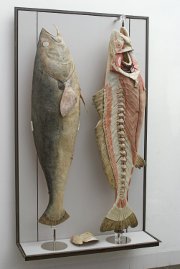
A policy backflip by the Dutch government means that the Netherlands’ most important science history museum has to find €700,000 (US$1 million) by the end of the year – or close its doors.

The Museum Boerhaave in Leiden houses one of Europe’s finest collections of medical and scientific instruments, dating back to the 16th century. The museum, and its education programme, will be closed on 1 January 2013 unless it can comply with a quirk in a recent federal ruling that the museum’s director, Dirk van Delft, describes as arbitrary and unfair.

Fourteen other museums have registered with the Meldpunt Bezuinigingen (Cutbacks Hotline) of the Dutch Museum Association as being in trouble, Volkskrant reported last Thursday.

(Photo of Papier-mâché model of a Sea Bass by Museum Boerhaave, Leiden, some rights reserved)

Tags: , ,

June 12, 2011

96 year old WW II hero admits to post-war killing

Filed under: History by Branko Collin @ 12:43 pm

“During one of the first days of this year” Atie Ridder-Visser sent a letter to the mayor of Leiden admitting that she had shot dead Felix Guljé on March 1, 1946, mayor of Leiden Henri Lenferink reported last Wednesday.

In the final years of the occupation (1944,1945) Ridder-Visser had been part of an underground team that located and assassinated traitors. Guljé, owner of a construction company, collaborated with the Nazis in the open but was a resistance member in secret. As he had several high-ranking members of the Dutch Nazi party NSB on the payroll, he could not openly defy the Germans.

So many threads coming together in this one—also echoes of both Steinbeck’s The Moon is Down and Couperus’ Old People and the Things that Pass here—it would take me a day to make something coherent in English of it. If you read Dutch, follow the link above. The mayor took trouble to tell the story in detail.

As the statute of limitations which was in force at the time of the execution has passed, Ridder-Visser will not be prosecuted. The statute of limitations was dropped for serious crimes in the Netherlands in 2006, but not retro-actively.

Link: Kulture Live.

Tags: , , ,

May 7, 2011

What have the Nazis ever done for you?

Filed under: History by Branko Collin @ 11:48 am

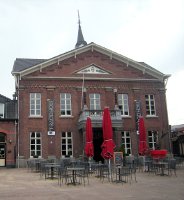
I grew up in Blerick, a town with a town hall but without the political body to inhabit it. See, in 1940 the town was added to the neighbouring city of Venlo by the Nazi occupier, which made the possession of a town hall moot.

Interestingly the previous municipality that Blerick belonged to, Maasbree, once had three different town halls, and the council would rotate among them until in 1904 the Blerick town hall was made the permanent one.

In celebration of Liberation day, daily De Pers summed up 6 of the changes the Nazis made that stuck:

  1. Child support (the Nazis wanted the Arian race to flourish)
  2. Corporate tax (funnily enough, these days our low corporate taxes make us a tax haven, according to the Berserker of Abbottabad)
  3. Central European Time (before that, we had our own sliver of a time zone)
  4. The Frisian islands of Vlieland and Terschelling (formerly of Noord Holland)
  5. Rent control and renter protection (including the right to live in a house forever)
  6. Job protection (including the right to keep a job forever)

In a number of these cases the occupier made into law what was already on the books. In other cases the law was kept because it made sense. For instance, with housing shortages being rather prominent after the war, it made eminent sense to protect renters from price gouging. In such cases the Germans had unwittingly produced both the diseases and the cures.

(Photo of the Blerick town hall by Wikimedia user Torval, some rights reserved)

Tags: , , , , , , , , , ,

April 23, 2011

Looking back at the first and short-lived Dutch constitution

Filed under: History by Branko Collin @ 3:52 pm

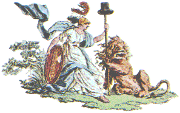
Wedged between the Dutch republic and the Dutch monarchy—and like France and the USA born of the Age of Enlightenment—was the short-lived Batavian Republic (1795-1806). It was both the product of its time and of the continuous threat of French occupation.

The republic was working on a constitution that would help it move away from provincial powers and to a more unified state. In 1797 the government held what was to be the country’s first national referendum, in which the new constitution was soundly rejected. In the end this rejection only served to hasten the French occupation.

The General Principles of this first Dutch constitution were:

  1. The goals of a societal union are the security of person, life, honour and possesions, and the improvement of mind and morals.
  2. The societal pact neither changes nor limits the natural rights of man, except where necessary to reach society’s goals.
  3. All members of society have an equal right to its advantages, regardless of birth, possesions, standing or rank.
  4. Every citizen is completely free to have disposal of his possesions, income and the fruit of his ingenuity and labour, and furthermore to do anything that does not infringe upon the rights of others.
  5. The law is the will of the entire societal body, as expressed by the majority of its citizens or by their representatives. It is equal to all in protection and in punishment. It only pertains deeds, never sentiments. Everything that agrees with the unalienable rights of man in society cannot be barred by any law. It neither orders nor permits that which would conflict with this rule.
  6. All the duties of a member of society have their basis in this one holy law: do not do unto others what you do not wish to happen to you; do unto others, at all times, as much good as you would wish to receive from them under the same circumstances.
  7. Nobody is a good citizen but he who excercises the domestic duties of his rank with care, and who furthermore fulfills his societal duties in every way.
  8. The reverent recognition of an all powerful supreme being strengthens the ties of society, and remains warmly recommended to every citizen.

Modern day republicans still regard this text highly, some of them even considering it better than what we have now. Which, I guess, helps to explain the huge support for the royal house of Orange by the Dutch. Having royalists run the country may not be perfect, but it does seem to be the saner alternative at the moment.

Tags: , ,