February 20, 2010

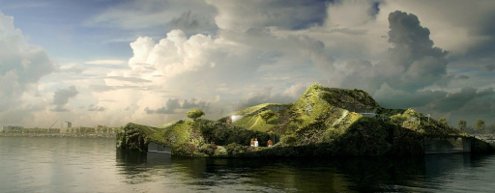
Floating wellness centre made of recycled materials

Filed under: Architecture,Sustainability by Branko Collin @ 3:13 pm

This artificial island was concocted by Studio Noach (what’s in a name?) and Anne Holtrop, and is based on recycled polystyrene.

The intended purpose of the island is to house a wellness centre in the IJ lake near Amsterdam.

For many tourists the image of Amsterdam as one of a city where you can celebrate your bachelor party but not your honeymoon will change when the city can offer a wellness arrangement without its equal in the world.

That sounds like a perverted marriage of the ideas of Robert-Jasper Grootveld (who came up with floating, polystyrene gardens long before Studio Noach, and was taken to his grave on one), and that of the current city government which wants to turns Amsterdam’s lively ecosystem of opinions and ideas into a sort of super-controlled Disneyland for rich tourists.

The walls and roofs will be covered in plants and flowers. […] [The island will be located] just 6 kilometres from the Grachtengordel (‘Belt of canals’), to be reached by shuttle over land or directly over the water.

(Source image: Studio Noach. Link: Ecofriend.)

Tags: ,

February 18, 2010

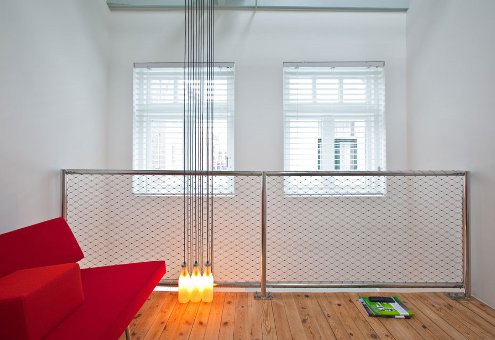
Maff studio apartment in The Hague

Filed under: Architecture by Branko Collin @ 1:15 pm

A 38-square-metre house for low income families in The Hague was converted into this studio apartment by Robert-Jan de Kort (RDKA) and Teun van den Dries (Eckhart).

It can be rented for 155 euro a night, smoking and shoe-wearing not allowed (Maff provides you with fluffy slippers). The price per night goes down the longer you rent the apartment. Facilities include a car park, wifi, coffee, and a library of 100 films.

(Source photo: Maff.nl. Link: Bright.)

Tags:

February 17, 2010

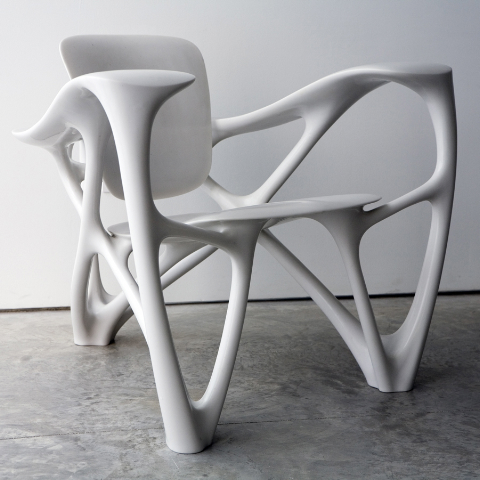
Joris Laarman’s solo exhibition in New York

Filed under: Art by Branko Collin @ 11:51 am

Says Dan Schwartz:

In 2006, Laarman’s Bone Chair revolutionized the design process by using an algorithm to translate the complexity, proportion and functionality of human bone and tree growth into a chair form. The algorithm, originally used by the German car industry, enabled him to reduce and strengthen his designs by optimizing material allocation, weight and stability, while minimizing material input. In his own words, he sculpted “using mother nature’s underlying codes.”

The upcoming exhibition is the culmination of five years of trial and error, exploratory material research and his continuous quest to translate science into functional objects of beauty, now on a monumental scale. His new body of work expands on his core investigations; it includes Skyline Storage, Fractal Bookshelf, Stair Cabinet, and Half Life Lamp, a sustainable lamp made from living cells.

The upcoming exhibition will start March 4 at Friedman Benda in New York.

See also: WirePod by Joris Laarman.

(Source image: Susan Grant Lewin Associates)

Tags: ,

February 13, 2010

Unemployment agency prosecutes entrepreneurs for working too hard

Filed under: General by Branko Collin @ 3:10 pm

UWV, the Dutch unemployment agency, is suing and sometimes prosecuting formerly unemployed people who followed UWV’s incorrect advice on how to report earnings. The victims participated in a scheme active from 2004 to 2006 in which they could start a company while still receiving benefits.

UWV’s argument revolves around the criterion for the amount of hours worked. Originally, the agency only counted billable hours, but since then it has started counting all hours that one puts into a business. UWV found discrepancies between what entrepreneurs reported to them and to the tax service. As databases of governmental agencies are linked, and the tax service gives single person companies certain breaks depending on the amount of hours they put in, it was easy for the agency to figure out the differences in hours reported.

NRC reports that people who have only recently recovered from unemployment have received fines as high as 50,000 euro, with an average of 15,000 euro. Ronald van der Krogt of union FNV says that as much as 42% of all participants in the reintegration program applied the rules incorrectly, in hindsight. “Allegedly those people are all frauds. You cannot maintain such a thing with a straight face. If that is the rule, then the rule is wrong. UWV are failing big time.”

Judges’ hands appear to be tied. A ruling from 1996 found that UWV’s most recent interpretation of the law is the correct one. (Which by the way strikes me as odd, since the reintegration program is a much more recent affair.) This means that even sitting at the office and reading a paper or picking your nose would have gotten you branded a fraud if you forgot to report those hours as work.

UWV has said it will take FNV’s complaints very seriously.

(Link: Geen Commentaar.)

Tags: , , , , , ,

February 11, 2010

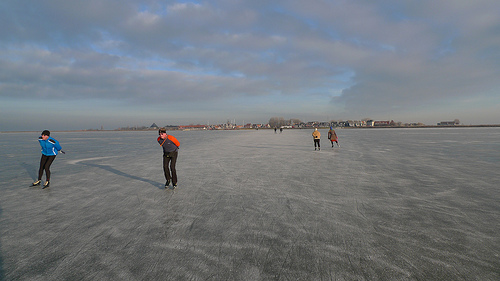
Elfstedentocht stronger brand than Olympic Games

Filed under: Sports by Branko Collin @ 11:48 am

A recent study by HBB Consultancy revealed that the Elfstedentocht, a rare and gruelling outdoor skating race, is a better known and higher valued sports brand in the Netherlands than the Olympic Games, Algemeen Dagblad reported yesterday.

Both events are about as old, but the Elfstedentocht is held on average every seven years, when conditions in Friesland are harsh enough to freeze over 200 kilometres’ worth of canals. On the list of strong sports brands, the Olympics only get a peek in at three, after the Elfstedentocht and football goalkeeper Edwin van der Sar.

As for the athletes, Van der Sar is better liked among men, whereas women prefer speed skater Sven ‘Svencouver’ Kramer.

Although Ajax is rated the top brand among football teams, arch rivals Feyenoord take off with the best appreciated stadium (De Kuip).

(Photo by Remko van Dokkum, some rights reserved)

Tags: , , , , , ,

February 10, 2010

Right to public transport refunds finite

Filed under: General by Branko Collin @ 12:56 pm

Dutch public transport companies have forced a new payment system onto their users, the ‘OV Chipkaart’ (‘Public transport chip card’), and are now complaining that travellers do not understand how the system works.

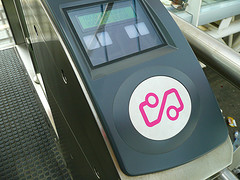
Rather than buying a ticket, you have to hold a chip on a card to a reader, once for checking in and once for checking out. Not surprisingly, a lot of people forget to check out, and in doing so lose the deposit that was subtracted from their digital wallet when they checked in. Until now most transport companies have refunded these lost deposits, but nu.nl reports that the refunds won’t be given forever.

Bus company Connexxion told the news site: “We look at this on a case by case basis. If you bump your head often enough, you’ll eventually learn not to.” Qbuzz, another bus company, estimates that it will keep giving money back for only a few more weeks.

Metro company RET of Rotterdam reports that people forget to check out about 0.5% of the time. Since the deposit is higher than the average amount of money the transport companies expect to make on a single fare and they do not have to do anything in return, that’s going to be a nice windfall for them.

The previous system (Strippenkaart) had a built in moneymaker like that too, in that you had to buy several tickets at once, which would undoubtedly get lost in one’s sofa to emerge only when the last date you could use the card on had gone by. Although it was possible to buy a ticket for just a single trip, these tended to be a lot more expensive.

The introduction of the OV Chipkaart also seems to have gone hand in hand with price hikes, Dutch News reports:

The government is to assess whether the switch to the new public transport smart card has made using buses and trams more expensive, Trouw [newspaper] reports on Tuesday.

There are have been numerous reports of price increases in recent months but the introduction of the OV Chipkaart had been coupled with a government pledge that travel would not become more expensive.

Uselog describes a host of usability problems with the OV Chipkaart.

(Photo by Franklin Heijnen, some rights reserved)

Tags: , ,

February 9, 2010

Bicycle Mania Photo Contest winner

Filed under: Bicycles,Photography by Branko Collin @ 1:58 pm

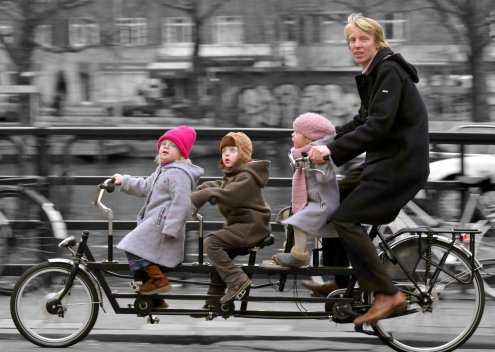
Last week Marc van Woudenberg won the Bicycle Mania Photo contest with this picture.

Van Woudenberg publishes a photo blog about cyclists in Amsterdam called ‘Amsterdamize’. My favourite photo of his is this one, from a series about biking in the winter. That back tire is almost flattened by the peer pressure.

The winning photo, called Family Cycle Train, can also be viewed on Flickr and distributed using a Creative Commons license.

If you were wondering, yes, this is a fairly common sight in the Netherlands.

Tags: , ,

February 8, 2010

Bathroom with vertical garden

Filed under: Architecture,Design by Branko Collin @ 12:25 pm

The owner of an Amsterdam canal apartment had to suffer the indignity of just seeing a wall whenever he looked out of his bathroom window, so interior designers i29 fixed that for him: they added a vertical garden to the wall.

This was enough to land them the Bathroom Design Award 2010 in the Home category. (Unfortunately, the entire ‘site’ is made of Flash, so I cannot link to the 2010 page directly. Just click “Winnaars 2010.”)

The other category, Hotel, was won by Marjolein Garritsen for the bathroom in the Ilyushin Il-18 based hotel room we wrote about two weeks ago.

(Photo: Horizon Photoworks, used with permission. Link: Bright.nl)

Tags: , ,

February 7, 2010

AEX CEOs mostly graduate from Rotterdam and Delft

Filed under: General by Branko Collin @ 1:23 pm

If you want to become a CEO or a supervisor of one of the 25 Dutch companies that make up the AEX, the index of the country’s most actively traded securities, you’d better study economics in Rotterdam or civil engineering in Delft, Z24 reports.
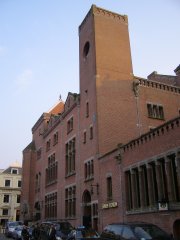
Together, both universities have produced the majority of current CEOs and supervisors of AEX companies. The oldest university of the country, that of Leiden, and the largest universities, those of Amsterdam and Utrecht, play lesser roles in supplying large Dutch companies with their management. Fifteen of the 25 CEOs are graduates of either Rotterdam (8) or Delft (7).

(Photo of the Berlage stock exchange by Flickr user Taver, some rights reserved)

Tags: , , ,

February 6, 2010

Airport on the North Sea

Filed under: Architecture,Aviation,Science by Branko Collin @ 3:07 pm

The way the Dutch viewed their national airport Schiphol has changed over the years. From the starting point of an adventure, it became the nuisance in the backyard. The Bijlmer disaster of 1992, when victims living (and dying) in Amsterdam’s biggest ghetto were pushed into a secondary role to El Al’s secret cargo, really helped define this latter view.

However, Schiphol’s own ambitions are radically different. Instead of becoming a smaller, gentler airport, it wants to become the major air traffic hub of this part of Europe. People therefore started to look at alternative locations for the airport, not as close to the most densely populated area of this densely populated country. An idea that keeps floating to the top is that of an airport in either the IJsselmeer or the North Sea, even though the Ministry of Transport and Water Management concluded in 2003 that a second national airport was superfluous, for now. Such a water-bound airport could be an artificial island, or a mega-floater.

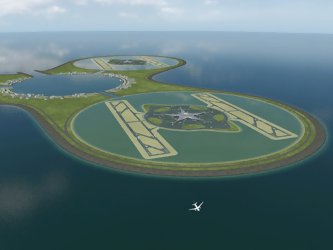
In 2007 Haskoning and Van Oord, who helped build artificial islands before, proposed rotating, floating landing strips (see illustration). And last week, Jan van Kessel got his PhD for a study into the stability of mega-floaters made of hollow, upside down, concrete ‘shoe boxes’, apparently, 50% more stable than traditional barges.

And even though the government has declared the debate redundant, the Dutch keep dreaming of their airport at sea.

Tags: , , , , ,