


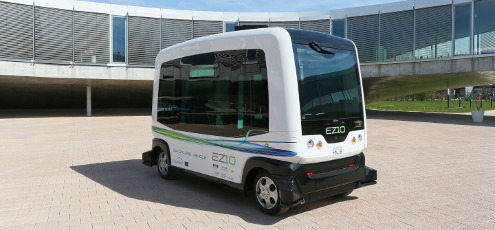
The province of Gelderland will try to achieve a world first in May 2016 when it hopes to run a shuttle service on public roads using self-driven vehicles.
The vehicles are called Wepods and should drive guests of the University of Wageningen from the nearby rail station of Ede-Wageningen to the university and back. Currently however the vehicle laws of the Netherlands don’t allow self-driven cars on the road. The province hopes to convince the relevant ministries during a demonstration in October. The first Wepod, produced by Ligier in France, was delivered in June.
Rotterdam was the first city in the Netherlands allowing self-driven vehicles on its territory. The Rivium shuttle bus however does not mix with other traffic and has its own road — it operates a bit like a train without the rails.
(Link: Smart Driving; photo: Wepod.nl)



 Amsterdam is 200 years older than is commonly assumed, says historical geographer Chris de Bont. The settlement was originally started in 1000 AC instead of 1200 AC, which is still pretty young. De Bont bases his conclusion on the patterns formed by old brooks. “I found the same patterns elsewhere in the region where farmers lived around the time,” De Bont told print daily Metro, “so it’s logical to assume that farmers also created the patterns in Amsterdam.”