

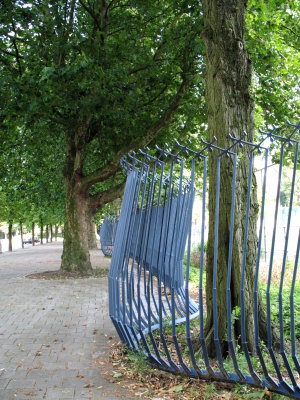
 The Olympiaplein in Amsterdam is located in my neighbourhood, the Olympic Quarter. I must have walked and biked past this spot dozens if not hundreds of times. And yet when I did so last week, the oddness of this fence struck me for the first time. Its builder and designer has taken special care to curve the fence around some of the trees, but has locked other trees out. It is clear that this was done on purpose, but not why.
Perhaps this is a reflection on the power of man over nature. Trees cannot walk, but even if they could, people would get to decide where. Or, more likely, it is a statement of the power of man over man. We, the city council, decide where our fences run. If we want them to zigzag, we’ll make them zigzag. If we want them to form obscene drawings to observers in outer space, obscene drawings it is. Or perhaps the architect merely mused on the nature of borders in general, with the rows of trees forming one border, and the rows of steel mixing in in an oddly compromising way.
In the end, the solution is far more prosaic. This fence, designed by Ruud-Jan Kokke, replaced its modest predecessor in 2007. The district council had decided to cut down 78 trees to make room for the fence, and this decision led to a storm of protest. Once the district of Oud Zuid had decided to give in to the complaints, the fence builders had already started (Dutch). The decision was then reached to have the fence curve out whenever it met with a tree. And so all my philosophies proved right, in the end, though not in a way I expected.
The city commissioned Gabriele Merolli to make a series of photos of The Fence, and he put them on the web.
 Foekje Dillema, the runner
  The New York Times is taking a look at
 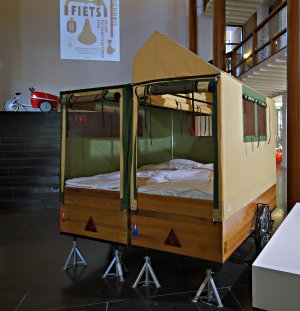 As any European can tell you, nothing says “Dutch” more than caravans … except bicycles. And so it was bound to happen that somebody would try and combine the two. That somebody was design agency Reggs’ Thijs Bouman, whose Fietscaravan reached the final round of design competition Het Beste Idee van Nederland last year. Two of these trailers can be connected to form a double bed. For something so small this looks mighty comfortable to me, although I could use some pockets for books and a reading light at the head end.
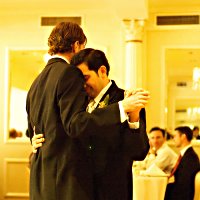 Civil servants who felt that the term “maiden name” might not be appreciated by the participants in an all-male wedding asked the Nederlandse Taalunie (Dutch Language Union) to come up with a new phrase. The Union is not in the habit of creating words but
  Earlier this year researchers from the Radboud University in Nijmegen published a