July 11, 2009

Calvin’s 500th birthday luxuries sell briskly

Filed under: History,Religion by Branko Collin @ 11:27 am

The granddaddy of the War on Fun must surely be Jean Cauvin (1509 – 1564), the French protestant priest who is seen around these parts as more influential than Luther himself. The man was a big believer in hard work and no (earthly) reward, so it is perhaps odd that the trinkets that are being sold in honour of his 500th anniversary are selling like hot cakes.

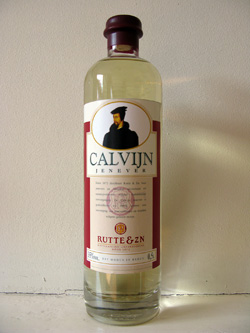
Brabants Dagblad reports (Dutch) that a small lake of Calvijn jenever has already been sold (500+ bottles), and that the 25,000 print run of the Calvijn glossy has completely sold out. The exhibition about his life in Dordrecht has so far attracted more than 60,000 visitors. It is unknown if all these people gorged themselves on nectar and ambrosia right after, but there are ten restaurants in Dordrecht that offer special Calvin meals. Perhaps just a pea on a plate, who knows?

Novelist Maarten ‘t Hart points out delicately in NRC Handelsblad (Dutch) that some of the rules of sobriety of Calvin derive from Roman stoic philosopher Seneca the Younger, who did not like music and dancing (“[there is] a time to dance”, Ecc. 3:4) and other exuberances, such as wearing anything other than dark clothes (“Let thy garments be always white”, Ecc. 9:8).

Meanwhile, in the same paper (Dutch) liberal politician Boris van der Ham points out that the celebration of 500 years sobriety is also the celebration of 400 years resistance against the Calvinist philosophy. The States of Holland had a session in 1608 in which theologian Arminius pleaded for the free will of people: “And so I think that man tries to think well, want well and act well.” But Van der Ham also points out that the Dutch reputation as being straight-shooters to the point of being rude is firmly rooted in Calvinism. “In other countries ‘sins’ were often allowed in a don’t-ask,-don’t-tell way, here the curtains were drawn wide open. […] If other countries sometimes look with bewilderment at our freedoms, it’s not because of the freedoms themselves, but because we are so open and honest about them, in what is essentially a Calvinist way.”

(Photo: Calvijn Dordrecht.)

Tags: , , , , , , , , , , , ,

July 9, 2009

After 195 years, Staatsblad and Staatscourant disappear

Filed under: General,History by Branko Collin @ 11:37 am

No law or decree has ever been valid in this kingdom until after publication in the Staatsblad (laws) or Staatscourant (other government decisions with the force of law). That is, until July 1st of this year, when the paper editions of Staatsblad and Staatscourant were abandoned and a law came into force that allowed electronic publication of laws and decrees.



The Staatscourant was founded by the first Dutch King, Willem I, in 1814. Volkskrant reports that the king wasn’t shy of using this formal publication for political purposes, especially since it could compete cheaply with commercial newspapers.

With the official publications now taken care of by a website, bekendmaking.nl, Staatscourant and Staatsblad publisher SDU will continue with a printed weekly called SC that will focus on commentary on laws.

Tags: , , , ,

July 8, 2009

Writing pad sheets optimized for making paper balls

Filed under: Art,Design by Branko Collin @ 11:33 am

This pad comes with ready-made sheets for creating paper balls, whether thrown away in frustration or just to tease the teacher. The pad was created by Trapped in Suburbia who are operating from the old Caballero cigarette factory in The Hague and describe it as follows:

Play More More More is a note book that encourages clients to play at their work. Every sheet has its own ball print.

(Link. Via Bright. Photos: Trapped in Suburbia)

Tags: , , , , ,

July 6, 2009

Faith healer says: “Always consult a physician”

Filed under: Religion,Science by Branko Collin @ 8:51 am

When faith healer Jomanda took to the stage yesterday for one of her sessions in Bergen op Zoom, Noord Brabant, she had a big sign with her that said “Raadpleeg altijd een arts” (“Always consult a physician”), an odd move perhaps for somebody who believes she is a healing medium between this world and ‘God’. On her website she even claims that “doctors merely apply the bandages, only God heals.” Jomanda was recently cleared from charges (Dutch) of contributing to comedy actress Sylvia Millecam’s death.

Millecam had been struggling with breast cancer and had been avoiding traditional medicine. The alternative ‘healers’ she sought out suggested that she merely had a bacterial infection, after which she died. The case against Jomanda and two ‘alternative doctors’ was unique in that for the first time a court held it had the authority to address the care duty of somebody who was not a legal care giver. Indeed, the court seems to take this for granted (Dutch).

The court considered it proven that Jomanda had violated her care duty, but cleared her of the charges because Millecam had also sought regular help during the time she consulted the medium, and that the medium merely had a “comforting” influence, not a decisive one. The justice department is appealing.

(Photo by Mike Locke, some rights reserved)

Tags: , , , , ,

July 5, 2009

Providers not eager to (multi)play

Filed under: Online by Branko Collin @ 1:38 pm

Four years ago I wrote a piece for the Teleread blog called “Consumers won’t (multi)play.” It told about how telecom providers had lined up all these great packages that combined television, internet access, and telephony. No more hassle with double or triple contracts and bills, just one easy, clean, simple package from a single provider. And the consumer wouldn’t have it, for reasons that remained unclear.

Well, it appears that consumers have finally started to make the move towards a single bill, and I have been caught up in the drift. My internet access provider of many years sent me a rather threatening letter, telling me to get with the program or else… The situation there has been rather more convoluted than elsewhere. My provider offered ADSL before the phone company did (former monopolist KPN), and as a result its customers had to have a contract both with the internet provider, and the phone company (which provided the physical lines).

Later the provider somehow acquired the possibility to offer ADSL without forcing the customer to tango with KPN (I don’t know why, I presume this has to do with some sort of liberalisation of the phone lines), and now it understandably wants to move all its customers that couldn’t be arsed to go the single bill route. So this is the sugar with which they are trying to coax us: “If you don’t move, we’ll raise the price of your subscription.” Naturally, I have been checking out the competition.

Oddly enough, the competition doesn’t seem to be too eager to take me on as a new customer.

UPC offers a handy looking tool to select your package with a great promise: they’ll pay for the cheapest of the three services. But you don’t even have to click around to realize that it’s pretty much the price of the internet service you choose that determines the final cost. Still, you have to choose all the premium deluxe services with all the bells and whistles and free champagne and hookers for a year to get at a price that’s substantially higher than what you would pay at the competition. Wait, there’s some dirt on the screen. Hm, I cannot get it off. Would it be …? Yes, it’s the tiny print that informs of all the extra costs that add 50% to your bills for many moons to come.

All this dancing around the do to hide the true costs.

KPN, that good old phone company, also offers triple play, and they also dance around. They’ve got a couple of special offers lined up right now that make their Basic and Premium package look much better than their Lite package. Well, for the first three months that is. Again, what’s with the deception? Why not give everybody the premium service for three months, and the choice to switch back for free after that?

Telegraaf reports (Dutch) that a change in the Telecommunications law last Wednesday no longer allows contracts to be silently renewed without the customer’s explicit consent, and predicts this change is going to cause a price war in the telecom world. Price comparison whizz-kid Ben Woldring tells the paper consumers can save hundreds of euros a year. So far, I have not noticed any participant who seems to take this war seriously.


Illustration: UPC’s two-out-of-three picker always yields pretty much the same price depending on the internet component you choose.


Illustration: If KPN’s premium packages are cheaper than their Lite package, why do they offer the latter at all?

Tags: , , , , , , , , , , ,

July 4, 2009

New station and city hall for Delft

Filed under: Architecture by Branko Collin @ 9:51 am

delft-station-planned

Mecanoo architects came up with this combined railway station and city hall for Delft, a small and otherwise picturesque city near Rotterdam. The ceiling in this photo is made of Delftware. I am thinking: hobbit on crack with a porcelain fetish, but hey, to each their own. I am certainly not adverse to good ceiling porn, this just doesn’t seem to be it. The railway is going partly underground in order to connect the two city halves, which I think is a good idea.

A couple of years ago the city council figured they had an image problem (Dutch), and spent 1 million euro of tax payer’s money to make it go away. One of the solutions they seem to have found was to make Delftware more prominent (Dutch).

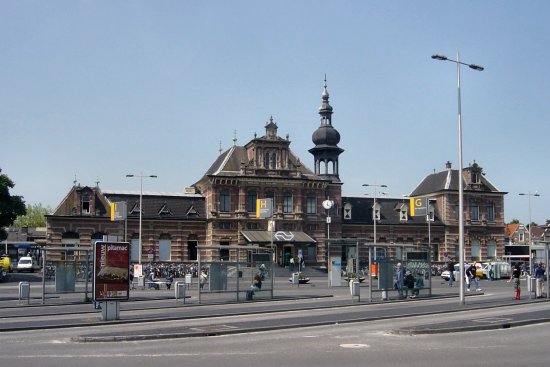
For comparison, here’s the current railway station:

delft-station-current

(Photo of the new station by Mecanoo. Photo of the old station by Markv, some rights reserved. Bright says building will start in 2010.)

Tags: ,

July 3, 2009

Van Gogh’s paintings as shot by amateur photographers

Filed under: Art,Photography by Branko Collin @ 9:06 am

The Wiki Loves Art contest that I reported about earlier is over, and all that is left is for the judges to declare a winner.

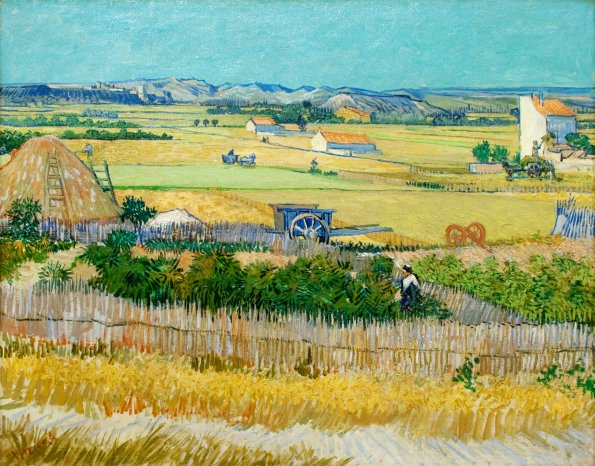
One of the extraordinary things about this contest is that the Van Gogh museum in Amsterdam opened its door to amateur photographers. That must have been a frightful decision to take, what with all the paintings worth millions just a camera stand leg away from scratching, so I hope it was a good experience for them.

Painting above is The Harvest (1888), photo taken by Flickr user Pachango. View the 4,500+ contest photos here, or just the 450+ Van Gogh ones here. (I edited the colours into oblivion, but I just could not agree with the red hue that Pachango’s version had, or the yellow hue on the museum’s website.)

Tags: , , , , , ,

June 29, 2009

Older men least likely to be fired

Filed under: General by Branko Collin @ 9:03 am

Men of age 45 and older are not sharing in the general economic downturn, reports Z24 (Dutch). To the contrary, in May of this year 9,000 more men of that age group were employed than in May 2008.

Statistics Netherlands economist Michiel Vergeer explains to the financial news site: “These are the people who have been in their jobs for a long time, you just cannot get rid of them. But once they have become unemployed, it becomes very difficult for them to find another job.”

In the Netherlands jobs are ‘protected,’ meaning that you have to get permission from a court to be able to fire somebody. Although mass lay-offs are possible, courts tend to spare older employees during such procedures. Unemployment has risen 8,000 from April to May, a number Vergeer calls “still modest.”

(Photo by Erich Ferdinand, some rights reserved.)

Tags: , , , ,

June 28, 2009

Hans Koning’s aphorisms online

Filed under: Literature by Branko Collin @ 10:36 am

Hans Koning (1921 – 2007) was one of that rare breed, an author who successfully traded his native tongue for another, in this case Dutch for English. A member of the Dutch resistance and a writer for the Groene Amsterdammer weekly, Koning emigrated to the USA in 1951. His publisher has put his book of aphorisms online, Hans Koning’s Little Book of Comforts & Gripes:

The tool for judging by those who don’t understand a thing about the arts is: categorizing. “What kind of books do you write?” they ask. “What kind of painting do you do?” It may seem harmless until art becomes dependent on money controlled by these ignorant men. Recently some people made a motion picture ‘based’ on Dostoyevsky’s “Crime and Punishment.” They hadn’t really understood much of the book and the film was a disaster. Now Hollywood producers know that “Dostoyevsky movies don’t sell.”

(Slide 53. It’s a pity that the book is published as images rather than text, and that it is riddled with spelling errors.)

See also: his New York Times obituary; his ever changing Wikipedia entry.

(Via Eamelje.)

Tags: , , ,

June 27, 2009

Tricycle car company Carver keels over

Filed under: Automobiles by Branko Collin @ 1:20 pm

Carver Europe, producer of the tricycle car with the same name, has gone bankrupt, reports Algemeen Dagblad (Dutch). The Carver is a cross between a regular car and a motor cycle, of which the cockpit and front wheel can roll (or list if you are nautically inclined)—something the Reliant Robin never quite got the hang of.

CEO Willem Verheul told the paper that there wasn’t enough of a market for the 50,000 euro vehicle: “We were hoping to sell 300 per year, instead we only managed 200.” The ‘s Gravendeel, Zuid Holland based company will lay off nine employees.

One company that is going to be distraught at the news are flying car / vaporware makers Pal-V, who based the design of their eponymous vehicle on the Carver One. When earlier this year Pal-V promised a demonstration of its technology, it disappointed the collected international press by showing a gyroscope and a Carver, but not the hybrid that everybody has been waiting for these past years.

Top Gear’s Jeremy Clarkson once famously said about the Carver: “Absolute, hands-on-heart, I have never had so much fun in a car,” and his side-kick whose name I forget called it “the gadget to end all gadgets.”

(Photo by Wikimedia user Detectandpreserve, some rights reserved.)

Tags: , , , , ,