

We started 24 Oranges in February 2007 and in late January 2022 it will become a column over at DutchNews.nl, also called 24 Oranges. After 4,100 posts under our belts, we might feel the need to post here every once in a while in the future, but have no current plans to continue. As two self-employed people, we’ve had to make sure we had enough work and energy to keep going, and honestly we just don’t these days.
Before we sign off indefinitely, let’s look back at a few of the stories that we still talk about in no particular order.
1. A beautifully preserved Jewish home in Amsterdam
We didn’t break this story, but we scooped all the Dutch media in getting the right to use pictures, which we’re very proud of. All we did was ask nicely, while other media tried to ask us, which was odd because we didn’t have the rights.
Recently discovered Jewish interior will not be wrecked for now.
2. The Dutch neighbourhood built by the Nazis
It’s not the province of Limburg’s fault for being a few kilometres from the Germany border. In this case, the city of Heerlen, which was occupied back in the day, has an entire neighbourhood with an eerie Dutch look on the outside, but efficient spaces for families on the inside.
Visiting a neighbourhood built by Hitler.
3. Diehard elderly Frisian man finishes 240 km bike race
Statistically, our cycling stories have always done well since we have the biggest this and the first that when it comes to bikes. Here’s a story about elderly Frisian man Wiebe Idsinga finishing a 240 km bike tour as the last man cycling, but he finished it. Watch the video in the link below.
Diehard elderly Frisian man finishes 240 km bike race.
4. Friesland home to world’s oldest working planetarium
This story made me finally visit the Royal Eise Eisinga Planetarium in Franeker in 2020 at a time when museums where one of the few things open. I even bought a booklet in French to send to my engineer father who knows it off by heart. It was one of the most impressive things I’ve every seen, and I’m happy to say it will become UNESCO heritage in 2023.
Friesland home to world’s oldest working planetarium.
5. Man found not guilty after blacking out hospital
This gaming story went around the world, and it’s truly the kind of weird news we liked to write about. A man shut down a hospital during a psychotic episode, thinking he was playing Silent Hill. The gaming community helped this story go viral.
Man found not guilty after blacking out hospital.
6. A French Canadian soldier single-handedly freed Zwolle
I wrote this story while visiting my parents in Québec, and anytime I could write a story that had a Canadian and Dutch angle to it, I did. This story is incredible to say the least, and people in Zwolle absolutely know who Léo Major is to this day.
The French Canadian soldier who freed Zwolle.
7. Fertility doctor uses his own sperm
A creepy story about a doctor who might have produced about 60 children, a story that had sequels in the media. The doctor died and then everybody scrambled to try and find out if they were one of his kids, with all the legal red tape this entails.
Dutch fertility doctor bragged about using his sperm.
8. Sexist advert denigrates Dutch women and men
After publishing this I got a call from Nyenrode Business Universiteit asking us why we were picking on them. I said many things, including they have openly assumed that managers are all dumb straight men and that women can’t be taken seriously. The man confessed his wife told him the same thing and they eventually pulled the advert.
Sexist advert denigrates Dutch women and men.
9. Photoshoot with original Leeuwenhoek microscope and specimens
Although Leeuwenhoek’s specimens have been imaged before, this was the first time that the latest digital techniques have been applied to the surviving specimens. Antonie van Leeuwenhoek from Delft, one of the world’s first microbiologists, had a special collection of specimens. Follow the link to get the whole story.
Photoshoot with original Leeuwenhoek microscope and specimens.
10. Subsidizing astrologers for job seekers raises eyebrows
I remember this story pissing off quite a bit of Dutch folks in the category throwing money out the window. Some government re-integration projects for the unemployed included help from astrologers, tarot readers, and folks that talk to space aliens.
Subsidizing astrologers for job seekers raises eyebrows.
Take good care of yourselves and each other, thanks for checking us out!
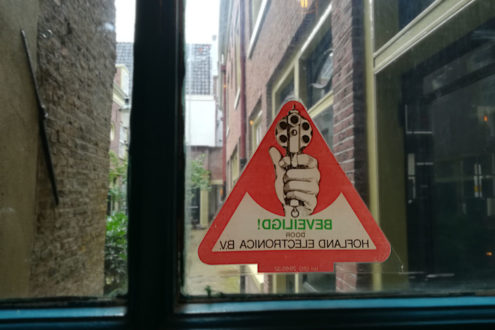 Orangemaster and I came across this sticker on a window overlooking the back alley of taco bar Mr. Haz in the Jordaan neighbourhood of Amsterdam.


 Like every year I present you my favourite stories of the past twelve months.