Dutch 14-year-old Stijn Oom has taken his Lego blocks up a few levels and made some fantastic WWII creations without using pre-existing Lego kits. He started building serious models when he was just five and hasn’t stopped since.
Flickr has helped him connect with enthusiasts and surely helped boost his ever-increasing popularity. “When I discovered Flickr, I found out that there was a HUGE Lego community going on! Reactions on builds, comments, favorites! It was the perfect system for every young builder.” Flickr is used by Lego fans to share their creations and they like it because they can annotate their images.
Why doesn’t Lego make military sets like there? Because it’s part of the company’s policy to not make anything military, with the exception of the Star Wars kits.
Some Australians were so pissed at a urinal design by Dutch artist Meike van Schijndel that they have been removed just three weeks after an establishment opened.
A trendy restaurant in Sydney had to remove the urinals shaped like the Rolling Stones’ logo because they were considered offensive to many patrons of the Ananas Bar and Brasserie. Unfortunately, many people feel that these lips are female and have been offended by the idea of peeing into a woman’s mouth.
The urinals are a commonly used European design piece from female Dutch artist Meike van Schijndel. Our female designer saw one in a shopfront in Paris when she was there on an inspiration trip for Ananas and felt it referenced the Rolling Stones logo which is based on Mick Jagger’s lips rather than a woman’s lips. She felt it would be a great way to bring a slice of Paris’s risqué nightlife to Sydney. We acknowledge that other people have interpreted it differently and have therefore removed them.
It’s one thing to mistake the Rolling Stones logo for women’s lips (and certainly a good argument), but to wash your hands in a urinal at a festival is just wrong yet funny. Watch Man mistakes urinal for sink.
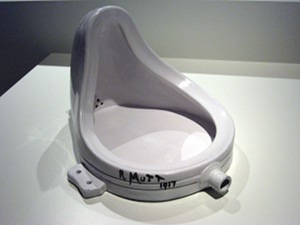
(Link: www.volkskrant.nl, Photo of Marcel Duchamp’s famous ‘urinoir’ taken at the Museu Nacional d’Art de Catalunya in Barcelona, in August 2008 by Orangemaster)
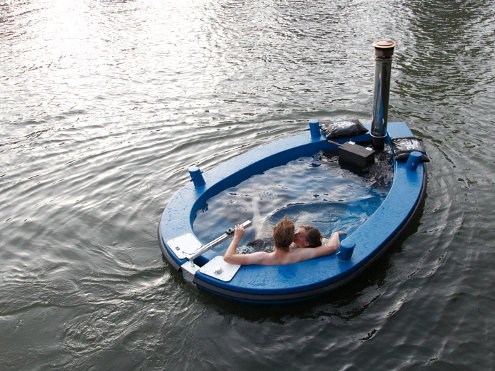
This is the HotTug, a boat that doubles as a (you guessed it) hot tub.
The boat is built from wood and fibreglass. A wood stove heats the water inside, and an electric engine propels the boat for about 2.5 hours (but there is also an 8 hour version). The entire contraption functions as a regular boat regardless of whether you fill the tub with water.
A version with stove or engine costs about 15,000 euro, but a version stripped of these accessories can be had for as little as 9,000 euro. Werf IJlst in Friesland rents out these babies for 300 euro per half a day.
The HotTug was designed and built by Supergoed from Rotterdam, the design studio behind the ‘bicycle tunnel as racetrack‘.
A student at the Delft University of Technology has won the audience award of a design competition held every year by Dutch department chain store HEMA.
Hiske Elferink designed a brassiere that contains a small wallet which can hold some change, a bank card and perhaps a key. She told Radio Netherlands (see the interview below) that she got the idea because when she goes clubbing, she puts her bank notes in her bra. The problem arises when you get change, because coins will slide down and jangle.
The professional jury did not award a first prize this year. The winners and runners-up will be on display at the public library of Amsterdam (OBA) until October 31.
HEMA organises a yearly design competition for students. In the past, several of the winners and runners-up have made it into the store’s inventory, such as the 103% Vase, a vase that had a little side vase for the inevitable broken flower.
Rijksmuseum Amsterdam, the home of many a Dutch master, has presented its new logo.
Oddly enough, the name is spelled “Rijks museum”, which is not correct according to the official Dutch spelling. As one commenter at Bright asked, who is Rijk and why does he have his own museum?
The designer, Irma Boom, explains that the space is on purpose: “Everybody is already using Rijks as a pet name for the museum”—her spelling merely codifies and pays homage to that practice.
Bright also links to a profile about Boom which is a must-watch for its opening sentence alone, “I hate hand-made books”, which runs completely counter to today’s idolization of all things artisanal.
Meldpunt Spatiegebruik, which collects examples of the misuse of spaces in compound words, writes: “Never have I received so many reports about a single space within half a day. But the Rijksmuseum belongs to all of us, so you can’t touch it.”
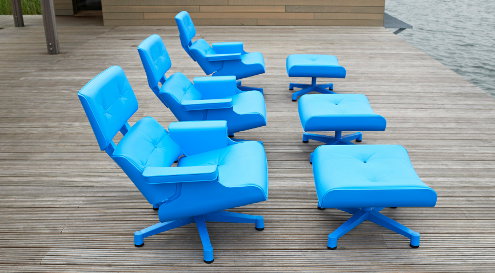
A new, Eindhoven-based label called Mal has introduced this Eames inspired chair called Mal 1956, intended to be used outdoors.
The specifications note that the chair is fitted with “a subtle drainage system to prevent stagnant water from collecting in the seat” and that it “can be cleaned using water along with common household cleaning products”.
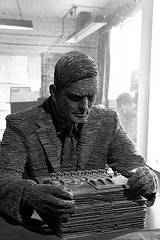
Jeroen van den Bos and Davy Landman from the Centrum Wiskunde & Informatica (CWI), a world-renowned scientific research institute specialised in mathematics and computer science, built a LEGO Turing Machine for the CWI’s exposition “Turings Erfenis” (‘Turing’s Legacy’) in honor of Alan Turing’s 100th birthday this year. The institute is known for creating the popular programming language Python, which is used by Google, while cwi.nl was one of the first national domain names ever issued in the world. The CWI played a pioneering role in connecting the Netherlands to the World Wide Web.
Enjoy the short documentary below and in true nerd fashion, you can read all about the making of this documentary by Andre Theelen right here.
“Alan Turing was an English mathematician who was highly influential in the development of computer science, providing a formalisation of the concepts of “algorithm” and “computation” with the Turing machine, which played a significant role in the creation of the modern computer,” say Wikipedia.
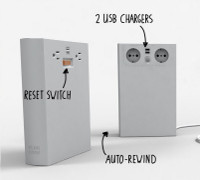
The Plugbook contains two outlets and two USB ports and is available in three colours. Dave is still looking for backers over at Kickstarter. He needs 45,000 USD in pledges before he can start manufacturing Plugbooks. Backers get to co-decide on a fourth colour. When the power-strip-meets-book hits the streets, it should retail at 30 USD.
Arif Yilmaz and Ersin Cumsit from Zaandam—the ingenuity of its townspeople already impressed Tsar Peter The Great of Russia in the 1700s—are aiming for traditional financing through banks, and will sell a closet with three safes and connectors for all current mobile phones for “a couple of hundred euro”. While the Plugbook is aimed at consumers, the ChargeCase seems to be a product for businesses.
Yilmaz explains: “I have worked in restaurants for years when I was a student. Customers asked every day if we had chargers for their phones, but we didn’t have them. I suggested that my boss would get some, but he didn’t know which type to get because there are many different phones and at that time every phone had its own unique charger.”
“We experimented with speed charging, but that turned out to be very bad for the phones. The ChargeCase does not charge the phone completely, but will let you get by for a couple of hours.”
Production of the ChargeCase in Turkey has commenced, albeit slowly (“it is a very bureaucratic country”), and the first shipment should arrive this week by truck.
If those inventions aren’t enough to get you through the day, check out the multiple bun slicer by YouTube user Idea Ed. The Internet is making fun of him and his inventions, calling them Dutch chindōgu, but I say that it’s better to have invented and built, than to have perfected and never built at all.
At Amsterdam’s first Repair Cafe, an event originally held in a theater’s foyer, then in a rented room in a former hotel and now in a community center a couple of times a month, people can bring in whatever they want to have repaired, at no cost, by volunteers who just like to fix things.
Conceived of as a way to help people reduce waste, the Repair Cafe concept has taken off since its debut two and a half years ago. The Repair Cafe Foundation has raised about $525,000 through a grant from the Dutch government, support from foundations and small donations, all of which pay for staffing, marketing and even a Repair Cafe bus.
According to the article there are currently thirty repair cafés spread around the country (several cities have more than one of them) . The idea was conceived by journalist Martine Postma in 2009, and implemented for the first time in October of that same year in Amsterdam West.
I totally dig this idea, as I always have broken stuff lying around that is cheaper to replace than to repair, which bugs me no end.
What’s more, sometimes you have devices that are impossible to replace. There is currently, for instance, no substitution on the market for my Canon Powershot A620 digital photo camera (2005), at least no substitution that combines all the useful features of that little device (see note below). If I brought it to a commercial repair shop, they would charge me just 50 euro to look inside. I have tried taking it apart myself, but being completely inept when it comes to electronics, I had to stop when the chance became real that I would accidentally touch the flash unit’s capacitor and shock myself.
(Note: before you mention it, I am aware that the Canon Powershot G12 and the Nikon P7100 come close, but both are considerably larger, taking them to the extreme of what can still be considered pocketable. The Canon Powershot S100 on the other hand lacks a viewfinder.)
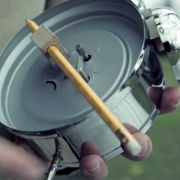
Eindhoven based design studio Hey Hey Hey came up with this intricate mobile device called Melvin the Machine. It stamps postcards. No, that is not a Dutch post box you see in the end (at least not a current one, to my knowledge), although that is a real Hema alarm clock starring in the clip.



 A student at the Delft University of Technology has won the audience award of a design competition held every year by Dutch department chain store HEMA.
 Bright reports about the
  Arif Yilmaz and Ersin Cumsit from Zaandam—the ingenuity of its townspeople already impressed Tsar Peter The Great of Russia in the 1700s—are aiming for traditional financing through banks, and will sell a closet with three safes and connectors for all current mobile phones for “a couple of hundred euro”. While the Plugbook is aimed at consumers, the ChargeCase seems to be a product for businesses.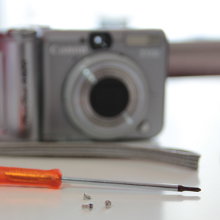
 Eindhoven based design studio Hey Hey Hey came up with this intricate mobile device called Melvin the Machine. It stamps postcards. No, that is not a Dutch post box you see in the end (at least not a current one, to my knowledge), although that is a real