November 9, 2008

Sunday quickies November 9, 2008

Filed under: General by Branko Collin @ 12:31 pm

Stolen credit card data for sale in user-friendly web shop

Zembla, the news show of Labour broadcaster VARA, bought stolen credit card data from a Russian website and used those data to purchase goods. Director Ton van der Ham told Webwereld: “The site is hidden behind a login. You can search credit cards by country and card type, and then you select a data package which you can pay for online. It’s almost unreal.”

The program got permission from the credit card holders before making the what Webwereld calls “fraudulent” purchases. Either Webwereld knows something about fraud that I don’t, or it’s trying hard to become the Telegraaf of Dutch tech news sites.

In 2006 investigative news show Zembla took claims of 9/11 conspiracy theorists serious by testing them. It concluded most of the claims were unfounded. The show is also famous for “exposing” (the news was not news to a limited circle) that politician Ayaan Hirsi Ali had lied in her asylum claim, which led to her resignation from parliament.

Serious satire

Perik is a copywriter who, when he noticed that he could write 2000 words about anything, decided to quit and become a bartender. The writing bug has never left him though, and now he is blogging satirical pieces at Sargasso. And darn it, he is good! Today he caught me unawares with his (fake) report about a banned ad in which fathers are encouraged to spend more quality time with their children. The ad is titled: “Who is this whiny broad anyway?” and in Perik’s world raised a storm of protest from the child protection board, which, as everybody knows, “has been campaigning for a radical feminization of the child rearing domain for almost a century.”

Disclaimer: the entire 24 Oranges editorial team has shared alcoholic beverages with Perik, so our conclusion that he’s a good egg might be somewhat clouded by the aforementioned beverages.

What Dutch space travel would look like

(From a 1983 ad for pot plants.)

Via Trendbeheer. Disclaimer: we’ve also shared alcoholic beverages with Trendbeheer contributor Jaap Verhoeven. At the same parties! What can I say? We like our drinks, and we go to the right parties.

Tags: , , , , , , , , , , , , , , ,

November 8, 2008

Dutch prefer to work around 27 hours per week

Filed under: General by Branko Collin @ 6:07 pm

OK, so I am going to throw these numbers at you without any attempt to explain why they are what they are, and without stating whether I think these reflect well or not on Dutch society, as my experience is that people tend to interpret such statistics along political lines anyway, regardless of my interpretations. TNO released a study last week that shows the Dutch would prefer to work somewhere between 25 and 28 hours per week. Earlier studies (Dutch) showed that the Dutch already put in the least amount of hours per week across Europe: 33 hours. A relatively large percentage of the Dutch work part-time (40%), and the Dutch also belong to the Europeans with the most irregular hours.
The Netherlands is also the country where most of the wages are fixed: paying somebody according to how productive they are hardly occurs here. The preferred increase of working hours is a function of the amount of hours a person already works (duh!). Interesting to see in TNO’s graph though is that only the more or less unemployed would like to work more, and only those that put in more than 40 hours a week would like to work less. People that work from anywhere between 8 and 40 hours a week seem pretty OK about the time they put in.

The study called Nationale Enquête Arbeidsomstandigheden (National Poll Working Conditions) is a collaboration between TNO and Statistics Netherlands, is repeated each year and involves questioning 25,000 members of the Dutch work force. The European working conditions study over 2007 referred to by Intermediair is fascinating reading.

Via print daily Metro. Photo by Shrekton, some rights reserved.

Tags: , , ,

November 6, 2008

Teenager’s business gets him out of school

Filed under: Automobiles by Branko Collin @ 8:25 am

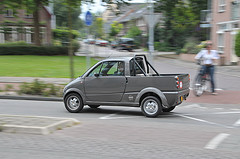
Last year the government raised the age limit for compulsory education from 16 to 18 years, but 16 year old Robbin Robijn probably could care less. He no longer has to go to school, because the government has just given him an exemption. Reason: the success of his company. Robijn, living in a village called De Kiel in Drenthe, turned 16 last month, and for the past year has been selling microcars of a type known as brommobiel—a car that’s legally a moped, and that’s not allowed to go faster than 45 kph.

The teenager discovered a market for microcars when he bought one off the internet last year, fixed it, and sold it for a handy profit. “Selling is in my blood,” he told Z24, “I’ve been doing it since I was ten. First chickens and rabbits, and now microcars.”

Photo: a Grecav Eke pick-up microcar, by FaceMePLS, some rights reserved.

Tags: , , , ,

November 2, 2008

Geometric family tree as birth announcement card

Filed under: Comics,Design by Branko Collin @ 5:35 pm

Piet Schreuders, him of the Poezenkrant (which is not about cats), designed this card in 1984 on occasion of the birth of his daughter Anna. It’s a family tree that goes back four generations, pink branches signifying girls, blue ones boys. It’s one of the reasons that the Fool’s Gold editors clamour for a Schreudermania book.

Ah, speaking of Fool’s Gold. People forgot to tell my clients that there’s an economic crisis supposed to be going on, and as a result I haven’t really had the time to review the latest Zone 5300. Issue 83 is all about Outsider Art. Like every other issue of Zone 5300. Which they sort of acknowledge in the foreword, then still power on.

The good thing though is that as part of that whole Outsider Art thing Fool’s Gold got two extra pages in full colour. Comics are mostly by the regular contributors. Lamelos’ Sam Peeters goes solo this time with In de schaduw van mijn lul (In the shade of my penis), which manages to pack armed robbery, monkeys, slipping-over-banana jokes, faeces, swamp things, camp fires, steaming hot sex, and a gruesome beheading all in six small pages, in that order. I thought you ought to know.

Zone 5300 also checks out how Teun Hocks, illustrator to amongst others The New Yorker and Harper’s Magazine is doing these days. He’s doing… wait, buy the damn magazine already!

Tags: , , , , ,

November 1, 2008

Geeked out coin wins design comp

Filed under: Architecture,Design,Dutch first by Branko Collin @ 4:18 pm

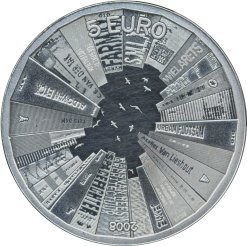
Stani Michiels, artist by day and Python hacker by night, created a five euro coin using only free software for a design competion issued by the Dutch mint, and won. The coin, commemorating a rich Dutch architectural tradition, should be available nowish.

The coin’s obverse consists of a portrait of the queen made up out of the names of famous architects, and the reverse displays an outline of the country that doubles as a skyline made by positioning architecture books in a circle.

Michiels — a Belgian responsible for SPE-IDE, a Python IDE, and Phatch, a photo editor — outlines all the little design details in a long blog post, including the software he used (Python, of course) and the calculations and Google search results that went into this design. Unfortunately the mint would not allow Michiels to release the designs under the GPL license.

The Netherlands has a long tradition of meaningful and elaborately designed money, as we touched upon earlier.

Via LWN.net.

Tags: , , , , ,

October 29, 2008

Lambiek comic book store turns 40

Filed under: Comics by Branko Collin @ 8:22 am

Not withstanding a recent lament (Dutch) by Dutch comic giants Hanco Kolk and Jean-Marc van Tol about the decline of the local comics scene, comic book store Lambiek is still going strong. Next week the store even celebrates it’s fortieth anniversary. As they put it themselves: “[Lambiek] is probably the oldest existing comics shop in the world.”

The store in the heart of Amsterdam, just off the busy Leidsestraat, is named after a character from the popular Flemish series Suske & Wiske who in turn was named after the beer. To those who don’t shop for comics in Amsterdam—what’s wrong with you?—Lambiek is probably best known for its online comiclopedia, an encyclopedia of comic artists from around the world in English and Dutch.

Tags: , ,

October 25, 2008

Man harassed by police for 13 years after identity theft

Filed under: General by Branko Collin @ 8:39 am

A Dutchman of Surinamese decent has been fighting the police, customs and the DoJ for the past thirteen years after a criminal junkie kept pretending to be him, says the national ombudsman. The anonymous man has a criminal record of 43 crimes, none of which he committed. Although the police knew almost from the start that a criminal junkie kept using the man’s identity, they never succeeded in entirely clearing his name. Instead, the treatment the victim received over the years at the hands of the police and customs got worse and worse. Among other things the man was arrested for reading a newspaper and his house was searched in the presence of his two young children.
When the man asked the police what they were going to do to clear his name, he bluntly got told to change his identity.

The ombudsman concludes:

“Kafka'” and “Kafka-esque” are terms in danger of becoming over-used when describing government actions, but in this case the label is entirely deserved.

The government will introduce a law next year that should miraculously help minimize mix-ups such as these by limiting civil freedoms even further and by increasing the number of points of failure, though the ombudsman seems quite happy with (part of) the proposal.

(Edit 22-5-2018: replaced link to Ombudsman press release by link to Ombudsman news article)

Tags: , , ,

October 24, 2008

Amsterdam 200 years older than previously believed

Filed under: History,Science by Branko Collin @ 7:55 am

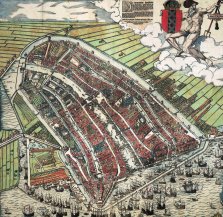
Amsterdam is 200 years older than is commonly assumed, says historical geographer Chris de Bont. The settlement was originally started in 1000 AC instead of 1200 AC, which is still pretty young. De Bont bases his conclusion on the patterns formed by old brooks. “I found the same patterns elsewhere in the region where farmers lived around the time,” De Bont told print daily Metro, “so it’s logical to assume that farmers also created the patterns in Amsterdam.”
According to Volkskrant, De Bont also claims that parts of the rivers Amstel and Zaan were dug, and that the IJ used to be a big swamp instead of a waterway. De Bont’s assertions are part of his PhD thesis which he gets to defend next Tuesday at Wageningen University.

Illustration: one of the earliest city maps of Amsterdam (1544) by Cornelis Anthonisz. after one of his own paintings. Check the larger version at Wikimedia Commons, it’s pretty detailed and a great demonstration of how little the inner city has changed in 500 years (they built a McDonald’s in the Kalverstraat and that new-fangled ‘palace’ on Dam Square, and that’s about it).

Tags: , , , , , , , ,

October 21, 2008

Chris Berens about his painting technique

Filed under: Art by Branko Collin @ 2:18 pm

Chris Berens talks to Kirsten Anderson of Hi Fructose magazine about his technique in this video.

Via BoingBoing.

Tags:

October 19, 2008

Second Dutch Project Gutenberg sampler

Filed under: Art,Literature by Branko Collin @ 8:36 am

I decided to make another Nederlandse Project Gutenberg Reader, containing the Dutch books that were released in the past month at the internet library. Once again you can find it at Brewster Kahle’s excellent Internet Archive.

Since the past month was a bit quiet with regards to new releases, I decided to add a couple golden oldies. The new releases were Jacob Cats’ Spaens Heydinnie and Shakespeare’s Twee edellieden van Verona. Cats was a moralistic writer from the Dutch Golden Age. Spaens Heydinnie (Spaans heidinnetje, Spanish gypsy) is a reworking of Cervantes’ La Gitanilla, in which an infant girl of noble birth is kidnapped and raised by gypsies. The third release last month was a lecture held in 1840 for the Frisian Association, which I find wholly uninteresting, but I am not going to be all judgmental about your kinks.

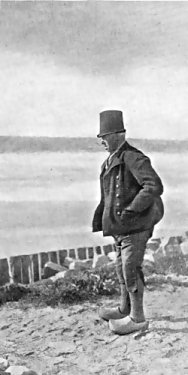
I added two extracts from older works. The first is a travel account of the Netherlands, Door Holland met pen en camera, by the French journalist and photographer Lud. Georges Hamön. Let me translate a bit for you:

One has to keep in mind though that Holland is a desperately flat and monotonous region, that it does not spark any fierce emotion, nor does it lead to excited enthusiasm or even quiet inner delight. Holland is the land of serenity, where one submerges in the calmest comfort.

The opposite of calm comfort is Herman Heijermans’ Diamantstad (Diamond City), a novel about and an indictment of the poor living conditions of the inhabitants of the Jewish quarter in Amsterdam around the turn of the century. Earlier I sort of translated the fragment I quote in the reader over here.

Photo of Father Kick in quiet contemplation by Lud. Georges Hamön. See also the first Dutch Project Gutenberg Reader.

Tags: , , , , , ,