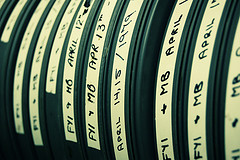
In its Bright Spot series, tech mag Bright reviews Rotterdam barbershop Schorem (‘scum’) which caters exclusively to men.
If you want, you can get a haircut and a shave there (55 euro all included) with old fashioned tools such as straight razors, and you can apparently have a beer while you wait. Only for men, because “every man has the right to a place where he can be a man”.
Last year Noël Schoolderman created a series of short documentaries about ‘old crafts’, and the first episode was about Schorem:
One of the barbers says in the video: “A man should only be touched by three other men in his lifetime: his doctor, his tailor and his barber. […] These days you can see a proliferation of Albert Heijns, Blokkers, Xenoses, all the big retail chains. I think people these days have a need for something unique, something with that special touch.”
Filed under: Technology by Branko Collin @ 4:09 pm
A tiny victory for real globalization. After years of pressure by Dutch consumer watchdog Consumentenbond, American electronics manufacturer Apple has finally adapted its warranty for the Netherlands to make clear that is bound by Dutch law.
Last Monday tech news site Webwereld pointed to the new warranty on Apple’s website, which now states: “If you buy an Apple product, you are covered by the limited Apple warranty of one year, optionally the AppleCare Protection Plan, and the Dutch law.” A handy table shows you what these three warranties cover.
Dutch consumer protection law states that a product must live up to a consumer’s reasonable expectations. A laptop battery for instance can be expected to last longer than a year, but the law does not protect you against capacity reduction, since that is something from which all batteries suffer. According to Internet law blogger Arnoud Engelfriet, a warranty can be both narrower and wider than this rule of conformity—a manufacturer could for instance cover battery capacity reduction in its warranty (this is just an example, Apple for instance does not cover capacity reduction).
Earlier Apple claimed that its warranty provided a better coverage than the law.
In the end of course this does not change anything legally. Dutch consumers have always been protected by the law. It’s good though that customers are made aware more of their rights.
Filed under: Architecture by Branko Collin @ 9:08 am
The oldest example of Western architecture in Matsue, on the West coast of Japan, is the Dutch Mansion. The Made in Matsue blog explains (pictures after the link):
Originally built to serve as a temple school, ‘Omachi School’ (苧町å¦æ ¡), it is quite extraordinary that it has remained intact in its original form to this day, as buildings of this style have almost all been reconstructed on or after 100 years since construction.
It is not clear from the article whether this building was actually based on Dutch architecture, I am guessing that ‘Dutch’ in this case may have been shorthand for ‘European’.
Between 1633 and 1853 Japan closed itself off from the rest of the world, a policy called Sakoku. During this time only a limited number of countries were allowed to trade with Japan, the Netherlands being the only European trade partner. Dutch traders were confined to an artificial island in the harbour of Nagasaki called Dejima.
The Commandry of Gruitrode, containing a castle and farm built in approximately 1400 AD, has changed hands.
The Dutch owners decided to sell it for 1 euro to the municipality of Meeuwen-Gruitrode in the Belgian province of Limburg.
Telegraaf quotes one of the owners, Cornelia ter Horst: “We have no children and feel that such a beautiful castle belongs to our fellow villagers. My husband always says that everything in life is borrowed.” The couple is in their eighties and will be made honorary citizens by way of thanks.
A lovely story, but personal experience makes me wonder if there isn’t a catch. My parents were able to buy castle d’Erp in Dutch Limburg in the 1970s, also for a very reasonable price, namely one guilder. The snag then was that the castle needed extensive repairs that would cost about one million guilders. The municipality of Maasbree ended up buying the castle and used it to house the mayor.
(Photo released into the public domain by Wikimedia Commons user Wasily.)
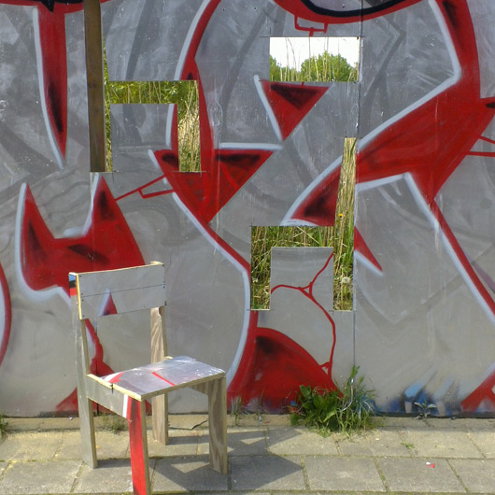
This is a series of unique pieces of furniture as art created from materials found and appropriated around the city of Amsterdam. On the spot where the materials were found these seemingly worthless road signs, fences and planters were freestyle (yes, without any plans) sawn, drilled, cut, screwed and put together as quickly as possible, turning them into extremely valuable pieces. Eventually they were left for lucky collectors to find.
Each object is accompanied by before and after photos, the time that it took to create the piece, and a list of the tools and machines involved (typically a saw, a measure, a felt pen, a screw driver, some screws, and ‘imagination’). Semeijn calls this type of forging art ‘guerilla upcycling’.
In the Rotterdam suburb Capelle aan den IJssel, a new neighbourhood was built in 2001 called Fascinatio, named after the children’s book ‘Fascinatio de wonderwind’ by Tom Manders. It prides itself on being a great place for kids to grow up in, go to school and play.
One of the street names is Flatusstraat, also from the book, which is a fancy way of saying ‘Fart Street’. Although the street has been around for a decade, it made the kids’ news a few days ago because grown ups would like to see it changed and journalist grown ups seemed to have run out of children’s stories.
There are actually worse names for streets in the Netherlands: Eendekotsweg (‘Duck Vomit Street’), Poepershoek (‘Shitters’ Corner’) and Windgat (‘Wind Hole’), to name a few.
The Plugbook contains two outlets and two USB ports and is available in three colours. Dave is still looking for backers over at Kickstarter. He needs 45,000 USD in pledges before he can start manufacturing Plugbooks. Backers get to co-decide on a fourth colour. When the power-strip-meets-book hits the streets, it should retail at 30 USD.
Arif Yilmaz and Ersin Cumsit from Zaandam—the ingenuity of its townspeople already impressed Tsar Peter The Great of Russia in the 1700s—are aiming for traditional financing through banks, and will sell a closet with three safes and connectors for all current mobile phones for “a couple of hundred euro”. While the Plugbook is aimed at consumers, the ChargeCase seems to be a product for businesses.
Yilmaz explains: “I have worked in restaurants for years when I was a student. Customers asked every day if we had chargers for their phones, but we didn’t have them. I suggested that my boss would get some, but he didn’t know which type to get because there are many different phones and at that time every phone had its own unique charger.”
“We experimented with speed charging, but that turned out to be very bad for the phones. The ChargeCase does not charge the phone completely, but will let you get by for a couple of hours.”
Production of the ChargeCase in Turkey has commenced, albeit slowly (“it is a very bureaucratic country”), and the first shipment should arrive this week by truck.
If those inventions aren’t enough to get you through the day, check out the multiple bun slicer by YouTube user Idea Ed. The Internet is making fun of him and his inventions, calling them Dutch chindōgu, but I say that it’s better to have invented and built, than to have perfected and never built at all.
My casual attitude didn’t last long — only until I began to put on my tuxedo, complete with tails, in the room in which candidates change. My interlocutors for the viva, kindly known as ‘the opposition committee’, were changing on the other side of the room. The solemnity of the occasion finally penetrated my thick skull — this was my rite de passage into an academic tradition that had been taking place in Europe for centuries.
Once I had changed, Leiden’s pedel (registrar) explained the viva process to me and my two paranymphs, Mirjam and Bianca. The role of the paranymphs is now purely ceremonial; they sit and stand beside you during the viva. Traditionally, however, they served as the candidate’s protectors, intervening on his behalf if the opposition committee was being unfair or physically abusive (!).
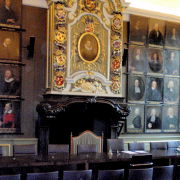
The defense traditionally takes place in the Senaatskamer (Senate Room, 1733) which is adorned with portraits of the professors of the early days of the university and seats 64.
Filed under: IT,Technology by Branko Collin @ 12:23 pm
The Dutch legislation to safeguard net neutrality as it was originally drafted had an escape clause for filtering on ideological grounds, but that clause was struck when the Senate passed the new telecom law last week.
Christian providers Solcon and Kliksafe, who filter the web on evangelical grounds, are now planning to sue the Dutch government as the new law threatens their business model. Webwereld quotes Kliksafe CEO Bert Jan Peters as saying, “this law actually limits a customer’s freedom.”
Although the Dutch telecom law forbids filtering at a network level, it leaves customers the opportunity to use their own filters or a proxy. Peters said, “some of our customers just don’t want to be tempted to disable the filter. They want security and peace of mind.”
Before taking legal action, the providers will first talk with the economics ministry.
Although I can somewhat sympathise with the providers’ stance, you have to wonder where net neutrality will end up if you leave the tiniest of loopholes open. If the providers were allowed to filter on ideological grounds, there should be strict limitations of what they are allowed to offer. In my mind, such a provider would have to a) offer an unfiltered version of every service at the same price or lower, b) advertise these unfiltered services just as prominently as the filtered ones (advertise the difference, for all I care), and c) allow a user to switch from filtered to unfiltered services at no cost.
Filed under: Film,Online by Orangemaster @ 11:48 am
Amsterdam film company A-film has its own YouTube channel offering free, full length films online. There are some 20 films such as Alles Stroomt (Upstream), Ik Omhels Je Met Duizend Armen (A Thousand Kisses) and First Mission. Not all films are in Dutch: there are English-language films such as Bend It Like Beckham, The Promotion and Youth In Revolt (watch here below). As a comparison, competitor Ximon.nl, which has a much larger selection, offers a film like A Thousand Kisses for 3,50 euro.



 In its Bright Spot series, tech mag Bright reviews Rotterdam barbershop Schorem (‘scum’) which caters exclusively to men.
  A tiny victory for real globalization. After years of pressure by Dutch consumer watchdog Consumentenbond, American electronics manufacturer Apple has finally adapted its warranty for the Netherlands to make clear that is bound by Dutch law.
 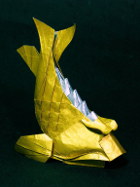 The oldest example of Western architecture in Matsue, on the West coast of Japan, is the Dutch Mansion.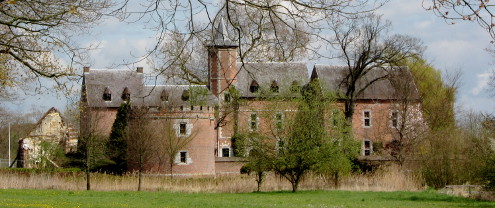
 Bright reports about the
  Arif Yilmaz and Ersin Cumsit from Zaandam—the ingenuity of its townspeople already impressed Tsar Peter The Great of Russia in the 1700s—are aiming for traditional financing through banks, and will sell a closet with three safes and connectors for all current mobile phones for “a couple of hundred euro”. While the Plugbook is aimed at consumers, the ChargeCase seems to be a product for businesses.
  Australian law blogger Kevin Jon Heller got his PhD in Leiden and describes
  The Dutch legislation to safeguard net neutrality as it was originally drafted had an escape clause for filtering on ideological grounds, but that clause was struck when the Senate passed the new telecom law last week.