June 6, 2010

The Netherlands has the highest car density in the world

Filed under: Automobiles,Bicycles by Branko Collin @ 11:00 am

Last week I linked to a video by Mark Wagenbuur that showed what bicycle rush hour looks like at Utrecht Central Station. If you watched that video you may think that the Netherlands is a relatively car-free country, but the opposite is true (as anyone acquainted with Dutch traffic jams can attest).

If you look at cars per square kilometre, The Netherlands, Japan and Belgium (in that order) lead the world by a wide margin. Not surprisingly, these three countries are both densely populated (skip the microstates for a second, and the Netherlands becomes the most densely populated country in the world) and fairly rich (positions 4, 14 and 19 respectively, again after discarding microstates).

If you look at the number of cars per household, the Netherlands is somewhere in the middle of the pack (400 cars per 1,000 people). Here, the US leads with 92% of the households owning a car (but in New York City less than 50% of households own a car).

It would seem that car ownership is both a function of income and available space and parking, but income is also a function of space, with high population density going hand in hand with low incomes.

Local governments try and find a balance between letting people own their cars and having a liveable environment. As we’ve reported before, some Dutch cities are trying to reduce the number of cars in the enviroment (others try to get rid of bicycles too) by cranking up parking fees.

What it means to be a country of car lovers is shown by the second entry of author John Scalzi’s list on Being Poor:

Being poor is having to keep buying $800 cars because they’re what you can afford, and then having the cars break down on you, because there’s not an $800 car in America that’s worth a damn.

In the Netherlands, if you own a car you are not poor, unless you live in your car. On the other hand, like in New York, plenty of well-to-do Dutch people do not own a car simply because they have no use for one.

In case this posting has just wet your appetite for more of Mark Wagenbuur’s mesmerizing videos, here is his latest:

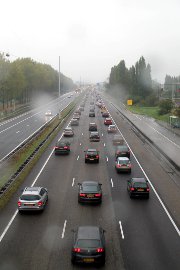
(The video is of a road frequented by cyclists in Utrecht. Note the foreigner at 1.41. The photo is of the traffic jam in Zoetermeer, at around 6 pm. The traffic jam there starts around 4 pm.)
Tags:

June 5, 2010

Merely mentioning file names is illegal in the Netherlands

Filed under: Online by Branko Collin @ 2:12 pm

Usenet community FTD has lost the lawsuit it had started pre-emptively against the Brein foundation to establish that its activities are legal.
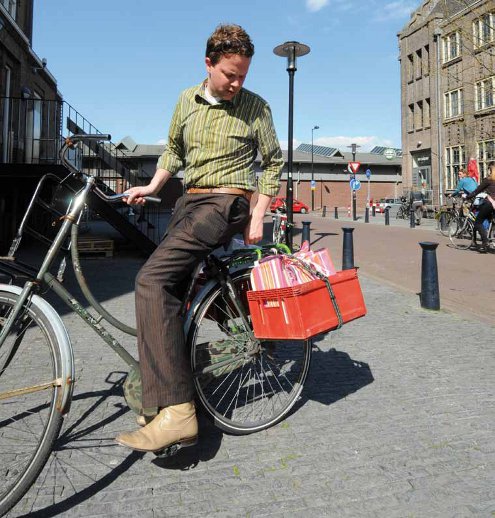
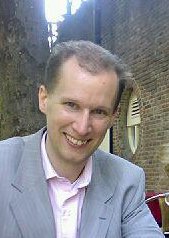
FTD’s members publish information about where to find binary postings that contain works published without copyright owners’ consent. According to a very annoyed Arnoud Engelfriet, one of FTD’s lawyers (photo), the judge held that mentioning file names isn’t just aiding illegal publication, it is a form of illegal publication in itself if the person doing the mentioning is performing a key role in getting the work distributed.

The judge in this case, C.A.J.F.M. Hensen, has a job on the side teaching people how to fight ‘piracy,’ and as such has a clear interest in establishing as hard a line as possible in copyright law.

Brein calls itself an ‘anti-piracy’ bureau, and is the Dutch equivalent of the infamous RIAA. FTD is considering an appeal.

(Photo of Arnoud Engelfriet by Petra de Boevere, some rights reserved.)

Tags: ,

June 4, 2010

Forest in the city

Filed under: Art,Nature by Branko Collin @ 8:10 am

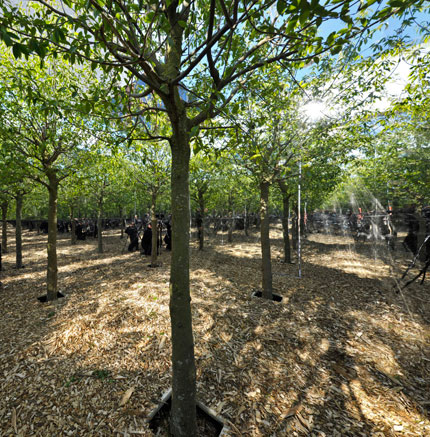
A quirky little idea by DUS Architects: put a 3 x 3 metre box next to the Amsterdam public library, line its inside with mirrors, and put a tree in the middle.

The Urban Woods pavilion is part of the Liefde in de stad (Love in the city) art project about which we wrote earlier. You can visit the forest (a short walk from Central Station) until June 27.

(Link: Bright. Photo: DUS Architecten / Pieter Kers.)

Tags: , , , ,

June 3, 2010

Folding metal bicycle freight rack

Filed under: Bicycles,Design by Branko Collin @ 10:05 am

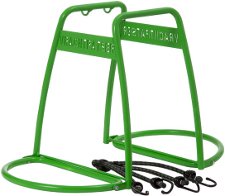
This green metal device can be attached to a regular bike’s rack to greatly increase the amount of freight it can carry. Sort of a free-form pannier.

Inventor René Bijsterveld came up with the Vrachtpatser (from the Dutch words krachtpatser, strong man, and vracht, freight) because as a student he has to lug a lot of heavy stuff around on in his bike, and not in the least crates of beer he confided to NOS Headlines.
The design netted him first prize in 2010’s HEMA design contest in which design students were asked to come up with items that make life on the road easier and more fun.

Worthy of their respective second and third prize were the cardboard pet coffin by Toon Welling, and the juice boxes by Annet Bruil that double as toy cars, air planes and boats.

Voting for the audience award will start June 14. HEMA is a retailer which holds a design contest for students each year with the express purpose of including the most marketable designs in their own line-up.

See also:

(Photos: HEMA. Link: Bright)

Tags: ,

June 2, 2010

Anti-German sentiments in World Cup commercials

Filed under: History,Sports by Branko Collin @ 10:16 am

Among the tidal wave of World Cup themed commercials, a disturbing trend emerges. Several Dutch companies have come out with TV ads that prominently feature German bad guys.

Heineken’s ad is perhaps the mildest, featuring a representative of the German football association proudly presenting earplugs to counter the noise of the Pletterpet, an orange cap. It paints Germans as rather dull folk, not quite the traditional stereotype over here.

Supermarket C1000 on the other hand goes the full nine yards, as it has a Cruella de Ville look-alike announce that she has to take one for the German team. Utilities company Nuon lets a ‘typical’ arrogant German fan get his comeuppance when his T-shirt turn orange, the Dutch national colour, while standing among his fellow fans.

Both Germany and the Netherlands participate in the upcoming World Cup in South Africa. Anti-German sentiments were alive in the Netherlands from World War II onwards to well into the 1990s, but kids these days just don’t seem to see the point. Which makes it even odder that these ads are so blatantly anti-German.

Something I heard a lot this year, now that Dutch coach Louis van Gaal and Dutch players Mark van Bommel and Arjan Robben have had such a successful year at Bayern Munich: “I never thought I would say this, but I am actually supporting the German side.”

Tags: , , , , , ,

June 1, 2010

Football players wanted for September polder cup

Filed under: Art,Nature,Sports by Branko Collin @ 8:35 am

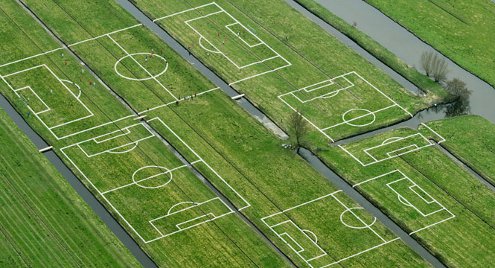
Spanish artist Maider López is organising a football tournament on September 3 and is looking for both participants and an audience.

The tournament called Polder Cup will take place on the pastures of Ottoland in South Holland, halfway between Utrecht and Rotterdam. Contestants will be given food, drink and swag all for coming out to the middle of nowhere (using the charter bus of the project) and having their picture taken.

What’s the catch? Is there a catch? There is always a catch! As you can see in the photo, the pitches will be drawn across drainage ditches, and the players are expected to come up with their own rules and methods for dealing with these hazards. If you want to know beforehand how to fish a ball from a brook, check out Hans van der Meer’s photo book on Dutch football pitches. As for crossing ditches, see here.

(Link: Bright. Photo: poldercup.nl.)

Tags: , , ,

May 31, 2010

More people in prison on suspicion than after conviction

Filed under: General by Branko Collin @ 8:28 am

Law professor Yvo Buruma has sounded the alarm about the number of innocent people being detained pre-trial in the Netherlands.
According to Buruma the numbers of acquittals in the country has risen from 4.5% to 7% in the past five years. More people are in gaol awaiting trial than people who have already been convicted.

In a blog entry last week Buruma claims this is a worrisome development because robbing somebody of their freedom is an exceptional power that the state should only exercise under exceptional circumstances, and because a person should be considered innocent until proven otherwise. Although he does not outright say it, it would almost seem that the justice department is keeping people imprisoned for the wrong reasons.

The criminal law professor at the Radboud University Nijmegen determines four categories of aquittal:

  1. It is unclear what happened,
  2. It is unclear what part the suspect played,
  3. There was no intent, and
  4. The judge fails to see the crime in the accused’s actions.

An example of the latter is the 14-year-old who jokingly told Prime Minister Balkenende on the social networking site Hyves that he was going to die and was acquitted earlier this month.

It is perhaps interesting to note that the falsely imprisoned typically only receive 80 euro a day in damages, regardless of actual income lost.

Link: Sargasso.

Tags: , , , , ,

May 30, 2010

26 letter shaped chairs by Roeland Otten

Filed under: Art,Design by Branko Collin @ 12:19 pm

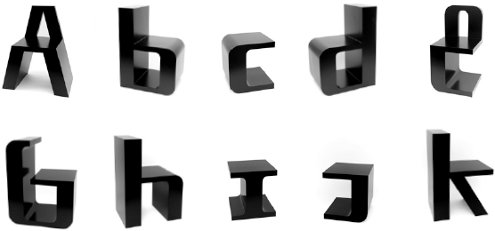
Designer Roeland Otten hopes to mass-market these alphabet chairs, writes Bright. He can see them being used by elementary schools.

The so-called ABChairs were made possible thanks to a grant by Fonds BKVB, the rich government sugar daddy for the visual arts. Otten, a 1999 Design Academy Eindhoven graduate, calls the Naked Alphabet by his teacher Anthon Beeke an inspiration. He is looking for a manufacturer to help him mass produce the chairs in plastic.

Unfortunately Otten uses one of them newfangled and unlinkable Flash sites instead of a real website, I would have linked to his work earlier if he had not. If you go there, see under “recent stuff / transformatie-transformatorhuisje” how he let an ugly electrical substation disappear from his Rotterdam neighbourhood.

(Photo: Roeland Otten.)

Tags: , , , , , , ,

May 29, 2010

Million digitized newspaper pages available at kb.nl

Filed under: Dutch first,General by Branko Collin @ 1:34 pm

newspaper_ad_2000_04_01_sportsLast Thursday, the Dutch national library opened its repository of digitized Dutch newspapers from the period 1618 to 1995.
So far the library has digitized 1 million pages from 70 papers, which can be viewed at http://kranten.kb.nl. It plans on scanning 7 million more in the next two years in order to cover 5% of all newspapers ever printed in the Netherlands.

For the occasion, the oldest copy of a Dutch newspaper in existance, Courante uyt Italien, Duytslandt &c, is on display at the library, on loan from the Royal Library of Sweden. The name, meaning “‘currents’ from Italy, Germany, etc.” stuck around, and now courantkrant in its modern spelling—is the word for newspaper in Dutch.

The Dutch national library is not the first with an online newspaper archive, and there are some genuinely cool archives out there such as the Australian one that lets you proofread OCRed texts (much like Wikipedia). The range of the Dutch archive is actually impressive.

(Links: Webwereld, Trouw.)

Tags: ,

May 24, 2010

Walking across the Wadden Sea

Filed under: Nature,Sports,Weird by Branko Collin @ 11:40 am

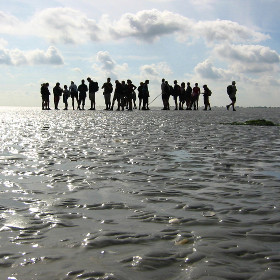
Legend has it that when God created the Groninger, the Groninger said: “Get off my land.” And as if to prove a point, Groningers (and Frisians) still walk across dozens of miles of sea each day, as New York Times reporter David Corn attests:

After about an hour, Mr. Kraster comes to a stop. He says he has some good news and some bad news. For the next stretch, the ground will be less muddy — but the water will be higher. He points in the direction we’ll be heading. I still see nothing but sky and water before us. He could be leading us anywhere — including into deep water. He takes a step, and the water is close to his waist. The rest of us realize we are standing on a ridge and about to take a plunge.

The activity described here is mudflat hiking, wadlopen in Dutch, and is possible because of the unique properties of the Wadden Sea. At high tide the area is a sea, at low tide it is land—partly—and you can cross from the mainland to the Wadden Islands over some of the muddy watersheds. This is exactly what 30,000 people in the Netherlands do each year. Mudflat walking is also possible across the Wadden Sea portions of Germany and Denmark.

(Photo by nl.wikipedia user Marieke78, some rights reserved.

Tags: , , , , , ,