

No Dutch Golden Age (17th century) collection of obscure and exotic trinkets and specimens appears to have survived, as heirs tended to sell off these collections to foreign collectors. However, we still have books that illustrate them at least. As Bibliodyssey writes:
The collection obsession of Early Modern Europe, that saw people stocking cabinets of curiosities […] with obscure and exotic trinkets and specimens from the worlds of ‘artificialia’ and ‘naturalia’, emerged in Holland under a local profile of influences.
Unlike most of their European counterparts, the Dutch republic lacked both a royal court or any sizeable aristocracy, so collecting was a hobby cultivated by regular citizens. […]
[There were numerous collections] built up by Dutch carpenters, merchants, tradesmen and artisans. The enthusiasm for collecting, in Holland at least, could be seen at all levels of society, but with the most notable collections owned by burghers and regents, in contrast to the kings, nobles and prelates of other European countries. And there is the rub. It was customary for families to sell off these ‘rariteitenkabinets’ and divide the spoils following the death of the collector. Accordingly, most Dutch collections of significance left the country, purchased by foreign nobility and no intact collections have survived; adding an interesting element of documentary detective work to scholarly assessments.
But at least a documentation of these collections has survived. The wonderful Bibliodyssey for instance liberally quotes a picture book by Levinus Vincent (1658-1727) called “Wondertooneel der Nature” (Wonder Stage of Nature).
 Web developer / musician / VJ Gijs Gieskes made these
  The
The  Dolphins perform better at the stock market than market analysts do, a recent experiment at the Harderwijk Dolfinarium suggests. The animals got to pick five balls that represented companies. Five stock analysts got to pick five companies that they thought would do well in the market. After a year, the dolphins’ stock had increased 27% in value, but that of all but one of the analysts had decreased in value. The one analyst that made a profit only made 10%.
 Below are some of the 24 Oranges posts of 2007 I like best.
 A court in Breda has found that Tilburg priest Harm Schilder is allowed to harass his neighbours by
 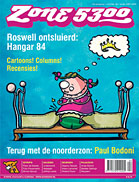 Once again the macabre is represented in the fourth and last issue of
 ![[illustration]](https://www.24oranges.nl/wp-content/uploads/2007/12/zone_5300-14_4-spruyt.png)
![[photo]](https://www.24oranges.nl/wp-content/uploads/2007/12/zone_5300-14_4-racetrack.jpg) New physical media give publishers an enormous opportunity to sell to you what you already own: DAT tapes to replace your LPs, CDs to replace your DATs, and so on ad infinitum. But what happens to the discarded carriers? Rotterdammer Matrijs van Merg takes care of them. He builds organs from diskettes, videotapes from LPs, and more, and Zone 5300 interviews him. Photo: race track made from LPs.
New physical media give publishers an enormous opportunity to sell to you what you already own: DAT tapes to replace your LPs, CDs to replace your DATs, and so on ad infinitum. But what happens to the discarded carriers? Rotterdammer Matrijs van Merg takes care of them. He builds organs from diskettes, videotapes from LPs, and more, and Zone 5300 interviews him. Photo: race track made from LPs.